
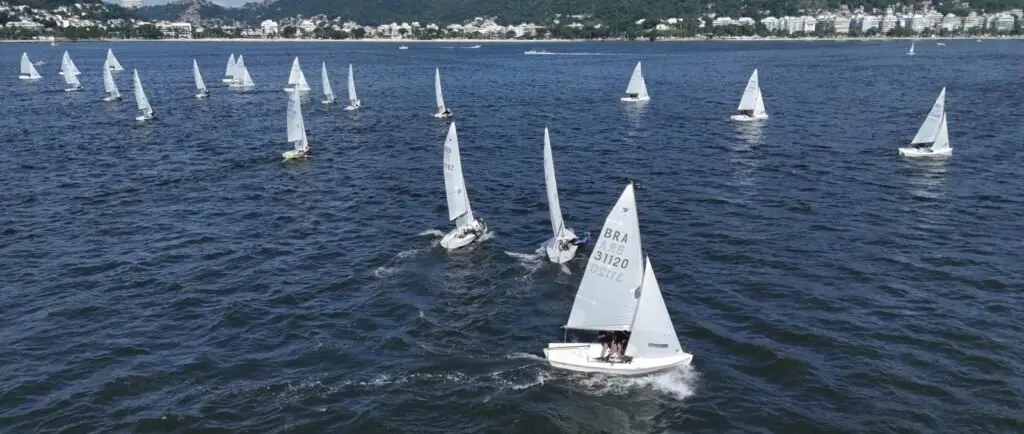
Spanish sailors Alfredo Gonzalez and Cristian Sanchez won the 2026 Snipe Campeonato Carioca in Niterói, Brazil, by a single point after a six-race series with one discard. The Snipe Class International Racing Association's official results report, dated 23 November 2026, gives the winners 14 points, ahead of Brazil's Caio Ribeiro Bailly and Alexandre Muto on 15. American crew Ernesto Rodriguez and Diego Lipszyc finished third on 16 points, while Argentina's Julio Alsogaray and Malena Sciarra were fourth with 21. The closely packed podium provides a clear sporting result, not a forecast or anecdote from a social-media photograph. For Leisure Boat Guide, the story highlights how competitive two-person dinghy racing can produce fine margins even after several starts, and why results must be interpreted according to the actual published scoring system.
A one-point margin after a six-race programme
The official event report says six races were completed and one result was discarded. Within that format, the winning total of 14 points was only one better than the runner-up's 15. The narrow difference matters because it demonstrates that the overall championship was not decided by a large points cushion. It does not by itself reveal who won the individual final race, which boat had the better starting record or whether a protest changed the outcome. Those details require the complete race-by-race results rather than an overall summary. The grounded conclusion is that Gonzalez and Sanchez finished the series ahead, with the next two crews separated from them by only one and two points respectively.
How a discard influences a series
Allowing one discard means a crew's worst eligible result can be removed from its total according to the applicable scoring rules. That can reduce the impact of a single poor start or difficult race but does not make consistency irrelevant. Teams still need enough strong finishes to remain competitive, and the value of a discard depends on how results are distributed across the six starts. It is tempting to invent a dramatic final-race reversal in a close championship, but the association's concise narrative does not establish one. A proper tactical analysis should either use the full score sheet or explain only what the published overall table proves. This report takes the second approach where individual race data have not been independently checked.
The runners-up represent the home fleet
Brazilian sailors Caio Ribeiro Bailly and Alexandre Muto took second place on 15 points. Hosting an international regatta can give local crews valuable opportunities to race against visitors without travelling abroad, although familiarity with local water is not an automatic competitive advantage. Weather and tactical decisions can change throughout a series, and a crew still has to execute its plan on the racecourse. The official score makes the runners-up' achievement clear, but it does not provide personal biographies or confirm how long the pair have sailed together. Such information should not be invented to add colour. Their result can stand on its own as a strong performance separated from the winners by the smallest available whole-point margin.
Rodriguez and Lipszyc complete a tightly grouped podium
Ernesto Rodriguez and Diego Lipszyc finished third with 16 points, one behind the Brazilian runners-up and two behind the Spanish winners. Their presence is notable because the pair also appear in other recent international Snipe reporting, but results at different events should remain separate. A third place in Niterói does not automatically imply what the crew will achieve in another format, venue or subsequent championship. Team racing calendars can be demanding, and performance may be affected by boat familiarity, weather and the specific opposition. The official announcement gives a clear ranking for this event. Without additional verified information, it would be unwise to construct an account of the crew's particular tactics or manoeuvres.
Argentina and Brazil add depth to the top five
Argentina's Julio Alsogaray and Malena Sciarra took fourth place with 21 points. The Brazilian pair Breno Valdetaro Bianchi and Fabio Horta were fifth on 35. That wider top-five table underlines the international nature of the competition and the range of experience represented among the leaders. It is not evidence that only those three countries participated; a complete entry list would be needed to describe the entire field. The class's official account lists the national affiliations beside the leading names, making it possible to identify the top finishers accurately. For a small dinghy class, such cross-border competition can help maintain a strong standard while giving national fleets opportunities to test themselves against visiting crews.
Niterói's role as a Brazilian sailing venue
Niterói faces Rio de Janeiro across Guanabara Bay and has a substantial sailing tradition. Its location makes it an appropriate setting for a high-level dinghy meeting, but the 2026 event report should not be read as a detailed weather record. Specific wind shifts, tidal conditions or squalls cannot be attributed to the racing without evidence from the race committee or sailors. The reported fact is that the six-race programme was completed by 22 November. A venue's reputation for competition is useful context, not a substitute for observing the actual races. The detailed sailing instructions and event notices remain the best authority for course locations, safety procedures and any race management decisions.
The Snipe rewards coordination between two sailors
A Snipe is a two-person one-design racing dinghy, which requires a helm and crew to coordinate balance, sail trim, timing and tactical choices. Unlike many larger boats, the crew cannot simply retreat to a sheltered cockpit when conditions become demanding. Both sailors need a shared understanding of manoeuvres, clear communication and attention to changes around them. The result does not reveal which competitor within each crew performed a particular task at every mark, so it would be inaccurate to credit an invented move to one individual. The useful observation is that a narrow points contest tests repeated crew cooperation over the whole series, not only a single burst of boat speed.
One-design rules make preparation important
Common class rules aim to create fair technical conditions, but boats still need careful maintenance and preparation. Sail controls, rigging, rudder and centreboard condition can influence reliability and the ability of a team to execute its plans. That does not mean a podium can be explained by a particular brand or new fitting; the class report gives no evidence for such a claim. Owners of older Snipes should consult current measurement and class documentation before making modifications for major events. A sound, rule-compliant boat provides the foundation for good racing, while actual performance also depends on the sailors. The Campeonato Carioca result is best interpreted as a competitive outcome rather than as endorsement of unverified equipment choices.
Results must be distinguished from race narratives
A published table confirms placings and points but rarely conveys every tactical choice that shaped the event. An exciting editorial narrative might describe a last-minute pass or a dramatic capsize, yet neither is justified by this concise official report. The association names its top five and the scoring format, which provides plenty of reliable information for a meaningful account. Where a race report does not identify protests, retirements or weather cancellations, an independent article should not supply them from imagination. Readers can consult the complete results through the official class channels if they want to study the progression of the scores. Responsible reporting can be engaging without turning an unverified assumption into a fact.
What the result means for Brazilian Snipe racing
The standings show a Brazilian crew only one point behind the visitors, while another placed fifth and international opponents from Spain, the United States and Argentina occupied the other reported leading positions. Such competition offers local sailors benchmarks against a broad range of opponents. It may also encourage clubs and coaches to examine areas of preparation before future meetings, although the official account does not announce a new training programme as a consequence. Brazil's class calendar continues with further scheduled events, including a national championship planned for Porto Alegre in January 2027. That event is separate from the November Carioca competition and should not be described as a rematch with a confirmed entry list.
The photograph is an authentic regatta image
The accompanying photograph comes from the first-party Snipe Class gallery for the 2026 Campeonato Carioca, with photographer José Olimpio credited by the class. It is an original image of the actual competition rather than a stock photograph from another country or an AI-generated illustration. Nevertheless, the photograph itself is not proof of every individual placing or point total. Those figures derive from the association's written results and linked score documents. Proper source separation helps readers understand why a race story can use a genuine photograph without making unsupported claims about precisely which manoeuvre or moment it captures.
The confirmed top five
The final published ordering is Gonzalez and Sanchez on 14 points, Bailly and Muto on 15, Rodriguez and Lipszyc on 16, Alsogaray and Sciarra on 21, and Valdetaro Bianchi and Horta on 35. These numbers are the event's reported final totals after six races and one discard, not invented single-race scores. The source does not establish an associated prize amount, a record entry figure or a change in official national rankings. Every one of those would require another published document. Keeping the report anchored in what has been verified preserves the meaning of an unusually close three-boat podium.
Why the one-point victory is newsworthy
For small-boat racers, a series decided by one point is a reminder that each start, boat-handling decision and finishing place can matter across a multi-race championship. For general readers, it offers a clear and understandable result that does not require the complexity of a larger offshore campaign. The official November 23 class report remains the primary authority for the standings. Gonzalez and Sanchez are the confirmed winners, with two crews immediately behind them in the points table. That is the sporting achievement of Niterói's Campeonato Carioca, and it deserves coverage without claiming a dramatic race detail the available evidence does not establish.
Explore related Leisure Boat Guide reporting
- ACI Cup Ends Croatia’s 2026 Snipe Season With Three Races in Opatija
- OK Dinghy Joins Palma’s 2027 Princesa Sofía Regatta Programme
- Hansson-Mild Tops Final 2026 OK Dinghy Ranking Ahead of 677 Sailors
- Nineteen Teams Gather at Spinnaker for 2026 Women’s Team Racing Nationals
Primary reporting and image credit
Primary manufacturer and organiser source(s): https://snipe.org/regatta-reports/2026-regatta-reports-regatta-reports/campeonato-carioca-3/. © Snipe Class International Racing Association / José Olimpio. Alternate original official 2026 Campeonato Carioca racing image from the first-party class regatta gallery. Image is used only for correctly attributed factual editorial coverage and never represented as open-licence stock photography.