
Spinnaker Sailing Club has confirmed 19 entered teams for the RYA/BUSA Women's Team Racing National Championships taking place on 28 and 29 November 2026 at its inland lake in southern England. The club's official weekly bulletin, published on 25 November, establishes the two-day schedule, entry figure and operational arrangements, including the closure of the lake to normal member access during competition. The announcement is unusually valuable because it comes directly from the host rather than from a speculative preview. The headline should not be confused with a race result: at the time of the bulletin the contest had not begun, and the document names no champion or final standings. For Leisure Boat Guide, the event presents a concentrated example of racing that depends on tactical coordination in modest dinghies rather than on expensive long-distance equipment.
What the host has confirmed
The essentials are clear. Nineteen teams have entered the Women's Team Racing Nationals, with racing planned for Saturday 28 and Sunday 29 November. Spinnaker Sailing Club, located at Blashford Lake near Ringwood, is hosting, and the lake is closed to the usual general access over that weekend. The source does not provide a complete entry list, race schedule or a finishing table, and none should be inferred from the total number of teams. Local conditions and the race committee will determine how many contests can actually be sailed. A reliable report must distinguish between the confirmed entries, the intended format and the results to be established by official race scoring after the event.
Team racing changes the tactical objective
Unlike a single-boat fleet race in which the first finisher usually has an obvious advantage, team racing requires several boats to cooperate to achieve a favourable combined score. A sailor may need to help a teammate rather than simply follow the quickest personal course. That changes how participants evaluate wind shifts, right-of-way situations and the positioning of other boats around marks. Teams must make fast, lawful decisions under the Racing Rules of Sailing, without assuming that aggressive positioning excuses unsafe conduct. The format makes a small, relatively simple dinghy an effective teaching platform for strategy, because the boat's handling and the crew's communication become inseparable from the final result.
The RYA and BUSA roles
The championship is associated with the Royal Yachting Association and the British Universities Sailing Association. Those bodies bring complementary interests to the event: national-level sailing development and a network of university racing sailors. The host club's current announcement confirms the event name, but it should not be treated as a complete statement of organisational responsibility, judging appointments or future qualification benefits. Sailors or clubs needing exact eligibility rules should consult the official notice of race and sailing instructions. The presence of both RYA and BUSA in the title indicates a link between women's racing and the wider university team-racing tradition, a strong setting for developing sailors who may later compete in mixed and open championships.
Why 19 teams is a meaningful entry figure
An entry of 19 teams creates a substantial field for a two-day inland contest, even before taking account of organisers, umpires, volunteers and rescue crews. It also complicates scheduling, because fair racing requires enough rounds and suitable progression rules to distinguish performance rather than relying on a very small sample of matches. The published club bulletin does not state how many races will be completed, so any estimate would be misleading. The figure matters as an indication of interest and organisational workload. The race committee will need to balance the desire for adequate competition against the constraints of daylight, wind, safety cover and the time needed to rotate teams between races.
Inland-water conditions test short-course decisions
Blashford Lake is not a coastal racecourse and should not be described as one. Its inland setting can make wind direction and strength more variable near shorelines or local obstacles, while shortening the distances sailors can use to recover from a poor start. Those are general features of lake racing, not a forecast for this weekend. Good teams respond by observing the race area carefully and adapting their tactics without chasing every small shift. Crews must also watch for the effect of gusts on boat balance and maintain awareness of nearby competitors. The setting allows spectators to see much of the tactical action without needing an offshore spectator boat, though access arrangements remain controlled by the host.
A championship depends on its volunteer network
The public sees sailors and results, but successful team racing also relies on race officers, umpires, safety-boat crews, equipment volunteers and people managing shore logistics. The 19-team entry increases the importance of clear briefings and consistent procedures. Safety support must be appropriate for the number of sailors on the water and for prevailing conditions, rather than copied from a normal weekend club fleet. The club's decision to close the lake to regular use illustrates the kind of access control required to operate a championship without unnecessary conflicting activity. The bulletin does not disclose the detailed volunteer roster or safety plan, which should remain with the organisers rather than be invented for editorial colour.
Women's racing as a development opportunity
A women's national championship provides a visible competitive setting in which female sailors can develop as helms, crews, team leaders and tactical decision makers. Participation is not solely about representation in an event photograph; repeated racing against well-prepared opponents can create experience that carries into coaching and wider competition. It would, however, be wrong to infer the age, university affiliation or level of experience of every participant from the competition's name. Different teams may approach the event with different objectives. The confirmed entry number shows the scope of this particular edition, while the longer-term measure of value will include opportunities for sailors to remain active and progress within the sport.
Fair racing requires disciplined rules knowledge
Team racing includes tactical manoeuvres designed to influence opponents' positions, placing special importance on knowledge of the applicable right-of-way rules and proper umpiring. Skippers need to understand what is permitted, how to avoid contact and when to accept a penalty rather than escalating a dispute. A good championship encourages competition without making the safety of sailors or equipment secondary to a result. Spectators unfamiliar with the format may find it helpful to follow a single pair of teams and watch the decisions at start lines, marks and crossings. The best tactical move is often not the fastest individual passage but one that enables another teammate to gain an important position.
Boats and equipment in a shared format
The announcement does not identify the exact dinghy type, the rotation procedure or who supplies every hull. Any equipment specification should therefore be checked against the event documentation rather than guessed from historical images of club sailing. When a team race uses comparable boats, it places a stronger emphasis on tuning, handling and tactics, though no equipment programme can eliminate every difference in condition. Crews also need to be ready for changeovers, rigging checks and simple maintenance between races. Those practical tasks connect the championship to everyday dinghy ownership, where careful preparation and knowledge of a boat's controls may matter more than purchasing the newest accessory.
A weekend with restricted public sailing access
Spinnaker's weekly bulletin explicitly warns that the lake will be closed to general access for the championship. That affects members and casual users planning to go sailing, paddling or training during the weekend. The notice is operational information, not a criticism of the event: reserving a confined venue for an organised race can be necessary to manage traffic and safety. Members should check current club communications before travelling, since local access arrangements can change. The notice also demonstrates why the communication between sports clubs and participants is important; an ambitious competition programme needs to account for people whose normal activities are displaced during the event.
The next season is already being planned
The same weekly club message says Spinnaker's 2027 racing programme has been uploaded and its training-course calendar is substantially available. That is separate from the championship itself, but it reveals the host's broader operating rhythm: major late-season racing, governance commitments and preparation for the following year's participation. The club has an annual general meeting scheduled for 6 December, another date in the bulletin. These confirmations provide context without turning a race preview into a generic club promotion. One of the practical strengths of an established local venue is that volunteers and members can plan ahead, ensuring that the machinery of the club remains usable after a high-profile weekend.
What can be reported after the final race
Reliable follow-up should use the event's official scoring, including the name of the winning team, completed rounds and any published decisions about ties or protests. A social-media photograph of a sailor holding a trophy is not enough to establish all details of a championship. The host's currently verified facts remain the 19 entries, the 28–29 November dates and the club's lake-access arrangement. Leisure Boat Guide can report those now without pretending that the two-day event is finished. What makes the nationals interesting is the combination of small boats, demanding tactics and the visible commitment of women's teams, backed by the less visible work of the host and its officials.
Explore related Leisure Boat Guide reporting
- Ryde School Wins RYA Schools Match Racing Title with Eight Straight Victories
- Angel of the North Team Racing Returns to Derwent Reservoir on November 28–29
- RYA Youth Nationals Set Weymouth 2027 Dates for Dinghy Fleets
- Ballyholme Honours Robin Gray and Elaine Taylor in Northern Ireland Sailing Hall of Fame
Primary reporting and image credit
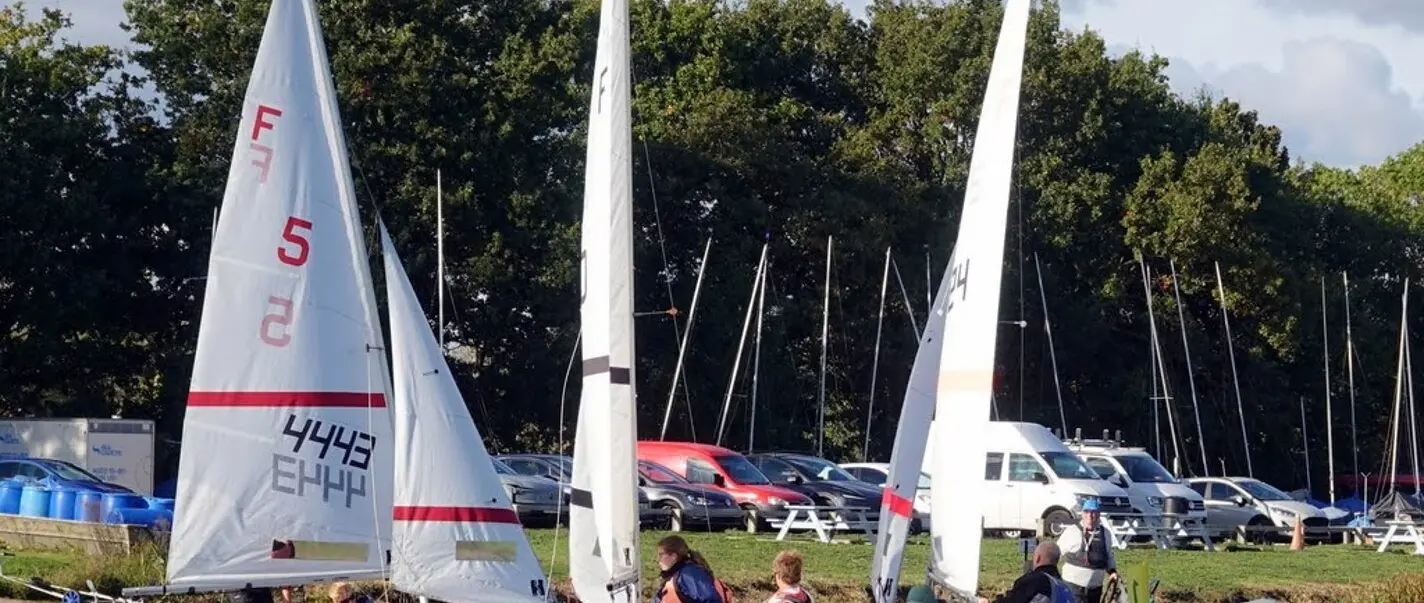
Primary manufacturer and organiser source(s): https://www.spinnakerclub.co.uk/article/weekly-news-2056. © Spinnaker Sailing Club / original photographer. First-party November club-news photograph illustrating club sailing; not identified as action from the 28–29 November championship. Image is used only for correctly attributed factual editorial coverage and never represented as open-licence stock photography.