The youngest crew sets the pace at Weymouth
A team from Ryde School on the Isle of Wight has won the 2026 RYA Schools Match Racing Championship after completing all eight round-robin matches without defeat. The event took place at Weymouth and Portland National Sailing Academy on 21–22 November, with the governing body publishing its results on 25 November. Four teenage sailors made up the victorious team: skipper Arthur Baker, aged 14, and crew Cass Day, Fallon Day and George Newman, each aged 15. Organisers believe Baker may be among the youngest helms to win the championship. The achievement is particularly notable because match racing rewards sustained decision-making and close-quarters boat handling rather than only speed over an open course. A perfect round robin means the team repeatedly executed its plan against different opponents.
What the eight-win record actually means
The RYA reports that nine teams competed, with each team scheduled for eight matches in the round robin. Ryde School won all eight, earning the NSSA Trophy and overall title. A complete set of victories is clear evidence of consistency within this specific competition, though it is not a measure of how the sailors might perform against every other school or in a different class of boat. Match racing places two boats in direct competition, so the quality of starts, tactical position and reactions to wind shifts can strongly affect the result. A successful team must often adapt several times in a short race. Ryde's eight wins stand as an accomplished result from a particular weekend, not a forecast of medals in unrelated future events.
A small keelboat with a demanding learning curve
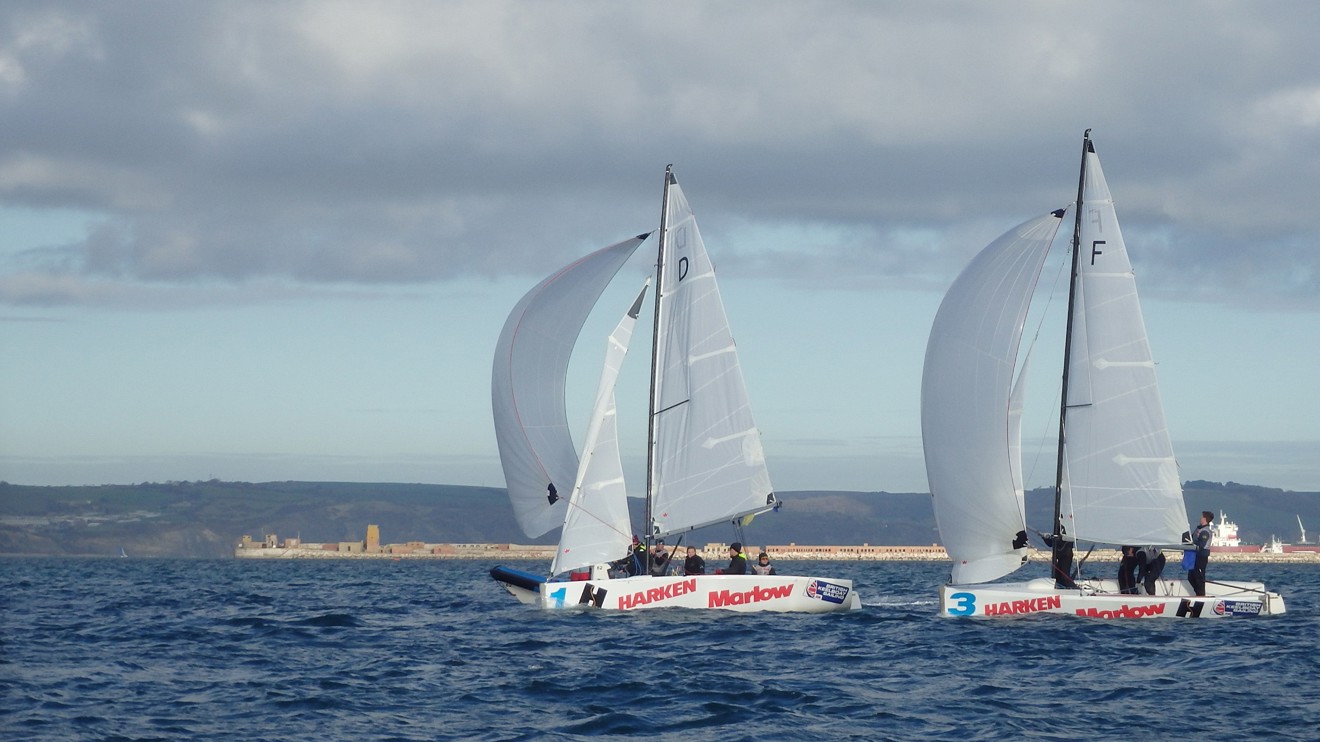
The competitors used the RYA's Elliott 6M keelboats. This approximately six-metre class is within the small-boat scope of Leisure Boat Guide, while giving sailors the experience of working as a coordinated keelboat crew. Compared with many junior dinghies, a keelboat can introduce different expectations for steering, manoeuvring, communication and responsibility among several people aboard. Six of the teams took advantage of an optional Friday training day to become familiar with the boats and the event format. That preparation is an important part of the story. Competence in one sailing class does not mean every control sequence is immediately intuitive in another. Training allows sailors to discover the characteristics of the supplied boats before the pressure of racing.
The wind shaped the event programme
The RYA's account describes easterly winds of approximately 10 to 15 knots on Saturday, with occasional shifts of about 40 degrees. Those conditions can make match racing technically interesting, particularly when teams are attempting close starts or positioning for the first windward leg. The forecast for Sunday was substantially stronger, so the organisers concentrated on completing the round robin during Saturday. Racing began in the morning and the boats were returned ashore before dark. This was a deliberate event-management response to the expected weather, not evidence that racing continued through dangerous conditions. The RYA says the teams helped crane out and secure the keelboats ahead of the incoming wind, after which the prizegiving took place.
Match-racing starts reward precision
A match race often begins before the start signal, with the two crews manoeuvring to gain a favourable position. The competing helm must consider right-of-way rules, available space, acceleration and the likely shape of the first leg. A team that handles the pre-start well can influence the tactical choices of its opponent, but mistakes can also lead to penalties or the loss of control of a useful position. The event director reported that the pre-start manoeuvring became increasingly technical as sailors learned throughout the day. This is a valuable part of youth racing: even experienced dinghy sailors can find the direct tactical contest unfamiliar. The result demonstrates the importance of systematic practice rather than relying entirely on quick reactions.
Spinnaker handling presented another test
The governing body's report says competitors were able to fly spinnakers early in the programme, and some crews used them to good effect. A pole breakage later led the race team to adopt a two-sail arrangement for the final three flights. That technical change altered the available sail choices but did not invalidate the championship results. It also illustrates a practical principle of racing: equipment limitations can require a different configuration, and all crews need to understand the revised sailing instructions. For a young sailor, such moments are lessons in adaptability. Being able to continue to race competently under a changed plan is a different skill from perfecting one manoeuvre on an unchanged boat.
The runners-up remained close
Another Isle of Wight-based team finished second with seven wins from eight matches. Skipper Will Bradley raced with Rafe Bradley, Biba Downer and Tom Yates, representing Peter Symonds and Cowes Enterprise College. Their result earned the Spanish Trophy and showed that the competition was by no means a one-team affair. Seven victories would be an exceptional performance in many round-robin settings; Ryde's unbeaten total simply went one better. The RYA lists Rutland Sailing Club's team in third place with five wins and Royal Hospital School's team in fourth with the same number. The difference between a close podium and an overall win can rest on a small number of tactical decisions, which makes match racing an unusually instructive format for aspiring sailors.
A female-helm award recognises another achievement
Scarlett MacLennan of Royal Hospital School received the RYA Shield as the top female helm. She raced with Sam Tan-Hardy, Samuel Whelan and Jaro Hoffmann. This award is separate from the overall trophy and recognises a specific competitive achievement within the championship. Including it helps portray the breadth of the weekend without treating a single winning team as the only story worth reporting. Schools and clubs aim to develop capable sailors over many years, and a successful youth event provides multiple meaningful benchmarks. It is still important not to infer individual career trajectories from one result. The value of a championship can be found in improved skills and confidence as much as in the final table.
The Isle of Wight connection
The first two teams both came from an Isle of Wight sailing network, and Ryde School's leadership credited local match-racing opportunities with helping its young sailors prepare. The school highlighted Cowes Match Racing and support from Graham Sunderland, alongside coaching from Martin Evans. This reinforces a familiar lesson in sport development: talented individuals benefit when clubs, schools and community organisations share access to boats, coaching and suitable competition. Match racing can be expensive and logistically demanding if each group must maintain its own fleet. Access to organised programmes can reduce some barriers and let sailors experience a discipline that might otherwise remain difficult to enter. The RYA's account presents this as a contribution to success, not as proof of a national ranking system.
Race management deserves attention
The event director, Eilidh Millar, acknowledged the race team, volunteers and officials responsible for delivering the competition. The RYA names race officer Nicole Ames, assistant Moya Weighill and a group of six umpires, including teachers. A match-racing championship needs more than well-prepared boats. Umpires must observe close tactical interactions, the race committee must manage starts and course changes, and safety arrangements must respond to the weather. Such work often receives less attention than the sailors' performances. Yet the decision to complete the round robin on Saturday and bring the boats ashore before the expected stronger winds was central to the event's successful completion. Competitors and organisers contributed different forms of professional or volunteer skill.
Why sailing schools use keelboat competition
Small-boat training is often centred on dinghies, but keelboat racing can provide valuable experience of a different team structure. The helm, sail trimmers and other crew members depend on clear communication and an understanding of each person's responsibilities. Mistiming a turn or failing to communicate a tactical decision can have consequences for the whole team. Match racing intensifies that pressure because the opponent is close and actively responding. For young sailors, the format encourages discipline under time constraints while remaining a sporting activity with a defined course and organised rules. The RYA's Elliott 6M fleet supplies a way to practise those skills without requiring each participating school to own an identical keelboat.
The event's educational value is wider than victory
The championship was contested by schools and sailing groups with different levels of experience. The RYA says some teams improved their manoeuvring over the day, making the event an opportunity for practical learning as well as competition. A sailor who loses a close start may gain insight into timing and positioning, while a more experienced crew may learn how to adapt when conditions change. Such knowledge is difficult to reproduce solely in classroom instruction. Youth sailing programmes are most effective when they combine coaching, supervised practice, rules knowledge and opportunities to make real decisions afloat. A published result shows who won, but the long-term value of an event also depends on what every team takes back to its home club or school.
Weather decisions provide a seamanship example
A racing programme must work within the limits of forecast conditions, daylight and available resources. The organisers concentrated the competition into one day because of the forecast for stronger winds on Sunday. This is a useful reminder that good seamanship sometimes means reorganising plans rather than attempting to complete a schedule at any cost. Boat handling, shore-side recovery and the availability of officials all belong in a safety decision. The public release does not describe an incident involving competitors and does not support speculation about hidden hazards. Its documented message is simpler: race management made a weather-informed change and still delivered a valid round-robin championship. That is a relevant lesson for any recreational skipper.
From the school fleet to lifelong participation
Not every successful school sailor will pursue professional competition. The skills developed through match racing can support club racing, coastal sailing and other kinds of boating. Knowing the rules, watching the wind and communicating under pressure are useful in many settings. Some participants may move into larger keelboats, while others continue in dinghies or volunteer to support the next generation. The Ryde result provides a visible example of how youth pathways can produce capable crews at a remarkably young age. It should not be turned into a prediction about professional careers or a guarantee that a specific sailor will represent Britain internationally. That remains to be determined by future opportunities and personal choices.
The verified championship result
The [Royal Yachting Association's official 25 November 2026 report](https://www.rya.org.uk/news/rya-schools-match-racing-championship/) confirms Ryde School's unbeaten eight-match performance, the four team members, the Elliott 6M boats, the 21–22 November event dates and the placings of other leading teams. The accompanying official event photograph shows the small keelboats used for racing and is not a generic yacht image or a depiction of an unrelated championship. No extra scores, unreported penalties or predictions are asserted. The achievement adds a fresh result to the UK's youth sailing record, demonstrating what a well-prepared teenage crew can accomplish when practical boat handling and tactical judgement come together.
Original industry sources and image credits
Reporting based on Original first-party Royal Yachting Association dated club and small-boat report.
Lead image: Official 2026 RYA Schools Match Racing Championship photo of small Elliott 6M keelboats. © Royal Yachting Association / original event photographer. Current 2026 school sailing championship event photo.. Original supplier image.