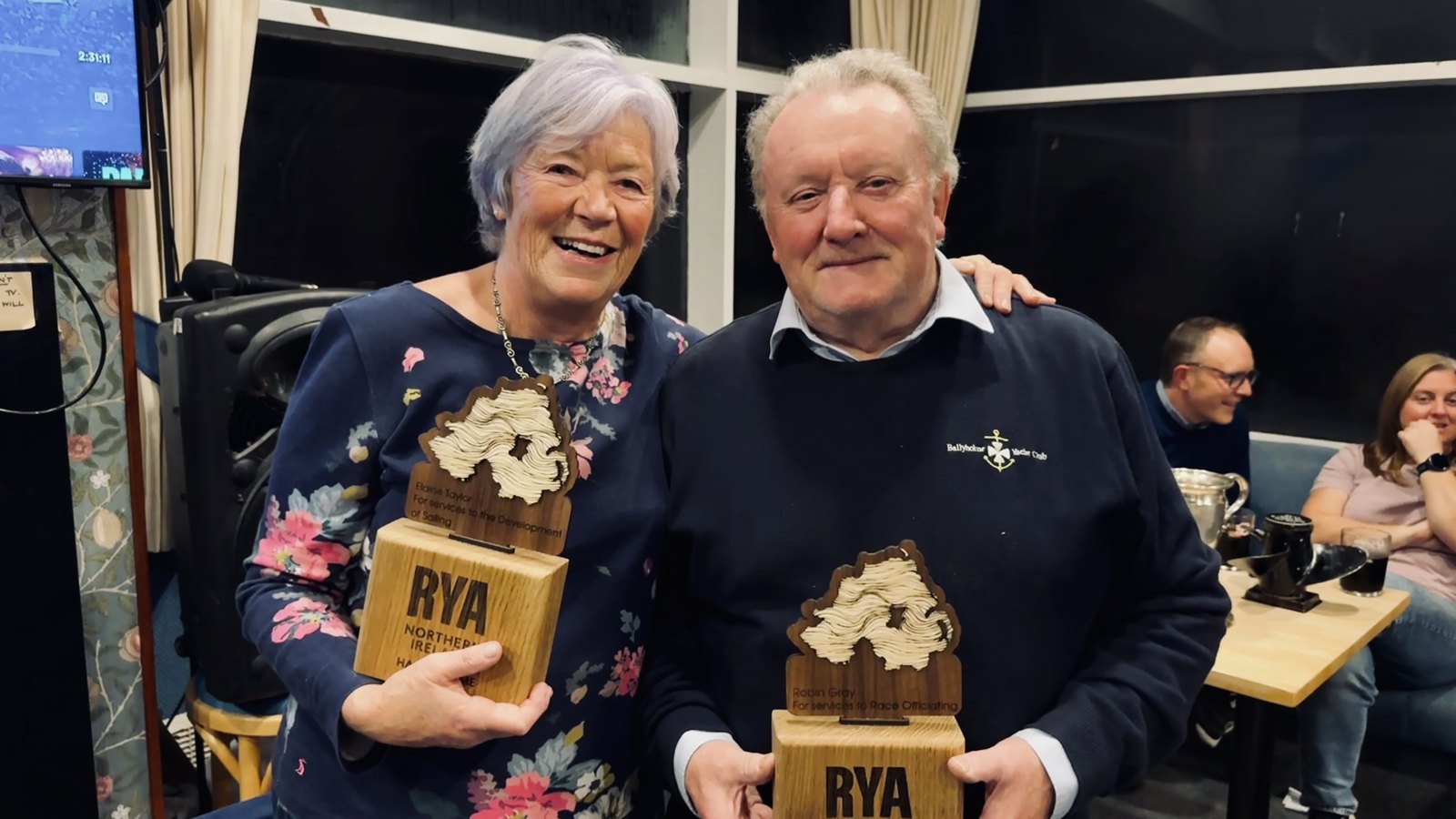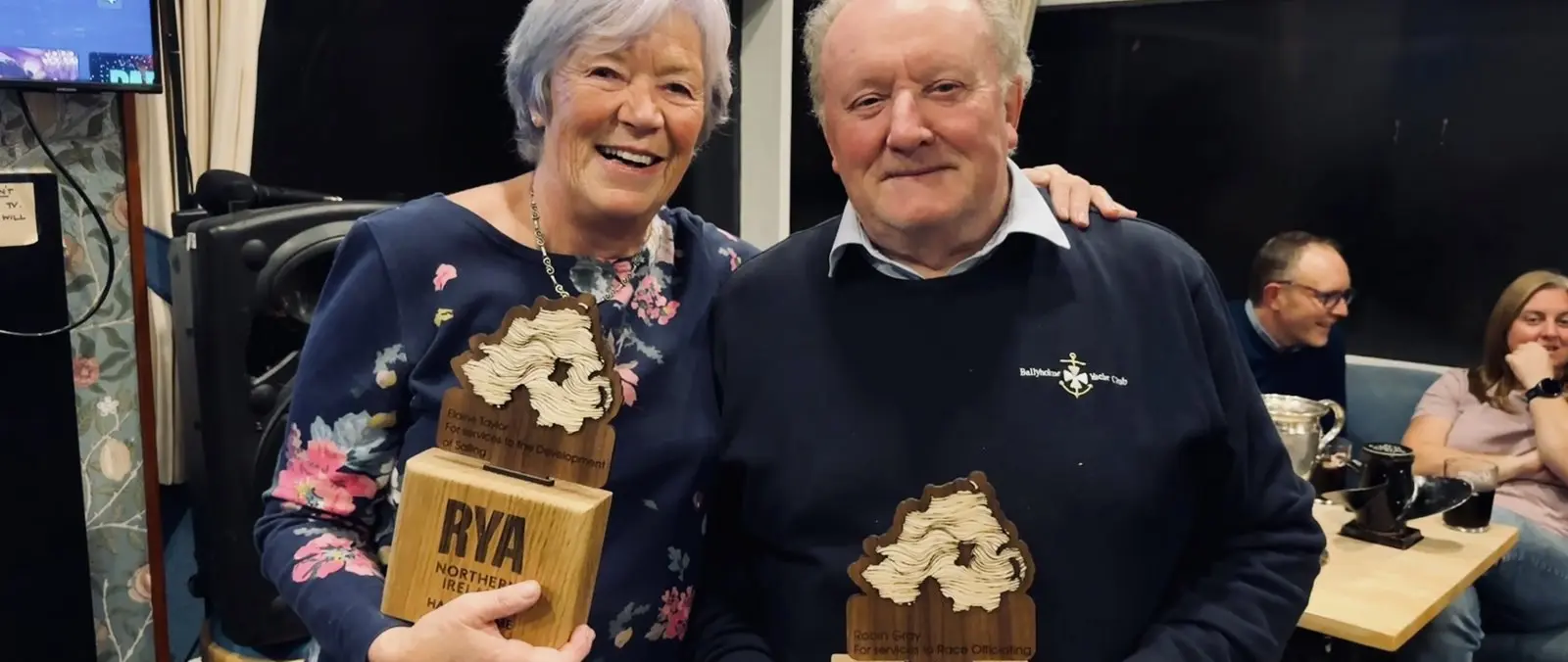
Two long-serving figures in Northern Ireland sailing have been inducted into the region's Sailing Hall of Fame at Ballyholme Yacht Club. Robin Gray and Elaine Taylor were recognised during the club's annual awards evening on Saturday 14 November 2026, with the Royal Yachting Association Northern Ireland reporting the presentations two days later. The awards acknowledge different contributions to the sport: Gray's work in race officiating and Taylor's role in developing sailing participation and leadership. Both stories are rooted in small-boat and club sailing, where a reliable race-management team and experienced volunteers can matter as much as the equipment competitors bring to the start line. The recognition is for sustained service, not the outcome of a new championship or a newly announced boat model.
Recognition for a regional community
A sailing Hall of Fame is intended to recognise achievements that extend over significant periods and have an impact beyond one individual regatta or club office. The association's announcement describes two surprise presentations at Ballyholme's annual awards night. That setting is relevant because much of the work being celebrated happens within the local community, away from major international headlines. Race officers, instructors and club officials can shape the experience of hundreds of sailors without necessarily being known to a wider audience. A formal recognition event offers a moment to document those contributions. It should not be confused with a ranking of current competitors or a change to the rules under which a class sails.
Robin Gray and the race-management task
Robin Gray was honoured for services to race officiating. According to RYA Northern Ireland, he is a World Sailing International Race Officer and the RYA Race Management Coordinator for Northern Ireland. His experience includes involvement in the race-management team for the Volvo Ocean Race in 2017–18 and work at the Sail for Gold Olympic test event before London 2012. These details establish an unusually broad range of involvement, from local coordination to high-profile events. Importantly, the award also recognises his mentoring of race-management volunteers across Northern Ireland. The strength of a sailing programme depends on new people learning how to run racing well, rather than relying indefinitely on a small group of experienced officials.
What a race officer actually contributes
A race officer's work begins before boats approach the starting line. Course design, weather assessment, race-team briefing, signal procedures and communication with safety teams all need careful attention. The precise responsibilities depend on the event and the rules governing it. In dinghy racing, the time between a wind shift and a change in course can be short, making clear decisions essential. Good organisation enables sailors to compete on terms they understand and gives volunteers the confidence to carry out assigned roles. No single award proves that every event supervised by its recipient was without difficulty. It recognises a long record of contribution to an activity where competence, judgement and preparation are central to a fair and safe sporting experience.
The value of passing on experience
The association specifically credits Gray with mentoring successive race-management volunteers. That work is particularly important for clubs where members may be willing to help but hesitant to take responsibility for starting sequences, course layouts or technical signals. An experienced official can explain how to prepare, how to communicate clearly and how to learn from a difficult day without becoming discouraged. Some volunteers will become qualified race officers, while others will remain valuable members of shore and committee-boat teams. The pathways differ, but their common requirement is sustained support. The Hall of Fame citation highlights the importance of that training and mentorship rather than treating the delivery of racing as a task performed only by recognised experts.
Elaine Taylor and the development of sailing
Elaine Taylor was recognised for services to the development of sailing. RYA Northern Ireland traces her involvement back to 1977, when she became one of the early buyers and sailors of a Laser dinghy. That class, now known internationally through the ILCA designation, helped establish an accessible and competitive one-design pathway in clubs around the world. The association links Taylor's early participation with the foundations of the class's regional strength. This is not a claim that one individual created an entire fleet. It illustrates how early adopters, active sailors and organisers can help a class take root in a local community. Their contribution often becomes visible over decades rather than through a single season's results.
Leadership at Ballyholme Yacht Club
Taylor also became Ballyholme Yacht Club's first female commodore. The significance of that role extends beyond holding a title. Club leadership involves decisions about facilities, member activities, volunteer support and long-term direction. A first appointment can demonstrate that roles previously held by a narrower group are open to a wider range of contributors, but it should not imply that the broader challenge of inclusive leadership is automatically solved. The RYA's report presents Taylor's record as part of her contribution to sailing development. It does not provide a comprehensive history of every decision made during her term or identify the current composition of the club's committee. Reporting should retain the confirmed milestone without inventing additional biographical details.
Why one-design dinghies build communities
A familiar, widely sailed dinghy class can support learning and club participation because equipment and technique are discussed among people operating similar craft. Owners may find shared knowledge about rigging, repairs, storage and racing. Class rules also provide a consistent framework for competition. That does not mean one design is appropriate for every age, weight, budget or operating area; each sailor needs a suitable boat and appropriate instruction. Taylor's early association with the Laser is noteworthy precisely because a small dinghy can be the starting point for long-term participation and service. For many leisure-boat owners, the value of a club lies in the community that develops around the craft over time, not simply the performance characteristics of a particular hull.
Two distinct routes to lasting influence
Gray's contribution through race management and Taylor's through participation and leadership show two ways that small-boat sport can develop. One depends on the invisible organisation that creates dependable events; the other on welcoming people into boats and supporting the institutions around them. These activities are related but not interchangeable. A regatta with skilled sailors still needs officials and volunteers, while a technically efficient race programme gains little if people feel unable to join. The Hall of Fame's recognition of both roles suggests that regional sailing success is built through the interaction of competition, development and community organisation. That is an interpretation of the two citations rather than a formal framework announced by the association.
What other clubs can take from the awards
Clubs may find it useful to examine their own succession plans. Who can take over the race-office role if an experienced volunteer is absent? How are new instructors or committee members welcomed, and where can they seek support? Does the club explain opportunities clearly to members who have never held office? A recognition ceremony cannot answer these questions for every organisation, but it can highlight the value of people who spend time developing others. New volunteers should not be expected to perform complicated duties without preparation. Equally, capable members may need encouragement to take on tasks they have not considered. These are practical lessons drawn from the careers described, not mandatory procedures imposed by the Hall of Fame.
The role of the sailing governing body
The presentations were made through RYA Northern Ireland during the Ballyholme evening. Chief executive Greg Yarnall presented Gray's recognition, while RYA Northern Ireland chair Gavin Watson presented Taylor's award. The organisation's announcement makes the honourees and their contributions clear. It does not state that the induction changes their sporting qualifications, creates new governance posts or confers a regulatory power. Such distinctions matter because sporting recognition and formal operating responsibilities are different things. A World Sailing race-officer qualification has its own framework, while a Hall of Fame induction is primarily an acknowledgment of service and lasting influence within the community.
Photography and provenance
The official photograph accompanying this article was supplied by the Royal Yachting Association Northern Ireland with its awards-night report. It documents a real presentation rather than a newly launched boat or a reconstructed scene. Its use as a lead illustration should not be read as evidence of any unreported event or personal history. The original RYA news page is the primary source for the names, date, officiating roles and the historical Laser and commodore milestones. Readers wishing to learn about local club racing or volunteer opportunities should consult the governing body and the individual clubs for current arrangements, rather than infer schedules or course details from an awards announcement.
The enduring news value
The new Hall of Fame inductions are a reminder that much of the recreational sailing sector is sustained by voluntary effort, technical competence and people willing to create opportunities for others. The 14 November ceremony brought those contributions into public view, and the subsequent official report documents the particular achievements of Robin Gray and Elaine Taylor. Neither award requires inflated claims about the economic value of clubs or the number of new sailors created through one person's work. The confirmed record is substantial enough: international race-officiating experience and mentorship on one side, and decades of sailing development and a landmark club leadership role on the other. Together they represent the human infrastructure behind successful small-boat sailing.
Sources and image attribution
Primary reported announcement: https://www.rya.org.uk/news/welcome-to-the-northern-ireland-sailing-hall-of-fame-robin-elaine/.
Official photographic provenance: https://www.rya.org.uk/news/welcome-to-the-northern-ireland-sailing-hall-of-fame-robin-elaine/. Image supplied by the originating organisation, credited in the photograph title; original copyright remains with the rights holder. Official image file. The photographs are documentary or clearly labelled archival illustrations, not evidence of events that have yet to happen.