
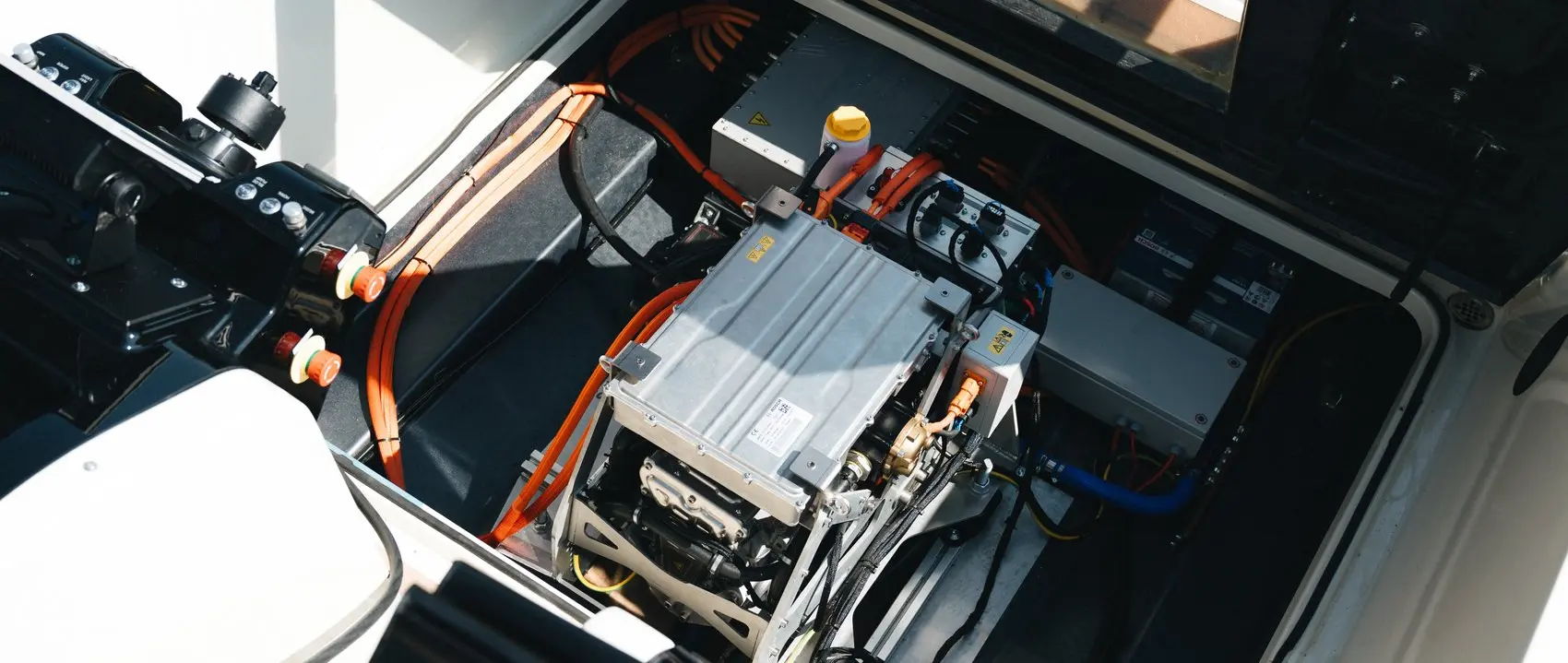
Bosch Engineering has used a 6.5-metre electric sportboat to demonstrate its integrated Electric Drive for Marine Applications, or EDM, a package intended to make electric inboard propulsion easier for boatbuilders and system integrators to install. In its official METSTRADE press announcement of 12 November 2026, Bosch describes a complete propulsion system built around a motor, gearbox, inverter, onboard charger, controls and thermal equipment. The company reports that its demonstration boat reaches planing speed in four seconds and 30 knots after 14 seconds, using a test installation with a quoted 140kW peak output. These are manufacturer-stated demonstration figures, not results independently measured by Leisure Boat Guide. The news matters to smaller recreational craft because the actual demonstrator is only 6.5 metres long, making the proposed integration relevant to a very different scale of boat from a large hybrid superyacht.
A complete package rather than a standalone motor
Converting an inboard-powered boat to electric propulsion involves much more than bolting a motor to an existing shaft. An inverter, charger, cooling arrangements, electrical protection, control software and suitable mechanical integration are all required. Bosch's EDM concept packages the motor with a gearbox, inverter, onboard charger, heat exchanger, electronics enclosure and the necessary cooling pumps into one ready-to-install assembly. The supplier also lists cabling, a charging inlet, a display and control elements within the broader delivery. For a yard that builds only a limited number of small boats, sourcing and commissioning these systems separately can be a significant undertaking. A coordinated unit may reduce that complexity, although installation and certification still demand engineering oversight.
The manufacturer quotes 120kW of continuous output
The complete EDM system described in the press release has a continuous rating of 120kW, which Bosch also expresses as roughly 160 horsepower. The assembled drive is said to weigh about 195kg, giving a claimed power density of approximately 0.6kW per kilogram. Neither figure is a complete boat weight or a battery-inclusive propulsion system weight. A hull designer needs to add the mass of batteries, structural supports, cabling and other associated equipment. The rating should also not be confused with Bosch's separately advertised 60kW modular electric motor in the METSTRADE component catalogue. Those are related offerings, but the 6.5m demonstration specifically concerns the larger integrated EDM package and its own stated performance.
How the 6.5-metre demonstrator performs
The centrepiece of the announcement is an actual electrically powered sportboat measuring 6.5 metres. Bosch reports that the test installation reaches the planing condition after about four seconds, while 30 knots is achieved after 14 seconds, with a maximum quoted test output of 140kW. Those numbers illustrate the performance the company wishes to show, but they cannot be treated as a universal prediction for every six- or seven-metre hull. Acceleration depends on displacement, propeller, load, sea conditions and the definition used for planing speed. The press statement does not provide an independently witnessed test sheet specifying all those variables. Buyers should seek repeatable test data on the exact boat and operating configuration they intend to use.
Peak power is different from sustained power
The distinction between 140kW peak output in the demonstrator and 120kW continuous output for the packaged drive is more than a technical footnote. A motor may be able to deliver a higher level of power for brief acceleration while its cooling system and electrical components are designed for a lower sustained duty. The actual relationship between continuous and peak operation must be governed by the manufacturer's control strategy and thermal limits. A recreational owner may only need high power for a short transition onto the plane, whereas a commercial craft making repeated fast runs could impose a very different load profile. The press release does not include an hourly battery-depletion curve, so a statement about extended high-speed endurance would be speculative.
Manoeuvring mode is a separate attraction
Bosch also describes a dedicated manoeuvring function for precise low-speed control near pontoons and harbour structures. That capability deserves attention because a six-metre dayboat spends time launching, berthing and entering confined spaces, not only travelling at speed. Fine throttle response may help a helmsman manage those situations, but it does not eliminate the effect of wind, current or limited visibility. Owners still need to understand how the electronic controls behave when switching operating modes and what happens if a sensor or controller loses communication. A competent skipper remains responsible for lookout and safe speed. No demonstration of a responsive propulsion system constitutes permission to approach other boats without an escape plan.
Mechanical integration offers installation flexibility
The company says the EDM includes a shaft coupling that can be angled by eight degrees in either direction, allowing designers some flexibility in aligning the drive with a propeller shaft and available hull space. That is important for yards trying to electrify an existing hull design instead of developing an entirely new boat around the motor. However, a stated coupling adjustment does not guarantee that every conventional inboard installation can be converted safely. Shaft geometry, propeller loading, motor mounts, engine-bed strength and vessel balance remain critical. An installer must also confirm that the actual hull and drivetrain meet appropriate vibration, structural and safety expectations before treating a theoretical retrofit as a routine equipment swap.
The high-voltage battery is not included
One of the most important qualifications in Bosch's release is that the high-voltage propulsion battery is not supplied as part of the standard EDM package. The system uses a standard communication interface intended to make it compatible with suitable batteries from different providers, which can give builders a choice of capacity and design. Yet the battery is essential to the boat's real operating range, charging time, weight, cost and safety case. Buyers should therefore not interpret a price or weight for the drive unit as the price or weight of a complete electric boat. Selecting a pack requires decisions about energy capacity, thermal management, installation position, certification and lifecycle support. Those details must be established for each vessel.
Cooling involves the drive and battery environment
The EDM's thermal equipment is designed to manage the drive's integrated components and support effective temperature control of the high-voltage battery. Cooling becomes particularly important in a compact hull where machinery, cabling and energy storage compete for limited ventilated space. A cooling system should be assessed not only at steady cruising output but also during repeated acceleration, slow manoeuvring and warm ambient conditions. The manufacturer claims a coordinated system but does not publish every environmental limit in the general press statement. Designers must work from the detailed installation and operating instructions, including how faults are detected and how equipment responds when temperatures exceed permitted ranges.
Software integration should not be overlooked
Bosch presents its control software as a flexible system that can be calibrated for different vessel designs. That is a useful proposition because boats differ widely in hull form, helm position, propulsion demand and intended use. A performance-oriented sportsboat will not necessarily need the same throttle mapping as a small harbour service craft. Software must also manage information from batteries, chargers, displays and protection systems in a consistent way. The ability to tune a system should not be confused with unrestricted access for an owner to alter critical safety settings. Commissioning needs appropriate technical oversight, documented configurations and a clear route for later support or approved updates.
A package intended for custom and small-series builders
Bosch says it can supply the system starting from a quantity of one. This matters to smaller boatbuilders, specialist refit yards and custom projects that cannot justify the tooling or development work associated with a large production run. The company also stresses its use of components and expertise derived from high-volume automotive manufacturing. That background may be relevant to quality control and parts management, but marine operation exposes equipment to different vibration, salt and humidity conditions that still require dedicated engineering. A compact system can simplify procurement without removing the responsibility for proper integration, service procedures and insurance or certification requirements on the finished boat.
Electric drive remains dependent on the wider energy plan
The press release provides impressive acceleration claims but does not report the demonstrator's installed kilowatt-hour capacity or a standardised range at typical cruising speeds. Kilowatts describe power, while kilowatt-hours describe the energy available to sustain that power. A boat's range also changes with sea state, wind, propeller efficiency and the energy held in reserve for a safe return. At high planing speeds, energy demand can increase significantly compared with low-speed harbour use. Owners should ask for independent or repeatable sea-trial figures with stated payload and conditions, not simply apply the maximum speed to a desired passage distance. Shore-charging capability and access at the home marina are further parts of the practical ownership decision.
Safety and rescue procedures still belong to the skipper
High-voltage propulsion brings particular precautions for maintenance, isolation and incident response. Crews need to understand the correct shutdown sequence and avoid attempting unqualified work on damaged electrical equipment. A battery fault or charging issue can affect the boat's ability to return, just as a conventional fuel or mechanical failure can. The specific emergency plan must be built around the chosen battery, hull and propulsion installation. A technically advanced helm display cannot substitute for a lookout, communications and conservative weather decisions. For a small craft travelling in coastal water, the availability of suitable assistance and the skipper's awareness of local regulations are as important as the novelty of the propulsion system.
What the demonstration really establishes
The 6.5m sportboat provides a tangible example of Bosch's integrated propulsion approach, supported by a first-party photograph of the actual demonstrator. It does not establish a fixed range, a universal retrofit price or a guarantee that all boats of this length will achieve 30 knots. The credible takeaway is that Bosch Engineering is bringing a more integrated package to builders seeking electric inboard propulsion, with meaningful attention to cooling, software, charging and mechanical installation. For Leisure Boat Guide readers, that is an important development in small-boat engineering, provided manufacturer demonstrations remain clearly distinguished from independently verified owner performance and detailed installation specifications.
Explore related Leisure Boat Guide reporting
- BlueNav Control Opens Smart Navigation to Other Electric Drives
- ZeroJet Tiller-Steer Electric Jet Targets Compact Leisure Tenders
- BlueNav and Tiger Marine Develop Hybrid 7.5m RIB for Fishing Operators
- Fetch Energy's Mantis Combines Wave and Solar Power for Small-Boat Berths
Primary reporting and image credit
Primary manufacturer and organiser source(s): https://www.bosch-presse.de/pressportal/de/en/metstrade-bosch-engineering-enables-fast-boat-electrification-with-plug-and-play-complete-solution-287168.html. © Bosch Engineering GmbH. First-party original 2026 Bosch Electric Drive for Marine Applications (EDM) 6.5-metre demonstration sportboat photograph, not an independent speed trial. Image is used only for correctly attributed factual editorial coverage and never represented as open-licence stock photography.