
A floating source of power for marinas with limited grid access
A marina does not always need a large offshore power station to benefit from renewable energy. British start-up Fetch Energy is developing Mantis, a floating system designed to combine electricity generated from waves with solar generation and onboard battery storage. The company presented its concept in the METSTRADE 2026 start-up programme, after describing its development plans in an interview with marine accelerator Yachting Ventures. Mantis is positioned primarily as infrastructure for marinas, coastal businesses and remote waterside locations, rather than a charger that an individual sailor bolts onto a dinghy. That distinction is important for Leisure Boat Guide's audience. Owners of small electric launches, dayboats and compact cruisers may ultimately use such equipment indirectly when a marina supplies shore power, but a company prototype is not evidence that ordinary berths are already supported by a commercial installation.
What the manufacturer says Mantis combines
Fetch Energy describes Mantis as an integrated platform with three elements: wave energy conversion, photovoltaic panels and battery storage. Wave activity can provide mechanical motion when sunlight is weak, while solar panels can contribute during daylight in favourable weather. The battery system is intended to buffer the differences between generation and demand, helping the platform deliver useful electricity to connected equipment. The manufacturer's current Mantis page describes a five-kilowatt class unit and operation over stated wave heights. Those figures are a published design specification, not a guarantee that every installation will provide five kilowatts continuously. A marina engineer would need the complete generation curve, storage capacity and electrical protection design to determine what loads could be supplied reliably. The combination is interesting because power at a berth is needed at particular times, not simply whenever the weather happens to favour one generator.
A different approach from charging a battery aboard
Small-boat owners may have seen concepts that harvest boat motion to add a few watts to a twelve-volt battery. Mantis addresses a fundamentally different scale and location. It is conceived as a floating power asset near a quay, mooring or aquaculture facility rather than a compact mechanism installed inside one hull. This means practical questions shift from fitting equipment in a locker to securing a structure within a marina, connecting it to approved electrical distribution, protecting other users and arranging professional maintenance. The output may be shared through a berth supply or dedicated installation, depending on the design. It should not be described as an alternative to an outboard charging system in itself. A small electric boat may still need an appropriate battery charger and shore-power connector to turn available electricity into a safe charge, whether that electricity originates from a floating Mantis unit or the local grid.
Understanding the quoted five-kilowatt rating
The company's product information mentions a five-kilowatt Mantis device and gives an illustrative estimate for recharging a leisure battery under moderate wave conditions. However, kilowatts describe instantaneous power, while an energy budget must be measured in kilowatt-hours over time. A marina with electric boats must know when power is available, how much energy the batteries store and how the system behaves during flat calm, heavy weather and extended demand. A small outboard's battery might be easy to replenish after a modest trip, but several larger electric craft charging simultaneously could require substantially more energy than one floating unit can provide. Owners and operators should avoid translating a nominal rating into an assumed number of fully charged boats per day. The important figures would be measured energy delivered to chargers, seasonal generation, inverter efficiency and the usable capacity of the site's storage system.
Berth power is a safety and infrastructure issue
Most marina electrical systems are managed with strict arrangements for earthing, circuit protection, moisture and public access. A new floating generator cannot be treated as a casual extension lead. The design must address marine electrical standards, appropriate isolation, fault detection and protection against people or boats coming into contact with damaged cables. Connection to existing shore power may require an authorised engineer and the harbour operator's approval. The floating equipment itself needs a location that does not block fairways, create a snagging hazard or interfere with mooring lines. Small-boat users often arrive after dark and may be unfamiliar with a harbour's layout, so clear marking and safe access are essential. Whatever the renewable source, dependable electricity must be delivered through an installation with the same attention to safety expected from an ordinary shore-power pedestal.
Anchoring and motion could determine practical viability
A floating energy system must remain effective while constrained by mooring or anchoring arrangements. The waves it uses to generate power may also produce large forces during storms. Designers must account for extreme conditions and decide when the equipment can remain deployed or should be secured. A protected marina might have gentle movement and low power potential, while an exposed approach offers more energy but may require more robust anchors and a greater exclusion area. The company's information describes a compact structure designed to be moved and deployed with relatively modest equipment. That advantage would need to be proven in particular harbours by survey and operational trials. Marina operators must also consider tidal range, seabed sensitivity and underwater cables. A generation device that works in laboratory wave conditions can still be impractical if the safe mooring arrangements conflict with normal boat movements.
Solar energy helps but does not erase variability
Adding solar panels to a wave-powered generator can broaden the time periods during which electricity is produced. Yet both resources are weather-dependent, and their seasonal patterns may be correlated or different depending on location. A summer marina with abundant sunshine may gain valuable photovoltaic output during daytime, while a sheltered winter harbour may have limited sunlight and limited wave motion. The battery component can shift some energy from times of generation to later charging periods, but it cannot create electricity after prolonged conditions with little input. A practical design should therefore include forecasts of actual demand and a clear strategy for what happens when the storage system approaches its lower state of charge. If there is grid backup, the switching and billing arrangements must be documented. If there is no backup, the marina should not promise an always-available charging service without adequate reserve capacity.
Electric dayboats create an emerging use case
Electric propulsion is increasingly discussed for harbour launches, small RIBs, ferries and dayboats making relatively short trips. Such craft can be suitable for electric power where their distances, speeds and charging arrangements are predictable. A floating berth-energy platform might help a small coastal harbour increase charging provision without a major immediate grid reinforcement, subject to permissions and proper system sizing. This is the market problem described by Fetch Energy's leadership: waterfront customers can face long delays and expense when they seek additional grid capacity. Nevertheless, each application needs a business case. A berth used by one small fishing boat has different demand from a busy electric rental fleet. Even if the available generation proves reliable, operators must decide who pays for installation, upkeep and future replacement. A pilot project should record energy delivered and customer experience rather than simply advertise an installed nominal capacity.
Environmental assessment needs a full picture
Using waves and sunlight could reduce dependence on diesel generators or carbon-intensive electricity in some locations. That outcome should not be assumed without analysing the full system. Mantis requires construction materials, batteries, electronics, moorings, transport and eventual replacement parts. It may also affect local wildlife or marina activities if poorly placed. A credible environmental assessment should compare measured energy delivered against the life-cycle impacts of installation and maintenance, using appropriate regional grid and alternative-generator data. Batteries involve manufacturing and end-of-life considerations that deserve particular attention. The system's deployment may avoid some shore-side civil works, but the benefit depends on actual conditions. An operator should also examine noise, visual impact, navigational safety and the protection of sensitive marine habitats. Renewable generation is valuable when it is well implemented, not merely because a product uses natural resources.
Maintenance in a working marina
Floating infrastructure experiences repeated wetting, fouling, corrosion, impacts and movement. Marine growth can affect moving mechanisms or solar-panel efficiency if it accumulates in the wrong places. Cables, seals, batteries and electrical connectors all require a planned inspection regime. Fetch Energy's technology may eventually offer advantages in low-maintenance deployment, but operators should request a written service plan and evidence from extended trials. It should explain access for technicians, how the unit is removed if repairs are required and whether standard parts can be sourced locally. A unit that reduces the need for shore-side grid work may still create considerable annual expense if frequent marine servicing is needed. Small harbours often work with limited maintenance staff, making reliable remote diagnostics and clear fault reporting important. Availability guarantees need to be based on actual operating data rather than expectations about the mechanical simplicity of a prototype.
The company is exploring different scales
Yachting Ventures' founder interview describes a route from smaller Mantis units toward static coastal charging solutions and eventually larger commercial maritime systems. That progression should be regarded as the company's intended development pathway, not evidence that the larger machines already operate as a mature product family. Scaling generation equipment introduces different structural loads, electrical requirements and financial risks. A system appropriate for a few small-boat berths is not automatically suited to supplying a commercial vessel or port. The strength of the present proposal is that the marina-scale application can be examined in manageable steps. Real measurements from a small coastal installation may establish how wave power, solar input and battery storage interact, allowing the operator to quantify cost per unit of electricity. Expansion should follow performance evidence and dependable service rather than an assumption that output rises proportionally with the dimensions of a floating unit.
What a useful pilot should measure
A serious marina trial would log wave height, solar irradiance, electrical generation, battery charge state, energy delivered to chargers and periods of unavailability. The report should separate raw generator output from energy that reaches a boat battery after storage and conversion losses. It should record conditions when the platform is shut down for safety and any marine maintenance required. Operators would also want to know how many days of high demand can be supported without supplementary power, and whether the equipment interferes with navigation or pontoon operations. An independent technical reviewer could compare those results with shore-side solar, battery storage or approved grid alternatives. None of those measurements are claimed here. The company's published capacity and charging illustrations establish the proposition, but repeated logged operation would determine whether the concept offers a dependable service for a particular location.
The photograph documents development, not deployment
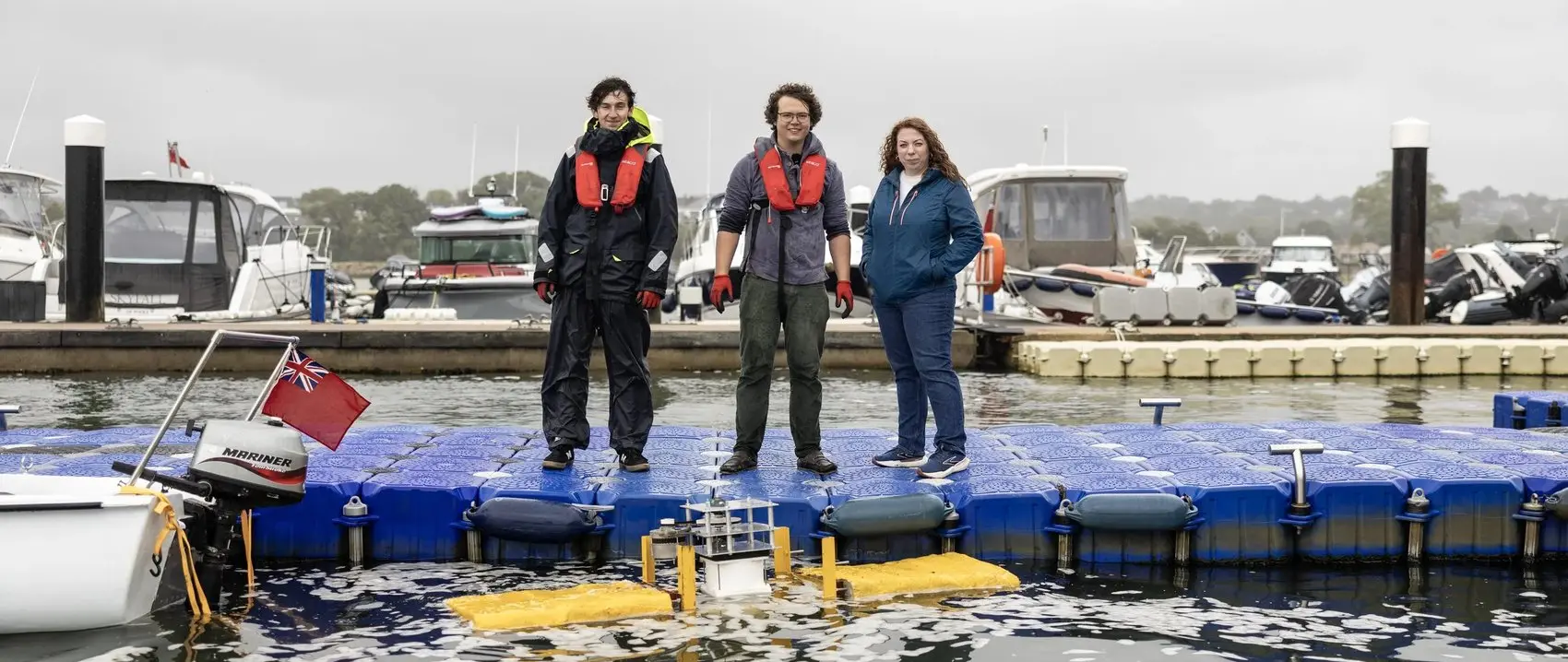
The accompanying first-party image from Fetch Energy's own website shows company personnel at a marina with a small wave-energy prototype during an earlier development trial. It is useful evidence of the company's work on floating harvesting technology, but it is not represented as a photograph of a fully commissioned commercial Mantis station operating in November 2026. Similarly, the company's Mantis web page presents specifications and use cases rather than independently certified energy yields at every possible marina. The September-to-November 2026 trade-show activity and the founder's published interview provide an appropriate basis for reporting the initiative. They do not justify inventing signed contracts, site approvals or installed units that the sources do not confirm. Clear provenance allows readers to assess the promise of the idea without mistaking a field demonstration for a completed infrastructure rollout.
What small-boat owners should watch
The meaningful development for ordinary boaters is the possibility of practical charging at smaller harbours where new grid infrastructure is difficult or expensive. A compact dayboat owner might benefit from a dependable shore charging point even without knowing which generator feeds it. Before relying on a new service, however, that owner needs to confirm connector compatibility, available charging power, price, operating hours and backup arrangements if the renewable system is unavailable. Marina managers should ask Fetch Energy for site-specific feasibility work, documented performance and a robust maintenance contract. The next important news will be independently measurable delivery from a properly authorised deployment, not simply a higher power figure in a brochure. Until that evidence is available, Mantis is a credible and technically interesting 2026 start-up concept aimed at solving a genuine small-marina infrastructure problem, with its practical value still to be established in real harbour service.
Primary reporting and image credit
Primary manufacturer and organiser source(s): https://yachtingventures.co/startup-spotlight-fetch-energy/; https://www.fetch.energy/mantis. © Fetch Energy / original company photographer. Genuine 2025 floating-platform prototype and its team at a marina; an archive trial photograph, not a verified commercial Mantis deployment in November 2026. Image is used only for correctly attributed factual editorial coverage and never represented as open-licence stock photography.