
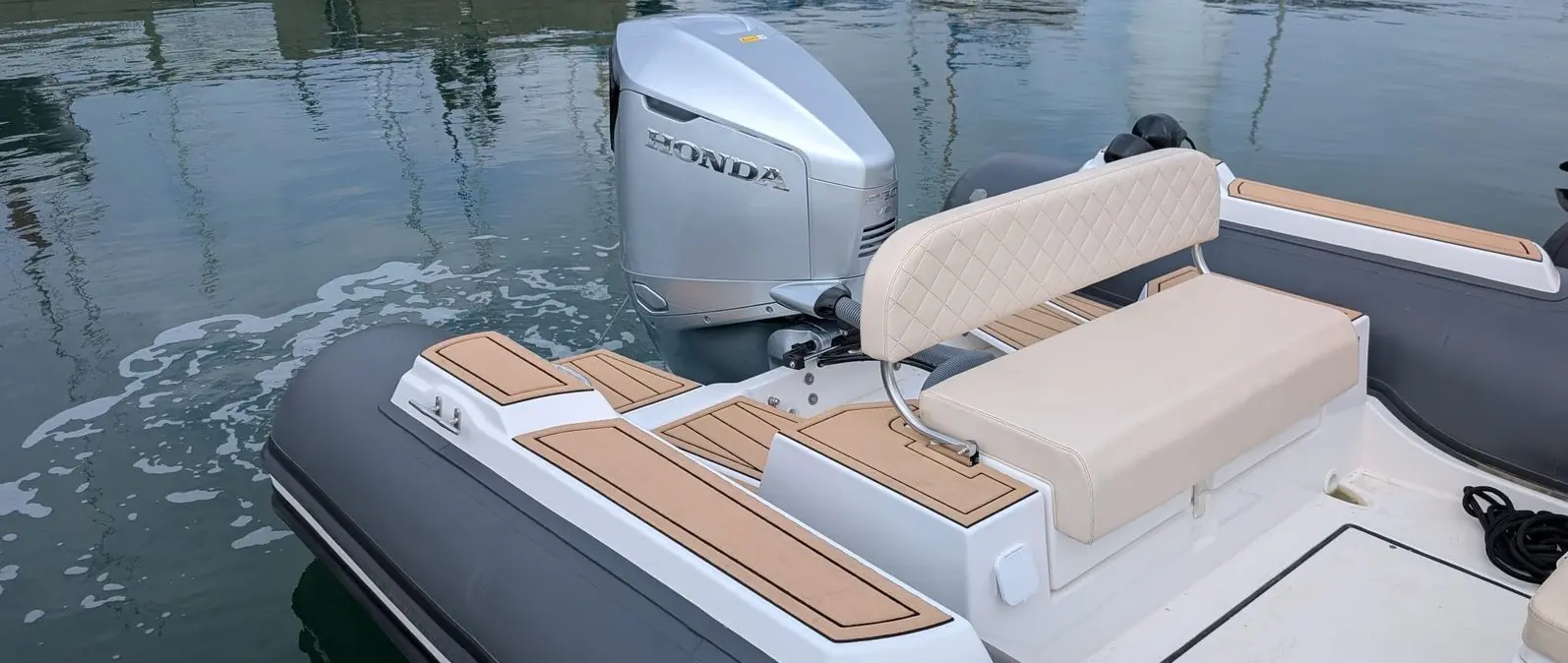
BlueNav and Tiger Marine France are using the Tiger Marine 750 Open Fishing as a practical platform for bringing electric manoeuvring and hybrid operation to a small rigid inflatable boat. Their original joint manufacturer announcement describes a Honda 250hp outboard combined with two BlueNav electric motors, each rated at 8kW. The partners target fishing operations, professional boat users and maritime tourism rather than a luxury yacht installation. The 750 model is a particularly relevant choice for Leisure Boat Guide because a boat of approximately 7.5 metres illustrates how auxiliary electric propulsion might fit into the operating patterns of small workboats and capable recreational RIBs. What the release establishes is the partnership, basic powertrain arrangement and intended benefits; it does not provide an independently verified fuel-consumption chart or a detailed real-world duty-cycle comparison.
A conventional outboard remains central to the package
The Honda 250hp engine is an important part of the published specification, not an inconvenient detail to overlook when describing the boat as hybrid. The combustion outboard remains available for passages, higher-speed operation and situations that exceed the electric system's capability. The two 8kW drives are intended to support low-speed or electrically assisted operation, where fine control and reduced noise may matter more than maximum speed. Nothing in the announcement demonstrates that the electric units can replace the 250hp engine at the RIB's normal planing cruise. Buyers should ask the manufacturer exactly which modes are possible, whether motors operate together or independently and what happens if a controller or battery becomes unavailable.
Why the Tiger Marine 750 was selected
Tiger Marine describes its 750 Open Fishing as a robust, stable platform suited to professional applications. A rigid inflatable has relatively accessible working deck space, while inflatable collars offer buoyancy and can soften contact in suitable conditions. Those qualities may help a fishing boat or maritime-tourism operator, but they are not substitutes for a formal stability assessment or documented carrying capacity. The announcement does not publish a complete weight-and-balance calculation for the hybrid demonstration craft. Installing batteries, two extra drives, displays and cabling changes a boat's loading, and users should seek an approved installation plan before assuming that a system demonstrated on one RIB can be fitted to every craft with a similar hull length.
The partnership has a commercial as well as technical dimension
The release says Tiger Marine France has become an official BlueNav distributor in France under a broader commercial agreement. That distinguishes the announcement from a single boat fitted for a temporary trade-show demonstration. Distribution arrangements can affect product availability, installation responsibility, warranty coordination and access to replacement parts, all of which matter to owners of small boats. A clear local service channel may make a complex hybrid package easier to support than a collection of independently sourced components. However, the precise dealer coverage, after-sales response times and contract terms are not published in the statement. Prospective buyers should confirm those directly rather than treating distributor status as a performance guarantee.
The Grand Pavois demonstration matters, with limits
The companies planned to present the Tiger Marine 750 Open Fishing x BlueNav at Grand Pavois 2026 in La Rochelle, including sea demonstrations and participation in a recreational-fishing innovation competition. That is a meaningful stage on which operators can see the layout and watch manoeuvring, but it is not the same as a published independent sea trial. Trade-show performance can be influenced by weather, crew, load and demonstration route. Without repeatable test data, an editor should not infer a stated number of nautical miles of electric range or a percentage of fuel saved. A proper commercial evaluation would specify the exact battery capacity, sea state, passenger load, engine mode and speed over which measurements were taken.
Virtual Anchor is an operating feature, not a ground tackle replacement
BlueNav lists its Virtual Anchor positioning function among the integration features for the hybrid package. In principle, dynamic positioning can use propulsion and GPS-derived information to keep a boat near a selected place without deploying a physical anchor. It may appeal to anglers who need to hold position over a mark, or to professional crews working near a station. It should not be confused with legal or physical anchoring, especially in poor weather, congested water or where equipment cannot maintain position reliably. A small boat owner needs clear instructions about loss of signal, power limitations and the operator's responsibility to remain at the helm when conditions demand it.
Manoeuvring with two electric drives
The advertised Smart Navigation features also include Smart Mooring, Docking 360° and control through the BlueNav application. Using two electric motors could make slow-speed movements more controllable when the installation and software permit suitable differential commands. The system nevertheless adds operating modes that crews must understand before leaving the pontoon. A change between electric and combustion propulsion should not surprise the helm, and the electronic display should communicate which units are enabled. Training is particularly important on shared or commercially operated boats, where different skippers may use the vessel in successive shifts. No app should become the sole source of situational awareness in a busy harbour.
Batteries determine practical electric usefulness
Two 8kW motors establish a nominal combined motor rating of 16kW, but that number does not reveal the energy available aboard. Battery capacity is measured in kilowatt-hours, whereas kilowatts describe power. For illustration only, a system drawing a constant 8kW from an ideal 16kWh battery would have about two hours of theoretical energy before considering losses and usable-capacity reserves. That is not a specification for this Tiger Marine boat; the actual battery and power demand have not been confirmed in the public release. Operators should ask for the installed energy capacity, charging arrangements, voltage, isolation equipment, expected continuous loads and a clear estimate of endurance for their own duty cycle.
Noise reduction may have value for fishing and tourism
Quiet low-speed movement is one of the easier advantages of electric propulsion to understand. It may help guides communicate with guests and can be attractive when approaching a wildlife-watching area or manoeuvring at a marina. The combustion engine would still contribute noise when operating, so the hybrid boat is not automatically a silent vessel in all situations. Equally, lower noise at the helm does not mean that wildlife disturbance is eliminated or that a site permits the boat to operate without restrictions. The claimed ability to access areas where combustion engines are restricted must be checked against the precise rules at the destination, including any restrictions on speed, hull type or commercial activity.
Electrical installation is a safety and maintenance issue
A hybrid RIB combines marine electrical equipment, saltwater exposure and the operating demands of a working deck. Batteries and their protection systems need ventilation or environmental controls appropriate to their chemistry, along with isolation, secure mounting, adequate cable protection and suitable electrical fault response. The exact engineering solution depends on the selected manufacturer components and certification requirements. An owner considering a similar conversion should not simply copy visible cable routes from photographs. Installation must allow service technicians to inspect connectors and shut down power safely, while protecting the basic buoyancy, drainage, fuel and steering systems of the original hull.
The true ownership calculation goes beyond fuel
Fuel use and engine hours may be reduced in suitable electric operating modes, but the commercial case depends on how the boat is actually used. A harbour patrol craft with long periods at low speed could have a different result from a leisure RIB making short, fast runs. The electric system introduces capital cost, battery replacement planning, software support and potentially new maintenance skills. Those costs need comparing with plausible savings in engine servicing and fuel, using reliable prices and duty cycles. The companies' announcement provides a product direction, not sufficient data to calculate payback. Small-boat businesses should demand a written calculation based on their own hours and operating zones rather than a general promotional percentage.
A possible retrofit does not mean a universal retrofit
A 7.5m working boat is small enough to interest many owners of existing RIBs, but compatibility is not automatic. Transom strength, access for batteries, displacement, control-wire routing and outboard mounting arrangements all affect whether an installation is safe and practical. The Tiger Marine programme demonstrates a collaboration built around a chosen hull, not a type approval covering every recreational RIB. Owners may also need to consider insurance notification, surveys and the effect of significant alterations on certification. The best question for an installer is therefore not simply whether the system can be bolted on, but whether the whole modified boat retains an appropriate operational margin.
What this means for the small-boat market
The partnership helps show that hybrid thinking is moving beyond larger motor yachts into relatively compact platforms used daily for fishing, guiding and local maritime services. Its strength is the combination of a familiar primary outboard with specialised low-speed electric assistance and navigation features. Its unanswered questions are equally relevant: total battery capacity, installed weight, demonstrated endurance, maintenance burden and full system costs. BlueNav and Tiger Marine have put forward a distinct product approach, with the official source photograph identifying the real 750 Open Fishing boat rather than an unrelated illustration. A careful buyer should use that information to begin a technically informed conversation, not as proof of a fully quantified efficiency advantage.
Explore related Leisure Boat Guide reporting
- BlueNav Control Opens Smart Navigation to Other Electric Drives
- ZeroJet Tiller-Steer Electric Jet Targets Compact Leisure Tenders
- Mercury and BlueNav Demonstrate Hybrid Highfield Patrol 700
- LiTime Argoseeker A1 Offers Wireless Electric Power for Dinghies
Primary reporting and image credit
Primary manufacturer and organiser source(s): https://bluenav.com/en/bluenav-and-tiger-marine-france-join-forces-to-accelerate-the-hybridization-of-professional-ribs/. © BlueNav / Tiger Marine France. Original company-issued Tiger Marine 750 Open Fishing photograph; model image, not a measured sea-trial result. Image is used only for correctly attributed factual editorial coverage and never represented as open-licence stock photography.