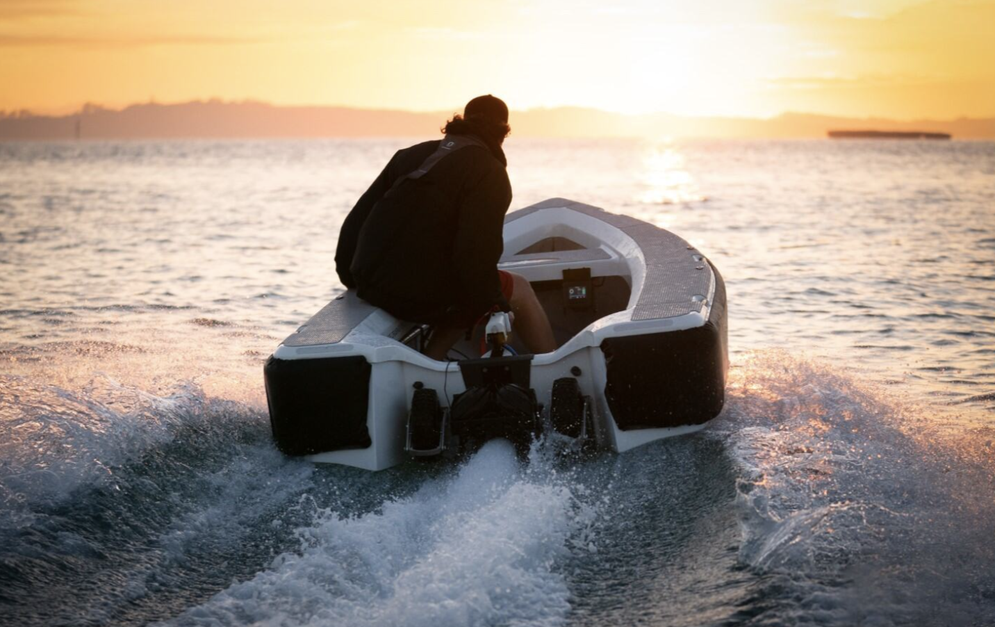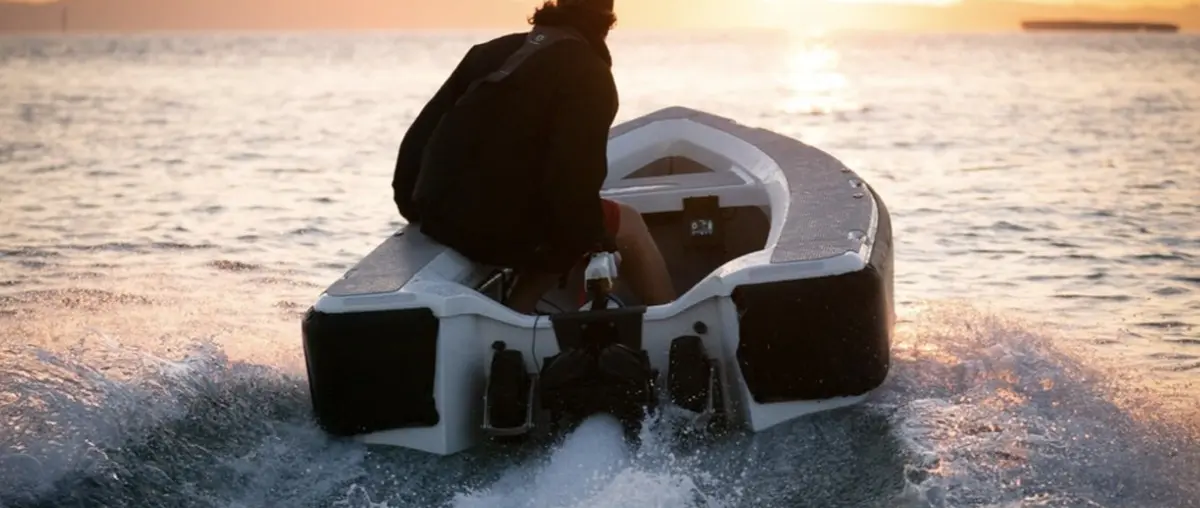
ZeroJet's tiller-steered 18-kilowatt electric jet propulsion system is part of the supplier's current METSTRADE 2026 offering for tenders, RIBs and other light recreational craft. Its official equipment listing describes a package marketed as equivalent to approximately 20 horsepower, paired with five-kilowatt-hour battery capacity and a tiller interface rather than a conventional wheel and console. The model's catalogue entry dates to January 2023, so this is a current product-and-application assessment, not a claim that the system was first launched in November 2026. The continuing trade-show presence highlights how electric jet propulsion can fit different small-boat designs while raising important questions about installation, endurance and safe handling.
The difference between jet propulsion and a standard outboard
A conventional outboard normally generates thrust with a propeller turning behind the boat. A waterjet instead draws water through an intake and accelerates it through a discharge nozzle. The arrangement can change how the propulsion hardware is packaged and how a boat manoeuvres, particularly when reverse thrust is directed through a bucket or another control arrangement. ZeroJet offers an electric system built around this principle for suitable compact craft. It should not be described as having no moving components or as being harmless to swimmers: intake suction, moving mechanisms and high-energy water flow require their own safety precautions. The manufacturer's installation and operating instructions remain essential.
An 18-kilowatt rating requires interpretation
ZeroJet names the system as an 18-kilowatt electric jet and markets it as a 20-horsepower-equivalent package. That equivalence is the supplier's comparative positioning rather than a precise statement that an electric jet produces the same mechanical shaft output as a named petrol engine. Hull shape, jet-pump efficiency, vessel displacement, battery state and water conditions all influence measured performance. A light RIB that reaches useful speeds with the system may behave differently from a heavily laden tender. For buyers, the most informative figures are independent loaded speed and energy-use results for a boat close to the intended installation, including low-speed steering and the transition to faster operation.
Tiller steering makes sense on selected hulls
The product listed here is the tiller-steer variant, a distinction from the company's separately offered console-steered electric jet. A tiller arrangement can suit a simple open boat where the operator sits close to the transom and values direct handling rather than a full helm console. It may save interior space and simplify the cockpit, but ergonomics vary between boats. Operators must be able to reach the tiller safely without obstructing passengers or cargo. Seat height, steering travel and the presence of tube or rail fittings can change how practical the arrangement feels. A demonstrator should be assessed while carrying the actual number of people expected during ordinary trips.
Battery configuration is a significant feature
ZeroJet describes five-kilowatt-hour battery arrangements that may be configured in a single pack or split into more manageable units. The distinction matters because a large battery may be awkward to move into a dinghy, while smaller packs can simplify carrying and removal. Every configuration has different physical dimensions, connection requirements and handling limits, which need confirmation from the supplier. A modular arrangement may help operators swap charged packs, but the complete package should be checked for water protection, restraint and the prescribed connection order. The batteries are an essential part of the installation, not a generic accessory that can be replaced with any similar-looking marine power source.
Practical range depends on more than five kilowatt-hours
A nominal energy figure cannot be converted directly into a fixed number of nautical miles. At high propulsion demand, stored energy is consumed faster than during modest low-speed operation, and the energy available to the drive may be lower than the battery's theoretical nameplate capacity. Crew weight, currents, waves and repeated acceleration also matter. Owners should therefore request usable energy and consumption figures for representative speeds and loading. The return leg may be more demanding than the outbound one, so a reserve should be included in every passage plan. A sensible trial combines a typical harbour passage, a cruising leg and a loaded low-speed manoeuvre.
Jet propulsion has its own shallow-water limitations
An enclosed drive arrangement may appeal to boatbuilders seeking to minimise exposed underwater components, but a waterjet still needs clean water to enter its intake. Sand, weed, stones or debris can affect performance and damage components if the boat is operated outside appropriate conditions. A low profile should not be mistaken for unrestricted access to shallow water. The manufacturer should specify minimum depth, debris precautions and the correct response to a blocked intake. Skippers must also observe navigational depth, tides and the potential to run aground. There is no engine arrangement that removes the need for prudent coastal navigation.
Installation can be straightforward only when planned early
ZeroJet markets the system as relatively easy to integrate into a compatible tender, RIB or watercraft design. For a new-build project, the hull designer can accommodate the jet unit, intake, motor, battery modules and required structural support from the beginning. Retrofitting an existing hull may be more complex because a watertight intake and appropriate thrust structure must be created. Any cut into the bottom of a boat is a significant structural and sealing operation. Owners should not treat an electric jet as an ordinary clamp-on replacement for a petrol outboard. A qualified installer must verify hull compatibility, access, safe electrical layout and permitted weight distribution.
Handling around docks deserves a full test
Low-speed control is one of the most important qualities for a tender that spends considerable time entering marina berths or ferrying passengers. Jet-drive boats can feel different from propeller-driven craft when reversing or changing thrust at low speed. The exact characteristics depend on the design, controls and water flow. Buyers should insist on a demonstration that includes slow forward travel, reverse, turning in restricted space and securing the boat alongside. A system that performs impressively during a straight-line test is not automatically the easiest to handle in a crowded harbour. Training unfamiliar operators is particularly important if the family is moving from a conventional outboard.
Battery installation carries high-current responsibilities
An 18-kilowatt electric marine drive can draw significant electrical current, requiring carefully engineered connections and protective equipment. Correct cable sizing, isolation, fusing, battery-management systems and waterproofing are not optional. The battery may also need to be restrained against impact, vibration and boat movement. Owners should use manufacturer-approved equipment and installation procedures, with particular care around connection points that may be exposed to spray. A system's low local exhaust emissions are not proof that it presents no electrical or fire hazards. Qualified marine electrical work and verified commissioning should form part of every installation quote.
Electric operation changes the daily routine
With a compatible electric drive, an owner may spend less time handling petrol, checking fuel hoses or dealing with combustion-engine exhaust. That can be convenient for short tender journeys between a yacht and shore. However, the new routine includes monitoring battery condition, ensuring charging capacity is available and maintaining high-current electrical components and the jet system. Owners who use a tender repeatedly throughout the day should consider how often a pack must be recharged or exchanged. A boat stored away from shore power may require a dedicated onboard charging strategy. A simpler departure does not necessarily mean a simpler complete ownership programme.
Total weight should be evaluated on the actual hull
The electric motor and jet hardware are only part of the system's weight. Batteries, mounting structure, controls, cabling and protective housings all contribute, and their locations can affect trim and buoyancy. A tender that previously carried a small petrol outboard may have limited space for batteries without displacing useful storage. On an inflatable, the placement of heavy equipment can affect freeboard and handling. Designers must stay within permitted loads and stability assumptions. An owner should obtain a complete installed mass breakdown, not compare the bare electric motor against the entire weight of a petrol engine and its fuel system.
Maintenance has shifted, not disappeared
An electric jet avoids certain engine-oil, fuel-filter and exhaust-system tasks associated with petrol propulsion, yet the waterjet intake, impeller, bearings, seals and electrical hardware still require inspection. Marine growth and debris can affect performance over time. Saltwater exposure also makes connector maintenance and corrosion prevention important. Owners should request service intervals, cleaning instructions and expected replacement parts before committing to a system. Ask what troubleshooting can be completed locally and whether a failed component requires the entire drive to be shipped away. Maintenance planning is particularly relevant to tender owners who rely on the craft for frequent shore access.
The first-party picture shows a working tender
The manufacturer's METSTRADE product photograph depicts a small powered tender travelling on the water. It is a real boating image associated with ZeroJet's exhibitor material, not a computer-drawn speed diagram. The scene illustrates the type of small craft for which the system is promoted but does not prove any particular speed, range, battery capacity or certification. Those figures must come from the relevant technical documentation and tests. The underlying product listing has been publicly available for some years, so the present report addresses continued market relevance during the 2026 equipment exhibition rather than suggesting an unreported new propulsion breakthrough.
What owners should ask before specifying ZeroJet
The first questions concern hull compatibility, permissible loading, expected cruising speed and actual usable range. Next come battery configuration, safe installation, charging facilities and availability of a trained service provider. An owner should also ask whether the tiller variant is the right control format or whether a console option would make the boat safer and more convenient for the crew. A proper evaluation includes repeated slow-speed manoeuvres, a loaded cruising run and a realistic end-of-day charging plan. ZeroJet's electric jet is an interesting alternative for compact tenders, but a successful installation is the one that meets the boat's actual operational needs without sacrificing safety or serviceability.
Original industry sources and image credits
Reporting based on ZeroJet manufacturer-authored METSTRADE exhibitor product catalogue current at 2026 edition; source first published January 2023 and not misrepresented as a new launch..
Lead image: ZeroJet Tiller-Steer Electric Jet Targets Compact Leisure Tenders — genuine first-party manufacturer product or boating photograph. © ZeroJet. Original supplier image.