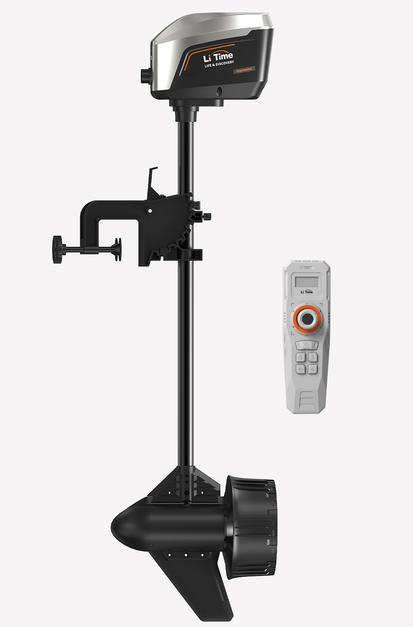
LiTime's Argoseeker A1 is among the small electric outboards presented in the METSTRADE 2026 marine equipment marketplace, bringing remote-controlled propulsion to kayaks, canoes, lightweight inflatables and other compatible small craft. The A1 is specified by the manufacturer as a 24-volt, 700-watt unit with up to 60 pounds of static thrust and a clamp-on mounting arrangement. LiTime launched the Argoseeker A1 and larger A2 series in August 2026, so this November report is an examination of their current trade-show presence rather than a claim that the products first appeared this month. The distinction matters as buyers compare compact electric systems for short trips, fishing and tender duties.
A small motor with a carefully defined job
The Argoseeker A1 targets craft that need controlled auxiliary power rather than the speed expected from a larger petrol outboard. LiTime describes applications including kayaks, canoes, small skiffs and selected boats in the approximately ten- to thirteen-foot range. Those are general application examples, not a substitute for assessing a particular hull's maximum engine rating, weight capacity and mounting arrangement. An open kayak has very different steering and stability characteristics from a rigid dinghy. Any manufacturer suggestion must be checked against the vessel's own documentation. Owners should start with their actual intended routes, average crew load and the normal wind and current conditions on their waters.
What 700 watts tells the buyer
The headline specification is a nominal 700-watt electric motor supplied from a 24-volt system. LiTime markets this as a two-horsepower-class solution, but that comparison is not a certified mechanical shaft-output equivalence for every operating point. Electric input power, thrust and actual propulsive efficiency are different measures. A buyer should not translate the figure into a guaranteed petrol-engine speed or a promise that the boat will plane. A well-matched small electric system may perform usefully at slow cruising speeds, especially on a light hull, while the same motor could feel inadequate on a heavier boat in wind or adverse current. Independent trials under realistic loading are more informative than a marketing equivalence.
The manufacturer claims up to 60 pounds of thrust
LiTime's trade catalogue gives the A1 a maximum static thrust rating of 60 pounds. Thrust figures are useful for comparing some low-speed propulsion applications, but they depend on test conditions and are not directly equivalent to the power rating of a petrol engine. The force available under way can vary with propeller speed, hull resistance and water conditions. For anglers using a compact craft, effective low-speed control may matter more than absolute top speed. A powered dinghy used to cross a tidal harbour, however, needs adequate reserve against wind and current. Users should evaluate the most demanding part of a proposed route rather than basing a purchase solely on the most flattering calm-water figure.
Remote control changes the operating position
One of the A1's more distinctive features is wireless control. The manufacturer's product listing describes remote operation rather than requiring an operator to sit immediately beside a conventional tiller. That can be attractive to paddlers or anglers whose seat position is farther forward than the transom. Yet remote control introduces responsibilities: the skipper needs to confirm steering direction, speed selection, stopping behaviour and what happens if the connection is lost. These functions should be demonstrated with the exact supplied controller and documented failsafe behaviour before the boat leaves sheltered water. A remote does not remove the need for a deliberate emergency-stop procedure or continuous attention to other traffic.
Clamp-on installation calls for accurate measurement
LiTime describes a quick clamp-on arrangement intended to simplify fitting to a suitable transom. On some small boats that may avoid permanent modifications, while on others the stern shape or structural capacity may make a clamp unsuitable. The motor must have adequate immersion without placing the propeller or lower unit at risk of striking shallow obstructions. Clamp opening, clamping force, transom thickness and location are all important. A light motor still develops propulsion loads and vibration, and a loose mount can be hazardous. Owners should follow the maker's mounting instructions and use approved retention arrangements where required. A trial lift on dry land should never be the only proof of secure attachment.
Portability is part of the proposition
The manufacturer's European marketing cites a motor weight of approximately 6.1 kilograms, a figure that should be read according to the exact components included. A battery, charger, remote and additional mounting equipment can contribute significantly to the total travelling package. Owners may appreciate an outboard that can be removed and carried separately from a kayak, but the installation also has to remain secure in service. Before ordering, ask for separate masses of the drive unit, mounting hardware and chosen battery system. Confirm whether one person can safely handle the components at a slippery ramp or floating dock. Convenience begins with transporting the actual complete installation, not the headline motor alone.
A 24-volt battery is a major purchasing decision
The A1 is intended to work with an appropriate 24-volt energy source, including compatible LiTime lithium iron phosphate batteries. A compatible battery is not automatically supplied with every motor offer, and the package contents must be verified for the particular retailer and region. Battery capacity, protection circuitry, enclosure, connectors and charger selection affect operating time, safety and cost. For an approximate energy comparison, a 24-volt 50-ampere-hour battery is often described as holding about 1.2 kilowatt-hours nominally, but usable energy may differ. That arithmetic does not establish how long the outboard will run in a real boat, because load and protective cutoffs are variable.
Electric range depends strongly on speed
Owners sometimes compare range estimates across electric products without noticing that one test uses low power and another uses near-maximum output. Running time generally increases as power demand falls, but a boat's progress against wind or current may not improve proportionately. A kayak moving calmly across a protected lake is a different use case from a tender carrying passengers and provisions. LiTime publishes its own performance examples, and those should be treated as manufacturer test results rather than guarantees under all conditions. A useful buyer's trial records the chosen battery's actual consumption over a representative journey, including starts, turns and a return leg against typical environmental resistance.
The A1 should not be confused with the larger A2
LiTime launched both Argoseeker models in August 2026. The A1 is the smaller 24-volt, 700-watt class outboard discussed here. The A2 is a separate, more powerful 48-volt, 2,000-watt product aimed at different loads and applications. The two model names can appear next to one another in marketing material, making it especially important not to transfer performance figures, battery requirements or pricing from one to the other. A motor and controller built for a 24-volt architecture cannot simply be assumed interchangeable with a 48-volt system. Buyers should check the nameplate, part number and ordering description before specifying a motor in a boatbuilding or refit project.
Electrical protection belongs in the plan
Although a 700-watt motor is relatively compact, its battery and cabling still need the protection appropriate to a marine environment. Water exposure, mechanical abrasion and poor connections can damage equipment or create hazards. The owner should use the manufacturer's specified cables, fuses or breakers, connectors, battery-management arrangements and charge procedures. Batteries should be restrained against movement, and contacts should be protected from salt deposits. An apparently simple clamp-on motor is not a reason to improvise an electrical supply from loose leads. Where the craft is used commercially or carries passengers for hire, additional requirements may apply that a consumer product listing does not address.
Steering and balance matter on a kayak
A kayak or narrow canoe can be sensitive to the weight and position of propulsion equipment. Moving several kilograms to the stern, particularly when combined with a battery, can change trim and handling. Remote steering may let the operator sit in a normal paddling position, but there must be a safe way to recover control if the remote is dropped, damaged or disconnected. Owners should also confirm that the motor does not obstruct paddles, rudder lines, fishing tackle or rescue access. In shallow water, the ability to raise the drive without losing balance can be important. A supervised test on calm water is an appropriate first step before operating in stronger conditions.
Consider the full cost instead of only the motor
The delivered price of an electric outboard system includes more than the drive head. A compatible battery, charger, cables, mount, possible transport bracket and local service support can alter the total substantially. A conventional small petrol outboard has different recurring costs for fuel, oil and servicing, while an electric unit introduces energy storage replacement and charging considerations. The most useful comparison is cost per typical season of actual use rather than a simple list-price comparison. Ask what is in the box, what the warranty covers and whether repairs require sending the drive to a distant service centre. Regional shipping, VAT and availability can change the quotation.
Trade-show listings are a starting point, not a test
The manufacturer's Argoseeker A1 appears in a current METSTRADE exhibitor-authored product catalogue, with the August 2026 release date clearly identified. The accompanying first-party product image shows the real motor and its remote in a studio presentation; it should not be interpreted as photographic evidence of a sea trial, speed or loading result. Some separate marketing graphics on the manufacturer's international websites contain synthetic or illustrative scenes, and these are deliberately not used to depict an operational test in this report. A buyer seeking evidence of suitability should ask the dealer for demonstrator access, electrical documentation and independently repeatable performance measurements.
Planning a responsible first trip
Before the first use, confirm the boat's weight and horsepower limits, proper motor mounting, battery restraint and the manufacturer's required stopping procedures. Practise turning, reversing and disengaging power near the launch point, then undertake a conservative route with sufficient energy reserve. Carry the communications and personal flotation equipment appropriate to the waterway. A small electric outboard should be treated as part of the boat's overall safety plan rather than as a substitute for it. For light recreational craft that travel predictable distances, the A1 offers a distinctive combination of wireless control and compact 24-volt propulsion. Its value will be determined by fit, endurance and reliability on the owner's own water.
Original industry sources and image credits
Reporting based on LiTime-authored METSTRADE 2026 exhibitor product page, states 24V, 700W, remote controls and up to 60lb thrust; manufacturer product photo, not a boat-action photo., Official LiTime August 2026 launch of A1 700W and A2 2000W, distinguishing them correctly from November trade-show listing..
Lead image: LiTime Argoseeker A1 Offers Wireless Electric Power for Dinghies — official manufacturer physical product photograph. © LiTime. Original supplier image.