
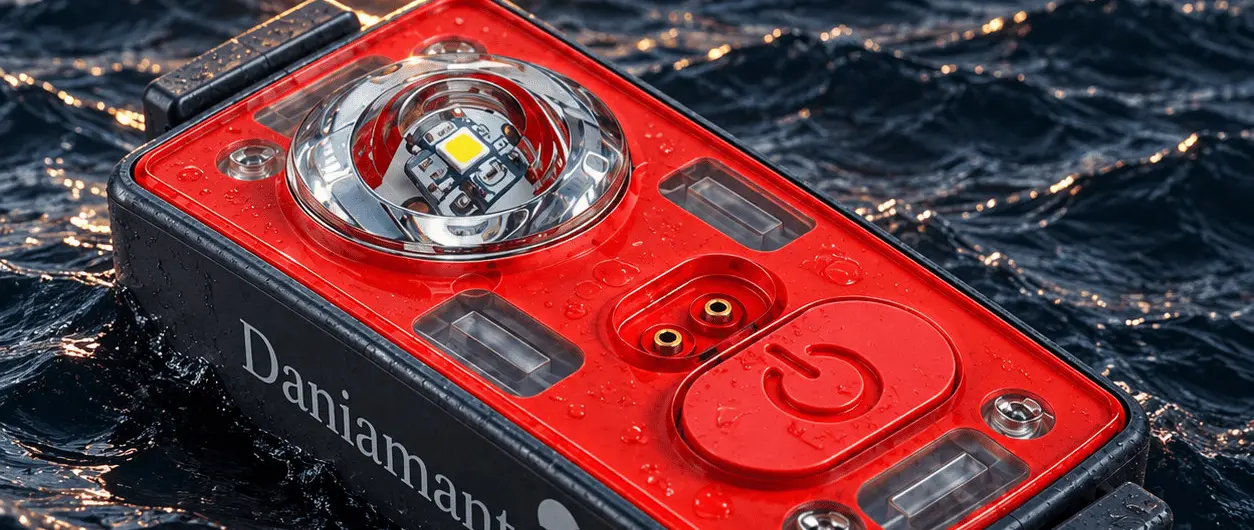
A safety product reaches the DAME shortlist
Daniamant has announced that its W4-VIR lifejacket light is among the nominees for the 2026 DAME Design Awards in the Personal Equipment category. The nomination, disclosed by the manufacturer on 26 October, draws attention to a piece of safety equipment intended to make a person in the water easier to locate after dark.
The W4-VIR is not a complete lifejacket or a replacement for an emergency beacon. It is an attached survivor-location light, combining a conventional visible flashing signal with an infrared output. The purpose is to improve the chances that rescuers can detect and identify someone whose position may otherwise be difficult to establish.
Visible and infrared signals work together
Traditional lifejacket lights are designed to attract attention by emitting a flashing light visible to the human eye. Daniamant's design adds an infrared beacon that can be seen through compatible night-vision equipment, offering rescuers an additional way to detect a casualty during darkness or reduced visibility.
This is a different approach from simply making the conventional light brighter. A person on another boat might notice the visible flashing LED, while a properly equipped search team could potentially use night-vision devices to pick up the infrared source. The extra channel depends on having the right viewing equipment.
Manufacturer cites longer night-vision detection
Daniamant states that the infrared element can make a survivor identifiable at distances of up to two to five kilometres when rescuers use appropriate night-vision equipment. The company contrasts that with a visible-light range of approximately 200 to 500 metres under its described conditions.
Those figures should be treated as the manufacturer's claimed capabilities, not fixed rescue distances guaranteed in every situation. Sea state, rain, spray, the casualty's orientation, equipment sensitivity and the height of the observing platform can all affect visibility. The product cannot eliminate the uncertainty inherent in a search at sea.
Automatic operation after immersion
The manufacturer says the W4-VIR activates automatically when immersed in water. Automatic activation matters because an unexpected fall overboard can leave little time to locate and operate a switch, particularly if the person is cold, injured or struggling to stay afloat.
Owners and professional crews still need to check the product's correct attachment position, maintenance schedule and compatibility with the lifejacket being used. An immersion-triggered light can only help if it is fitted securely, unobstructed and in serviceable condition. Regular inspection should remain part of the pre-departure safety routine.
Certification and regulatory considerations
Daniamant says the light complies with marine safety requirements including SOLAS and references MED/MER, USCG and EN 4862 standards in its product announcement. These claims are relevant to professional and recreational operators shopping within formal approval frameworks, though the exact certificate and version should be confirmed for the intended use.
Regulatory language deserves care because an approval for a particular accessory does not certify an entire lifejacket, vessel or personal safety arrangement. Buyers should request current documentation and ensure equipment is appropriate for their jurisdiction. A leisure owner should not assume that a device designed for a commercial application automatically satisfies every local rule.
Who might benefit from an infrared option
The dual-light concept is especially pertinent to operations where search-and-rescue teams may use night-vision equipment. Commercial crews, offshore sailors and frequent night passages can face situations where locating a person quickly is difficult, even when others know broadly where the incident occurred.
For smaller leisure boats, the usefulness of infrared depends on the likely rescuers and their equipment. It may offer an extra detection route, but many nearby recreational vessels will rely on ordinary eyesight and conventional searchlights. The visible beacon therefore remains a vital part of the arrangement rather than a secondary afterthought.
The awards decision is still ahead
The DAME Design Awards are linked with the Metstrade marine-equipment exhibition in Amsterdam. Daniamant says the winners will be named during the official opening on 17 November 2026. A nomination recognises that a product has reached the judging shortlist; it should not be reported as an award win.
The Personal Equipment category puts the W4-VIR in a field where fit, clarity of operation, durability and real-world usefulness can matter more than visual novelty. An external design jury may assess such factors, but boat owners should continue to evaluate the product on the published standards, performance evidence and suitability for their needs.
The wider lesson for lifejacket safety
The nomination is a useful prompt to look beyond the buoyancy rating when reviewing personal safety equipment. A lifejacket must support a person in the water, but a successful rescue also requires that person to be noticed, reached and recovered. Lighting and locating aids address one part of that broader chain.
Operators should assess lights alongside whistles, reflective material, distress communication, personal locator beacons where appropriate and practised recovery procedures. Daniamant's W4-VIR offers one more technical option for nighttime visibility; its practical value will depend on correct use and the wider rescue system around it.