
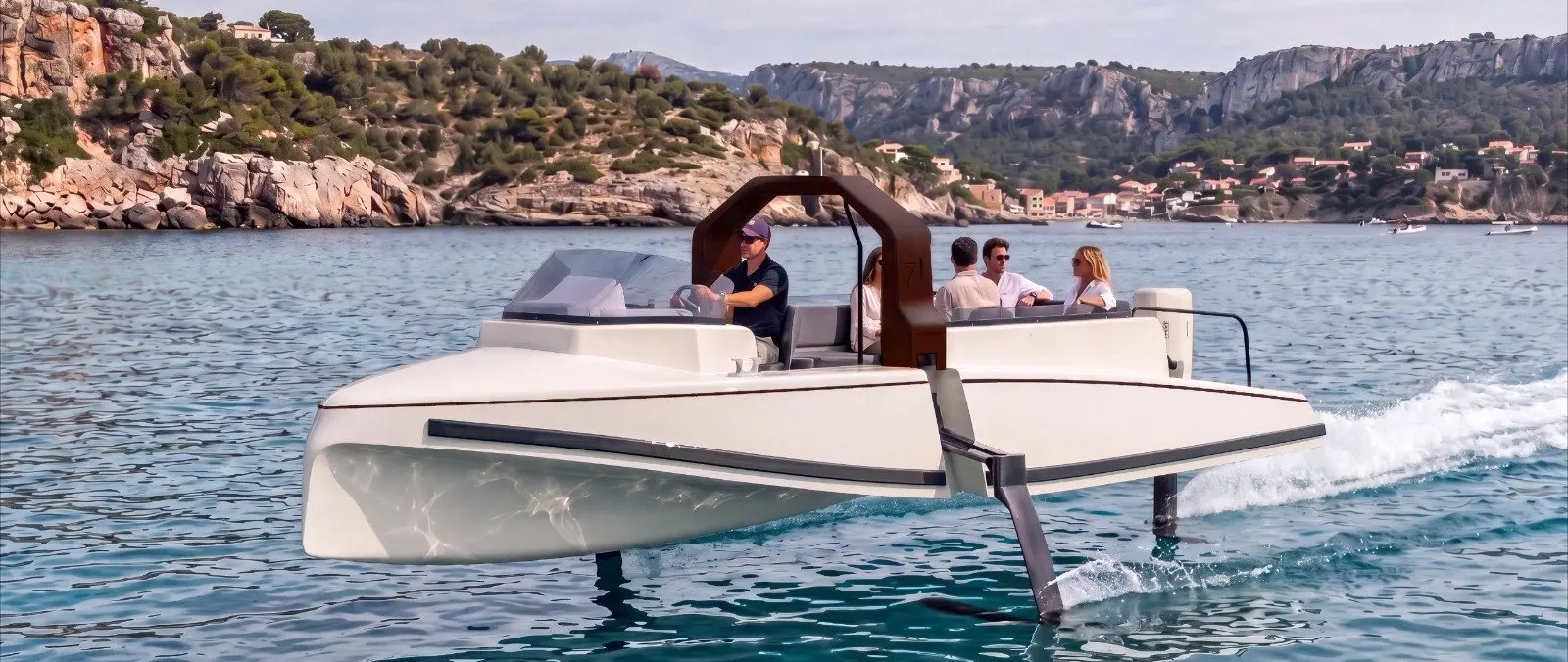
Italian design project Zefiro appeared in the METSTRADE 2026 foiling programme with an electric passenger-boat concept built around retractable hydrofoils, a low-draught hull and a platform intended for short transfers. PressMare reported on 18 November that the design was developed by Adidesign with specialists in naval architecture and engineering, presenting a vessel intended to carry eight passengers and a skipper. The project website describes a hull approximately 9.7 metres long and a target cruising speed of 20 knots when foiling, with the foils folding into the hull for low-speed operation. These are proposed design figures, not independently verified sea-trial results. Crucially, Zefiro states that the first hull has not yet been built and that it is seeking an industrial partner. The story is therefore about an ambitious engineering concept, not a production boat ready for delivery.
A small vessel intended for several roles
Zefiro's design team sees possible uses for a compact, electrically propelled passenger craft as a private tender, a resort shuttle or a short-distance water taxi. Each application has different operating requirements. A yacht tender may need to fit a garage and approach a larger vessel safely, while a resort shuttle may carry passengers along repeated routes with limited charging time between trips. A small urban ferry may face regulatory and accessibility obligations not shared by a privately operated boat. Designing one hull to serve several roles is attractive in principle, but the final practicality depends on certification, interior layout and the demands of each operating environment.
What retractable hydrofoils are intended to achieve
A hydrofoil generates lift as water flows over its surfaces, allowing a hull to rise partly or substantially above the water. Reducing contact between hull and water can reduce drag at suitable speeds. The Zefiro concept incorporates foils designed to fold completely within the hull profile while the boat is moving slowly or at rest. This may make berthing and shallow-water handling easier than with permanently protruding foils. The advantage is especially relevant to under-12-metre craft whose owners use ordinary marinas and slipways. However, any reduction in draught must be measured on an actual completed vessel before being treated as a proven operating benefit.
A two-mode operating strategy
The concept operates in displacement mode at lower speeds and is intended to transition to foil-borne running around twelve knots, according to the project information. It lists a planned 20-knot cruise and a higher maximum speed of 28 knots. These numbers explain the design team's intended operating envelope but do not establish guaranteed performance with full passengers, adverse sea conditions or ageing batteries. Foiling efficiency is influenced by hull loading, sea state, control systems and propulsion demands. A prototype will need to show how reliably the transition occurs and whether passengers remain comfortable during acceleration, deceleration and manoeuvring.
The mechanism sits below the deck
PressMare describes a retractable-foil system using an articulated pantograph arrangement rather than sliding components. The design aims to change foil position while keeping its mechanism within the hull. The team also proposes adjustment of foil incidence through movement of the supporting frame. Such an arrangement may offer benefits in reducing protrusions, but moving parts operating in seawater require careful protection and inspection. Seals, bearings, actuators and access points may all influence maintenance. The claimed ability to service elements while afloat needs practical verification on a completed boat. A technical drawing or animation is a useful starting point, not a service manual.
Draft matters most near shore
Shallow-water handling is an ordinary concern for small-boat owners. A boat may cruise comfortably in open water but still need to approach a marina, beach or floating dock with limited depth. Protruding appendages can complicate those tasks and may be vulnerable when the vessel is lifted or stored. Zefiro's folding foil concept is intended to address that problem. However, the project website's promotional statements about entering almost any marina should not be interpreted literally. Actual clearance depends on the hull, propulsion arrangement, tide, bottom conditions and local restrictions. Safe approach calculations will require certified dimensions for the completed craft.
Electric propulsion shapes the design
The designers have proposed an electric drive system with a total continuous power figure around 60 kilowatts. Electric motors can offer quiet operation and control suited to low-speed manoeuvring, but battery design is fundamental to the system's real capabilities. An electric motor's rated power does not translate directly into a universal speed or range. The hull's drag, propulsion efficiency, battery capacity and speed profile must all be considered. The project has not published a completed independent energy-consumption trial. It would be premature to compare operating costs with conventional boats without verified data from representative routes.
The claimed seventy-nautical-mile range
Zefiro's website refers to a planned range of approximately seventy nautical miles, and PressMare describes a figure greater than seventy nautical miles in the concept's feasibility study. Such estimates are useful indicators of the design team's objectives. They should not be treated as proven passage distances. The achieved range may change substantially with speed, load, wind, waves and repeated stops. A shuttle making frequent short journeys may spend more energy accelerating than a boat cruising continuously at an efficient speed. Owners will also need to account for a reserve and charging arrangements rather than planning to use every advertised unit of battery capacity.
A nine-seat concept below twelve metres
The project lists eight passenger seats plus one operator, fitting a people-moving role within an approximately 9.7-metre hull. That places it inside Leisure Boat Guide's under-12-metre editorial scope. The number of people carried will ultimately depend on approved capacity, layout and relevant commercial or private-use regulations. A proposed nine-person arrangement should not be confused with certification for all routes and conditions. Stability, emergency exits, life-saving equipment and passenger mobility are among the issues designers will have to address. It is too early to infer how much usable deck space will remain once production equipment and seating are installed.
Carbon construction and its trade-offs
Zefiro describes an all-carbon design, a material approach that may help control weight and structural stiffness. Lightweight construction can be important for hydrofoiling because unnecessary mass increases the lift and energy required. However, composite engineering involves more than selecting a material. Laminate design, load paths around the foils, repair methods and resistance to impact all require careful assessment. Carbon fibre also presents questions about manufacturing energy and end-of-life handling. A vessel advertised as zero emissions at the point of operation should not automatically be described as having zero environmental impact throughout its lifecycle.
Stability and control are central questions
The project team reports using computational fluid dynamics and other engineering methods to develop hull and foil geometry. These tools can help designers understand likely flow behaviour before building prototypes. They do not substitute for testing under actual waves, wind and load changes. A foil-borne vessel relies on control of attitude and lift to maintain a comfortable ride. Sensors, actuators and software may be important, but the precise production architecture has not been established in the available information. Before a private owner or commercial operator can rely on the craft, the handling and safety response to failures will need to be demonstrated.
A shuttle has different duties from a private tender
Short island transfers may call for frequent docking, predictable charging and robust access for different kinds of passengers. A yacht tender may be more concerned with storage dimensions, appearance and launch-and-recovery equipment. A water taxi may operate under local licensing requirements and have stricter passenger-service obligations. Zefiro proposes a common technological platform that could support different layouts. That is a product-development strategy rather than proof of readiness for each market. The designer and any future manufacturing partner would need to demonstrate compliance for the particular service.
Why a fold-in mechanism appeals to yacht operators
A private yacht's garage imposes constraints on beam, height and appendages, and the tender must be recovered safely in changing conditions. A hydrofoil that protrudes permanently could create additional storage complexity. Retractable foils may reduce that problem if the mechanism works reliably and the hull fits the available envelope. The company's published 9.7-metre length is far too large for many ordinary yacht tender garages, however, and the project should not be portrayed as suitable for every yacht. A future owner would need to verify launch systems and storage dimensions. The design may be more appropriate to selected large yachts or shoreside operations.
The METSTRADE presentation was a development milestone
METSTRADE took place in Amsterdam from 17 to 19 November 2026. PressMare's 18 November report described Zefiro within the exhibition's foiling area. This brought the engineering concept to an audience of marine suppliers and industry professionals. It was a presentation milestone, not the formal commissioning of a hull. Visitors could evaluate the design arguments and discuss potential manufacturing, while independent performance data remained unavailable. The event matters because it placed the project among companies exploring new propulsion and hull technologies, but exhibition visibility cannot guarantee investment or production success.
The team is seeking an industrial partner
The company's official website explicitly says the design work is advanced but the first hull does not exist, and that it seeks manufacturing, licensing or investment support. This is a crucial disclosure. Many concept presentations include convincing illustrations and technical targets, which can make a project appear closer to the water than it really is. Zefiro's own statement helps readers distinguish completed engineering phases from the next step of building a functioning prototype. A sensible purchaser should not place the same expectations on a concept as on a boat with a type certificate, warranty, delivered examples and a service network.
Environmental promises need real-world measurement
The proposed electric propulsion is intended to avoid onboard combustion emissions during use. Hydrofoiling may reduce energy demand when the lift system performs efficiently. Yet construction materials, electricity supply, batteries and maintenance all contribute to environmental effects. The website's claims about low wake and protected-area access cannot override local regulations. Some waterways restrict high-speed operation regardless of propulsion type. A future operator would need to examine certification, permissions and independently measured wake characteristics before assuming the vessel can use a particular route. Sustainability should be evaluated through evidence instead of slogans.
What under-twelve-metre owners can learn
Even if Zefiro never reaches production, the design illustrates technical questions that matter to small craft: how to reduce drag, how to manage shallow-water appendages and how to combine propulsion with practical berthing. These issues are relevant beyond specialised hydrofoils. Owners choosing a conventional boat may benefit from understanding that speed, range and draught are interconnected. Promised improvements always come with engineering and operational compromises. A complex moving foil may offer advantages while also adding maintenance and control demands. Independent trials will be needed to establish whether the overall balance is attractive.
The concept's status in November 2026
On 22 November, Zefiro is a proposed 9.7-metre electric foil-borne passenger craft with a retractable mechanism, stated nine-person layout and ambitious speed and range targets. Its design was presented at METSTRADE, and PressMare reported technical details from the team. There is no completed first hull or verified independent sea trial in the cited material. For Leisure Boat Guide readers, the story is about the search for a practical electric small-boat platform that can combine efficient travel with ordinary berthing. Its ultimate value will depend on what a prototype can demonstrate when engineering ambition meets real water.
Sources: PressMare, original 18 November 2026 technical report, *Zefiro debuts at Metstrade with an electric boat with retractable foils*; Zefiro project team's official design and status information at flyzefiro.com. Lead image: Zefiro official first-party concept rendering, credited to the designer. Original fact-checking and small-boat analysis by Leisure Boat Guide.