
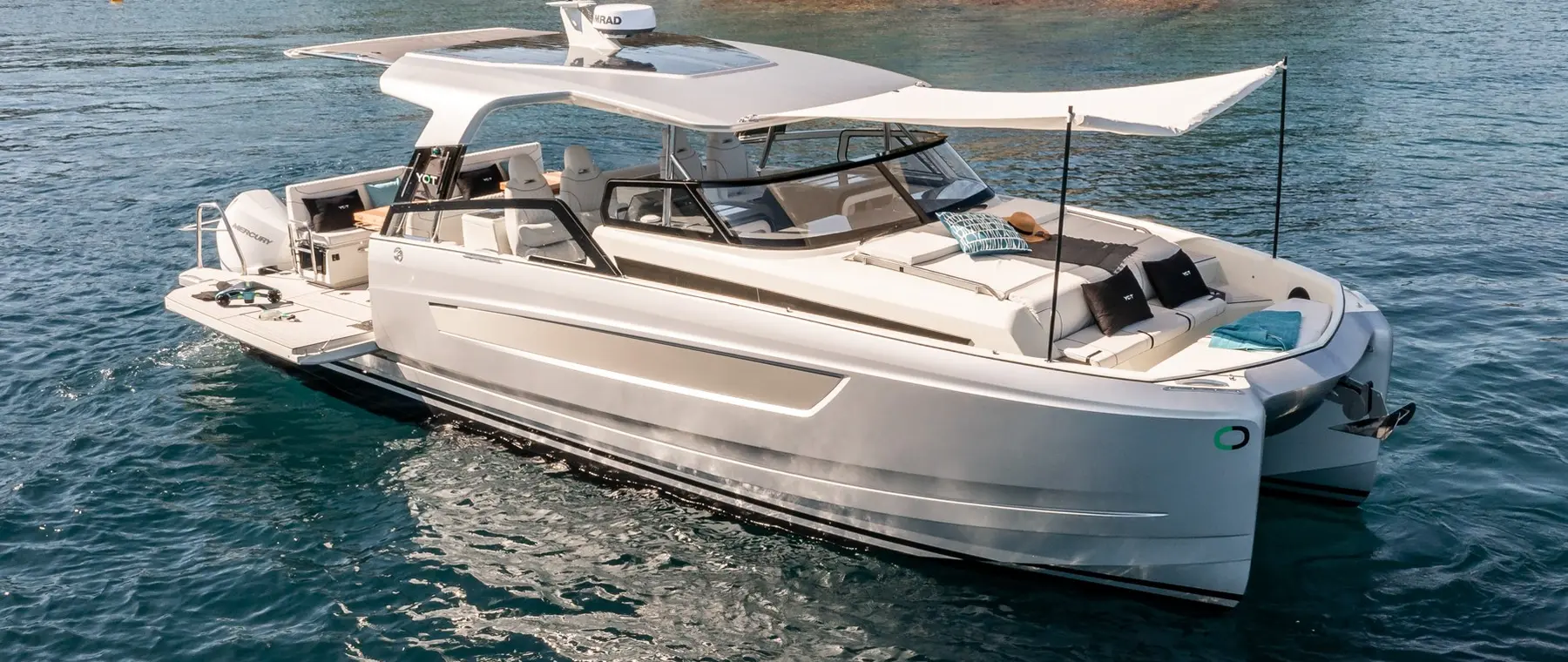
A power catamaran within the dayboat market
Barcelona International Boat Show’s 2026 catalogue lists the YOT 36 at 10.92 metres, placing a twin-hull powerboat among the many conventional motorboats expected at Port Vell from 14 to 18 October. Developed around a broad deck and flexible outdoor living, the boat offers an alternative way of distributing space inside a compact overall length.
A power catamaran may feel exceptionally wide for its length, particularly when boarding from a narrow pontoon. That is appealing at anchor but important to consider when booking a marina berth. Prospective owners should compare actual beam, berth fees and available service facilities rather than assume that shorter length always means less expensive operation.
Fold-down sides expand the deck
The YOT 36’s two fold-down platforms increase the space available for sunbathing and water access while stationary. The builder promotes the idea of a terrace spanning much of the boat’s width, making the social experience a central part of the design. In the cockpit, furniture can be rearranged for lounging or dining in different group sizes.
A demonstration should include folding the platforms back into their secured travelling positions. Buyers should ask about loads, locking systems, drainage and the impact on people moving along the side decks. How the layout manages shade and stores loose tables and cushions will determine whether the flexibility is genuinely useful each weekend.
A driving station designed for company
Rather than isolating the helmsman at a small console, the YOT 36 places four forward-facing seats near the driving position. This encourages a group to share the trip, but still requires everyone to remain appropriately seated and protected as conditions change. The builder identifies CE classification B10 on its published material, with exact certification details to be confirmed for each hull.
Power-catamaran handling may differ from a single-hull sports cruiser when crossing waves or approaching a dock. An owner unfamiliar with twin hulls should request proper familiarisation, including turning characteristics and manoeuvring in crosswinds. Published power and speed figures need comparison using realistic fuel and passenger loading.
A different set of compromises
The design is best understood as a social coastal craft rather than simply a smaller version of a much larger cruising catamaran. It prioritises a sizeable outdoor area, multiple seating arrangements and easy water access. Those strengths may matter more than long-range onboard accommodation to a family that mainly returns to its home marina after a day afloat.
The October exhibit provides an opportunity to compare hull access, equipment specification and maintenance arrangements with other boats just under twelve metres. An inviting layout is a good starting point, but purchase decisions should include a trial in open water and a close inspection of the electrical and propulsion systems. The use of two hulls also makes it worthwhile to ask how bilge systems, engine-room access and emergency equipment are arranged on each side of the boat. A simple explanation of these systems during a handover can save confusion during a demanding moment afloat.