
Why the standing format still matters
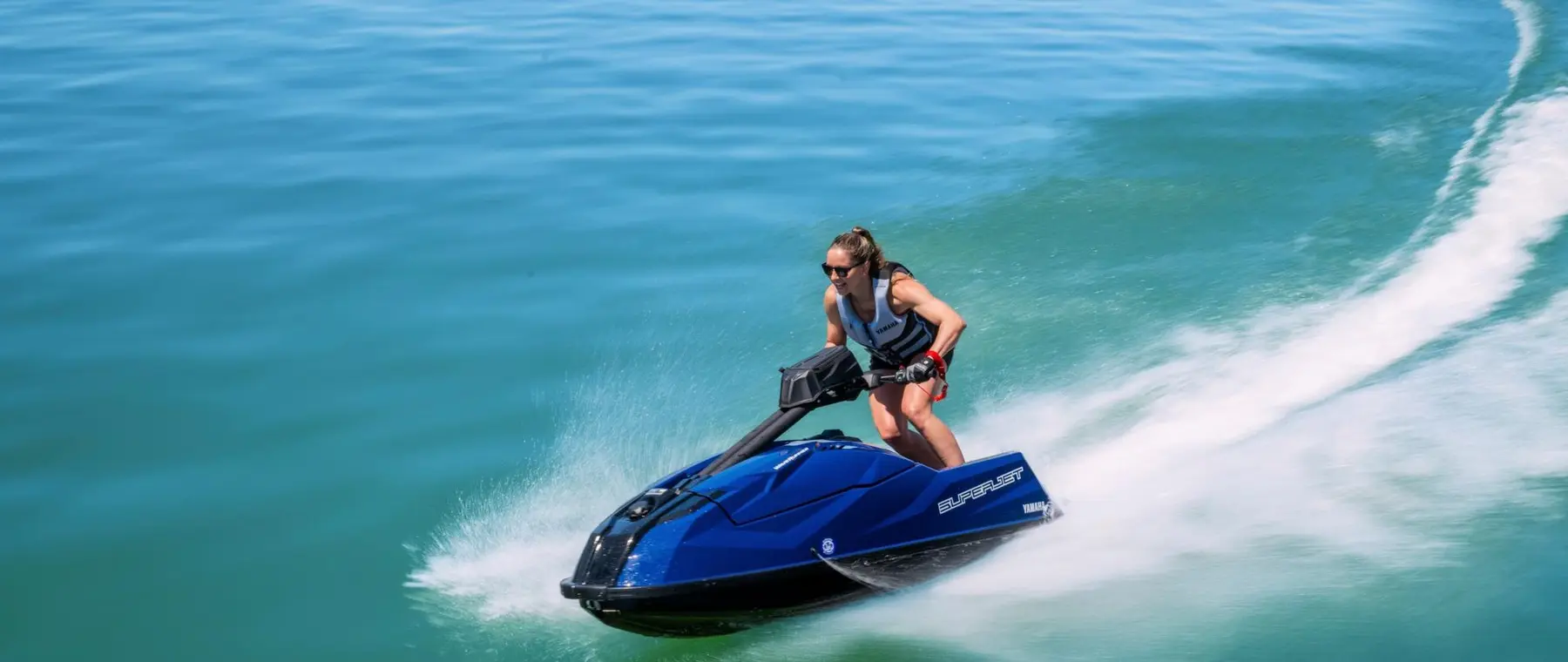
The stand-up personal watercraft represents a very different experience from the three-person touring models that dominate many showroom displays. Yamaha’s 2027 SuperJet is designed for a rider who stands in a tray, actively balances the hull and uses body position as part of the steering process. It asks more of the operator than sitting behind a broad cruiser seat, but that direct relationship between rider and machine is precisely why it retains a following.
Yamaha has kept the SuperJet in its 2027 sport offering alongside the new WaveBlaster. That makes the distinction between the two especially important: the WaveBlaster is a seated single-person machine with lean-in handling, while the SuperJet uses a traditional stand-up stance and handlepole. They are separate riding disciplines, and experience on one should not be assumed to transfer automatically to the other.
The manufacturer describes a three-cylinder, four-stroke TR-1 engine with 1,049 cc displacement and a 144 mm high-pressure jet pump. The published European specification also gives a 19-litre fuel tank. Those numbers should be interpreted in the context of an agile sporting craft, not as an invitation to compare range or carrying ability with family-oriented PWCs that have much larger tanks and several seats.
Learning the craft is part of ownership
An owner choosing a stand-up SuperJet needs to be comfortable with regular immersion, climbing back aboard and the physical demands of balancing at low and changing speeds. The adjustable handlepole is integral to the rider interface, and Yamaha highlights the compact form and responsive steering that define this class. Even experienced boat operators may benefit from specific tuition before attempting more demanding manoeuvres.
The equipment list should be read with the intended training area in mind. A useful first session involves controlled straight-line runs, predictable turns, safe stopping and repeated reboarding away from obstructions. Riders should also know how the engine-stop lanyard works and what steps to take if they become separated from the craft. Personal flotation equipment and appropriate protective clothing are essential considerations.
The SuperJet is not designed to transport family members or to carry the same supplies as a large touring model. That limitation has benefits for people who explicitly want an uncluttered sporting machine, but it makes the craft unsuitable as a sole vessel for group outings. Owners should also examine the local rules governing the use of stand-up PWCs, since access arrangements and operating areas differ by jurisdiction.
A specialist offering for 2027
The presence of the SuperJet in the current range is noteworthy because the wider personal-watercraft market increasingly emphasises multifunctional features, entertainment screens and extensive storage. Yamaha is maintaining a product focused on rider involvement. The value here is the process of improving technique over time, learning to control balance and body movement, and using an appropriate area where that form of riding is permitted.
Potential buyers should check how the SuperJet will be launched, transported and stored. Its smaller footprint does not remove the need for a suitable trailer or secure storage, and a low-capacity fuel tank changes the planning of sessions. An experienced dealer can demonstrate correct maintenance, freshwater flushing after saltwater use and checks of the steering and propulsion systems. It is also sensible to identify a launch area with room for recovery and a companion ashore who knows the rider’s intended route and return time.
For a customer who wants passenger capacity, long-distance range or protected storage, Yamaha offers other machines. For a rider who deliberately wants the challenge of a stand-up personal watercraft, the 2027 SuperJet continues to offer a distinct format. Its success should be assessed by the quality of the ride and the suitability of local water, not by how many conveniences can be fitted to the deck.
Models, equipment and availability vary by market. Readers should confirm their local configuration, safety requirements and delivery dates with an authorised Yamaha dealer. The specification reference is Yamaha Motor’s official model page. Photograph courtesy of Yamaha Motor Europe.