
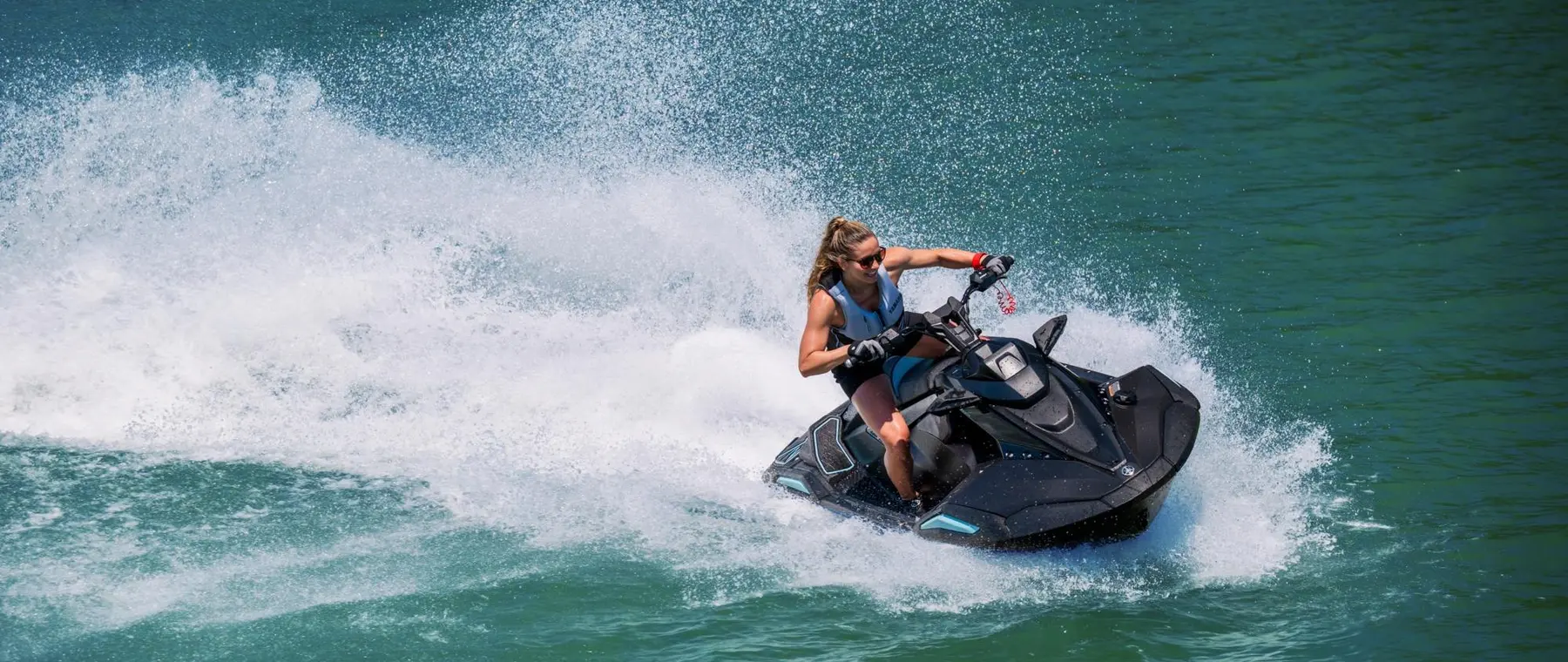
A playful member of the 2027 WaveRunner family
Yamaha’s JetBlaster PRO occupies the energetic, freestyle-focused portion of the company’s 2027 WaveRunner range. It is intended for owners who want an agile personal watercraft for active turns, short bursts of acceleration and a riding experience where body movement matters. This is different from a touring model designed to spend hours following a long coastal route with supplies and passengers.
The PRO designation signals an emphasis on equipment that supports that lively character. Yamaha’s current European model page highlights responsive handling and an attitude built around using wakes and open stretches of water as opportunities to improve riding technique. Such language is promotional, but the underlying positioning is clear: the JetBlaster is designed to make a relatively small machine entertaining through repeated manoeuvres.
A sporty approach should not be confused with permission to ride aggressively wherever a convenient wave appears. The most enjoyable sessions take place in areas where speed and manoeuvres are allowed, visibility is good and there is room to remain clear of swimmers and other craft. Owners should build skill progressively and respect conditions as carefully as riders of larger, faster machines.
The TR-1 High Output engine supports short-session fun
The 2027 European JetBlaster PRO continues with Yamaha’s three-cylinder TR-1 High Output marine-engine family. The approximately 1,049cc design provides a different character from the large 1.8-litre supercharged GP and the naturally aspirated 1.9-litre engines found elsewhere in the range. The practical attraction is a lively power-to-weight balance in a comparatively compact craft.
Yamaha’s 2027 range materials identify the PRO as an upper-level freestyle choice, with details such as a colour display and rider controls. Precise model equipment can differ between the two- and three-person variants offered in different markets. A buyer should therefore use the full product designation and ask a dealer to confirm seat capacity rather than assume every photograph or brochure describes the same configuration.
An enthusiastic riding style also raises the importance of maintenance. The jet pump and intake should be inspected according to the manufacturer’s instructions, and debris-prone shallow water should be avoided. Riders must not attempt to clear a blockage while the engine is operating. A controlled session that ends with a clean and serviceable machine is more valuable than a spectacular manoeuvre followed by preventable damage.
Rider aids make the machine practical as well as lively
Yamaha includes its RiDE dual-throttle control concept in the more highly specified JetBlaster models, giving the operator a way to manage forward and reverse thrust from the handlebars. That can help during low-speed manoeuvres and recovery to a landing area, but it should be learned through practice in clear water. The system is a control aid, not an automatic collision-avoidance feature.
The company also highlights a 4.3-inch multifunction display in the PRO specification, offering essential riding information in a compact format. Such equipment suits a machine whose owner is likely to concentrate on handling rather than on long-distance navigation. Depending on regional version, the exact controls and functions may vary, so the individual market brochure should be checked before ordering.
Freestyle-oriented features still need to fit the rider. Handlebar position, foot placement, seat arrangement and reboarding ability become especially important when the craft is being used for repeated turns and acceleration. An in-person inspection can reveal whether a rider feels comfortably connected to the machine, something that cannot be determined from an engine figure or glossy action photograph.
Compact ownership does not mean careless operation
The JetBlaster PRO appeals partly because a smaller machine can be easier to launch, store and transport than a much larger touring PWC. That benefit depends on the complete package, including trailer, lifting arrangements, fuel and safe access to the water. A craft may be relatively compact but still require adequate space and proper securing procedures when being moved on the road.
Every outing should start with a sensible check of the hull, steering, cut-off mechanism, flotation equipment and expected conditions. When the aim is to practise active turns, choose water with a suitable depth and clear space, and avoid creating hazardous wakes near moored vessels. The most experienced rider in the group should not set a pace that others feel compelled to match.
Passengers change how a small PWC behaves, and manufacturers publish different capacity ratings by variant. A two-person craft should not be loaded like a three-person recreation model, and any additional gear should be carried only within the specified limits. Planning an activity day within those limits improves both safety and the enjoyment that the machine is intended to deliver.
Freestyle has a specific place in Yamaha’s lineup
Yamaha’s broader 2027 range now encompasses the single-rider WaveBlaster, larger VX and FX machines, the high-performance GP series and the unusually spacious CrossWave. The JetBlaster PRO fits between those extremes: small enough to emphasise playfulness, but equipped with practical controls and a capable engine. Its appeal is strongest for a rider who wants repeated short sessions rather than a full day of passenger touring.
The purchasing decision should reflect the actual use planned. For a family with several passengers, capacity and comfort may favour another model. For an enthusiast looking for compact acceleration and engaging manoeuvres, the PRO is a more focused option. An authorised dealer can help clarify which 2027 version and accessories are sold locally and what training or registration is required.
The JetBlaster PRO’s new-season positioning is a reminder that personal watercraft need not all grow larger or more complicated. There remains a clear market for simple physical enjoyment, provided it is pursued with care. Yamaha’s combination of a responsive TR-1 engine, rider-focused controls and compact packaging makes this one of the distinct choices within its 2027 programme.
Model specifications, configuration and availability are subject to market and dealer confirmation. See Yamaha Motor’s official model page for the latest information. Photograph courtesy of Yamaha Motor Europe, official 2027 JetBlaster PRO action photograph.