
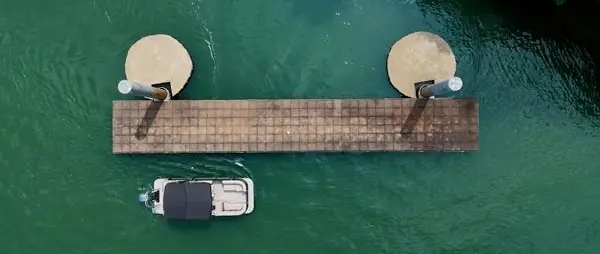
A docking solution designed for a single outboard
Yamaha has introduced DockPoint Pontoon, a control system intended to make it easier to manoeuvre a large pontoon boat fitted with one outboard engine. The product combines Yamaha Helm Master EX joystick control with the Jet Thruster system from Holland Marine Parts.
The manufacturer says one joystick can command forward and reverse motion, sideways movement and rotation on the spot. That is a distinctive proposition for a single-outboard pontoon, where the driver normally has to coordinate steering, throttle and the effects of wind around a broad, high-sided deck.
The product was announced on 13 October 2026 and is intended for future factory installations. Yamaha expects availability to boat manufacturers during 2027 for selected 2028 model-year pontoons, so buyers should not assume that current dealer stock already incorporates DockPoint.
A pump creates additional bow thrust
Toward the rear of the centre pontoon, a water pump draws water from beneath the boat. The system directs it through jets positioned toward the bow, allowing the joystick to provide sideways thrust while the main Yamaha outboard contributes propulsion and steering.
Twisting the joystick coordinates the engine and thruster to rotate the vessel, while moving the stick forward or backward uses the outboard. Yamaha also specifies a Joystick Hold function for precise low-speed movement.
Pontoons often present a large surface area to a crosswind, making slow manoeuvres demanding in a confined marina or close to a trailer. Added control authority may assist the helmsman, but situational awareness, good lookout and space around the vessel remain essential.
Twenty-four-volt equipment supports the thruster
Yamaha has specified a Vetus BowPro brushless twenty-four-volt motor arrangement supplied by two standard twelve-volt batteries. A DC-to-DC charging feature enables the outboard to charge the batteries during normal operation and maintain capacity for future docking manoeuvres.
The Jet Thruster pump and its outlets are designed to sit within the pontoon structure without taking over the normal storage areas. The manufacturer says the arrangement seeks to minimise interference with trailering and the boat’s performance when travelling at speed.
As with any high-current onboard accessory, correct cable sizing, protection and battery management will matter. The system has been designed for manufacturing integration, and buyers should not infer that it is a simple do-it-yourself retrofit.
Yamaha identifies the intended pontoon sizes
DockPoint Pontoon is recommended for single-engine boats between twenty-four and thirty feet fitted with Yamaha DEC or DES equipped outboards from 150 to 450 horsepower. Compatibility depends on the specified combination of hardware and the hull that the boatbuilder is supplying.
Yamaha says the system will be covered by its standard three-year limited warranty. The precise conditions should be checked with the boatbuilder and supplying dealer, especially if additional control components are installed alongside the main engine.
The company is positioning the technology around easier close-quarters control, not autonomous collision avoidance or a substitute for the person steering. Owners should seek practical training even where joystick control substantially changes how the boat feels.
A future option rather than a present delivery claim
Tenders, pontoons and dayboats increasingly use electronics that make handling feel more approachable to occasional users. DockPoint is an example of this direction, connecting a familiar joystick to additional propulsion rather than requiring a second full-size outboard.
For a buyer looking at a 2027 or 2028 pontoon purchase, the announcement provides a feature to discuss with participating manufacturers. Those considering a boat for immediate delivery will still need to work with systems that are already in production and supported locally.
The real test of DockPoint will come through boatbuilder integration and demonstrations in everyday marina conditions. Yamaha has outlined the technical concept clearly, but individual owners should confirm a complete fitted specification before selecting it for a new boat.