
The next World Sailing Championships move into sharper focus
World Sailing has published the Notice of Race for the Gdynia portion of the 2027 World Sailing Championships, an important step for athletes and national teams planning their Olympic-class campaigns. The Polish Baltic-coast city will host competition from 22 July to 1 August 2027. The official notice sets out entry, qualification, race-management and other requirements that teams must understand well before arriving at the venue.
This is an administrative milestone rather than a report of races already completed or places already won. The event will follow the first part of the championships in Fortaleza, Brazil, during January 2027. By splitting the programme across two locations, World Sailing aims to provide appropriate racing conditions for different classes while maintaining a combined world-championship identity. The published notice gives teams a more concrete basis for training and logistical decisions.
A two-venue championship begins in Brazil
The 2027 championships will use a split format for the first time, with Fortaleza staging the earlier programme from 15 to 23 January. The Brazilian races will involve the men's and women's windsurfing events on iQFOiL equipment, Formula Kite events and the ILCA 6 and ILCA 7 dinghy fleets. Gdynia will then host the technical skiff, mixed-dinghy and multihull competitions in July, creating two concentrated periods for world-level sailing.
World Sailing expects approximately 1,300 elite sailors across the combined championship programme. That figure refers to the broader two-venue event, not the number of competitors scheduled to race in Gdynia alone. Travel, equipment transport and support-team arrangements will differ considerably by class. Competitors should read the specific notice and class guidance rather than assume that procedures established for the Brazilian leg apply unchanged to the Polish regatta.
Gdynia will stage four Olympic disciplines
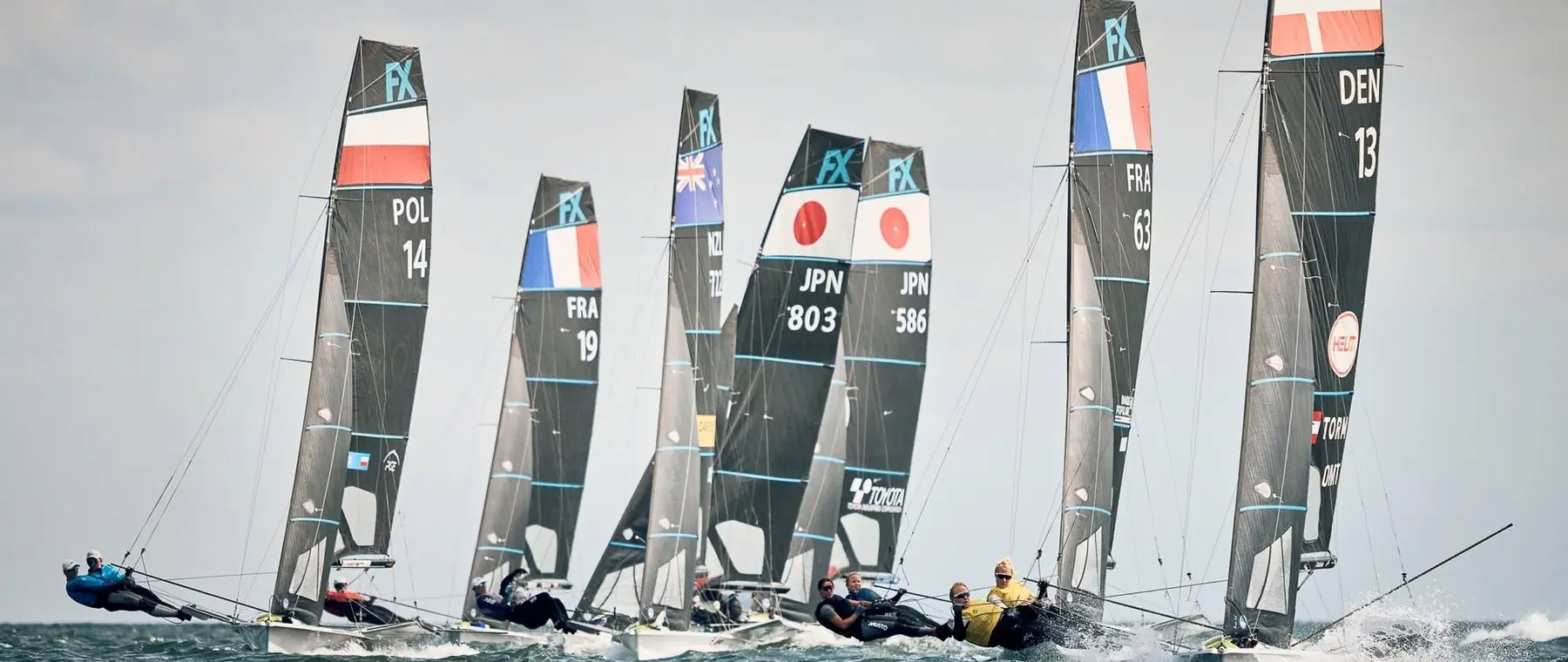
The Polish venue is scheduled to host the men's 49er skiff, women's 49erFX skiff, mixed 470 dinghy and mixed Nacra 17 multihull. Each class presents different handling demands, from the skiffs' emphasis on teamwork and fast manoeuvres to the Nacra 17's foiling performance. The combination brings a substantial concentration of two-person technical sailing to the Baltic coast during the main European summer season.
These boats cannot be compared simply by overall speed or length. Their sailors must work with specific equipment rules, class regulations and conditions on the racecourse. A successful championship also depends on crew coordination, starting decisions and the ability to adjust to shifts in wind and sea state. The published notice establishes the framework for competition, while the results will ultimately depend on performances during the 2027 event.
Olympic qualification raises the stakes
The Gdynia regatta will be a significant qualification opportunity for the Los Angeles 2028 Olympic Games. World Sailing has stated that a substantial number of national quota places will be at stake during the championships. Class information for the 49er, 49erFX and Nacra 17 describes forty percent of the Olympic nation places for those fleets being determined at Gdynia, making this an especially consequential event for countries seeking an Olympic starting position.
A quota place belongs to a country rather than automatically to the individual crew that earns it. National authorities may operate their own selection processes to determine which sailors represent them in Los Angeles. Athletes therefore face two related tasks: helping their nation qualify and satisfying any applicable domestic selection requirements. The exact entry and qualification regulations should be checked in the official documents, not inferred from informal rankings or past Olympic cycles.
The Notice of Race turns ambition into procedures
A Notice of Race identifies the rules and conditions under which a regatta will be conducted, providing a foundation for preparation by sailors, coaches and national authorities. The Gdynia document addresses eligibility, the entry and qualification process, scoring, race format and the field of play. These are practical requirements rather than promotional details, especially when teams must organise equipment, support personnel and international transport well in advance.
World Sailing specifies that athlete entries must be processed through the relevant Member National Authority using its appointed team leaders. Individual competitors should not assume they can complete the full registration independently outside that structure. The official notice and subsequent amendments take precedence over media summaries. Teams need procedures for monitoring the notice board and responding to changes as the championship approaches, since an early announcement cannot capture every later operational detail.
Para Inclusive sailing returns alongside Olympic classes
Gdynia will also host Para and Inclusive Sailing world-championship events. The announced programme includes one-person Hansa 303 keelboat racing, two-person RS Venture Connect, vision-impaired fleet racing using RS21 boats with sighted crew, and Challenger multihull racing. An inclusive two-person Hansa 303 competition is also specified. World Sailing's decision continues the integration of Para Inclusive sailing within its major championship programme, following the approach used at The Hague in 2023.
Bringing different classes to one venue offers opportunities for shared infrastructure, visibility and exchange among athletes. It also requires thoughtful planning for accessibility, equipment handling and suitable shore facilities. The programme does not mean all classes use identical race formats or eligibility rules. Competitors and support teams should consult the detailed class documentation and the organiser's accessibility arrangements rather than rely on general statements about inclusion.
The July 2026 test event helped prepare the venue
Gdynia hosted a World Sailing Championship test event in July 2026, providing organisers and competitors with an opportunity to evaluate the local sailing conditions and trial elements of the competition infrastructure. World Sailing describes the test as successful and notes that it allowed the involvement of technology partners. The test event forms part of the preparation for the larger championship but is not equivalent in scale or logistical complexity.
Test events are useful for identifying practical issues before a major competition, including communication between shore staff and race officials or the management of competing fleets. Their findings can inform planning, but no event can demonstrate that every future condition has been anticipated. Gdynia's reputation as a sailing venue is supported by its Baltic location and existing marina facilities. The real test of the 2027 programme will come when the international fleet arrives.
The Baltic setting shapes the sporting challenge
Gdynia lies on the Gulf of Gdańsk and provides access to the Baltic waters chosen for the championships. As with any coastal regatta, wind direction, wave conditions and changing weather can influence the tactics used by different classes. Crews who perform well in one training location may need to adjust their approach when racing in a different sea state. Local knowledge can help but cannot eliminate the uncertainty inherent in a sailing competition.
For visiting athletes and support teams, the destination also brings practical questions about accommodation, boat storage and moving equipment between the venue and local services. The notice and organiser's later information should clarify the arrangements relevant to different categories of competitors. A recreational sailor travelling to watch the championship should not assume public marina berths or visitor access will be unaffected by the event. Detailed local arrangements will require separate confirmation.
National teams have several months of preparation
The publication of the Notice of Race gives federations time to coordinate qualification, sailor selection, coaching and transport. In the technical classes scheduled for Gdynia, equipment maintenance and reliable shore support can influence performance during a demanding series of races. Teams also need to plan around the wider calendar of class regattas and preparation camps, balancing experience on the water with recovery and logistical commitments.
The document's release does not settle the final list of competitors or identify winners in advance. National authorities will make entries under the event rules, while the athletes must earn their results on the racecourse. Coaching teams should confirm which documents apply to their classes and monitor updates from World Sailing. The championship is particularly important in the Olympic cycle, making accuracy about deadlines and eligibility more valuable than excitement about potential medal contenders.
A landmark event for competition and access
The Gdynia notice marks another tangible step towards a world championship that combines Olympic qualification with a substantial Para Inclusive sailing programme. It also confirms how World Sailing is putting its split-venue approach into practice, with different groups of disciplines assigned to coastal locations selected for their racing requirements. These decisions affect athletes, national federations, equipment suppliers and the organisers responsible for hosting the fleets.
For the wider boating community, the announcement offers a reason to follow the sport as preparations continue through 2027. It does not establish an outcome for any country, and spectators should verify event access arrangements when they become available. The clear facts are a published Notice of Race, a July–August championship in Gdynia and important opportunities to compete for world titles and Olympic nation places. The results are still in the hands of the sailors.
Source: World Sailing — 2 November 2026.