
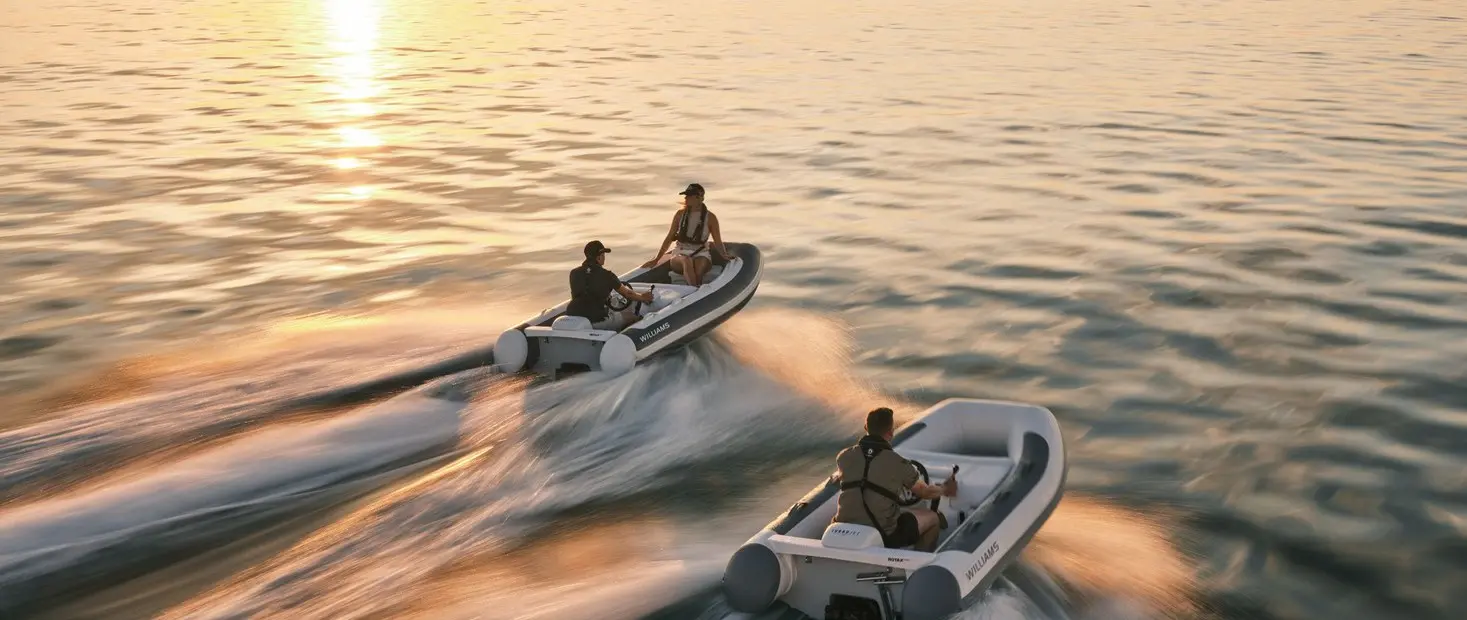
Two compact jet tenders head across the Atlantic
Williams Jet Tenders has confirmed the North American debut of its TurboJet MX range at the Fort Lauderdale International Boat Show, scheduled for 28 October to 1 November 2026. The company will show the new 280MX and 320MX, each intended to make the marque's premium jet tender concept accessible to a broader audience. At 2.79 and 3.19 metres respectively, both craft sit comfortably inside Leisure Boat Guide's small-boat remit.
The firm has developed the MX range with a more competitive starting price than some existing premium jet tender offerings. The announced US prices begin at $26,950 for the 280MX and $29,950 for the 320MX, excluding applicable tariffs, sales tax and other charges. Such starting figures are helpful for comparison but are not final drive-away quotations for a boat with accessories, registration and delivery.
The 280MX targets tight storage spaces
The shorter TurboJet 280MX is powered by a 60hp BRP Rotax ACE 903 engine and is rated by Williams to carry three adults and one child. The company quotes speeds up to 42 mph, a manufacturer performance figure that will depend on loading and conditions. Its small dimensions may be valuable to owners dealing with garage constraints, davit limits or limited space at a home dock.
Jet drive can reduce exposure to an external propeller, but it does not remove the hazards posed by a moving vessel or its intake and propulsion system. Responsible operators should follow the manufacturer's approach to swimmers, ropes and shallow-water operation. The boat's passenger rating and weight limits matter even when the outing involves only a short transfer across a sheltered harbour.
A more powerful 320MX option
The 320MX uses an upgraded 90hp engine and carries up to four adults and one child, according to the launch information. Williams quotes a maximum speed of 45 mph, and the larger hull will suit some families who want more seating and additional room for equipment. The difference in size and power should be assessed against actual usage rather than viewed simply as a progression from good to better.
Both versions carry updated upholstery and a choice of white or grey tubes. The company states that its MX designs are around thirty per cent lighter than competing jet tenders, though a prospective customer should request exact weights and comparable specifications before relying on that broad comparison. Handling and storage compatibility are usually more meaningful than a headline percentage.
What small-craft buyers should investigate
For a tender used independently of a mothership, fuel consumption, storage, maintenance access and launch arrangements will help determine whether a jet-powered design is appropriate. Jet propulsion offers different steering characteristics from many conventional outboard dinghies, so instruction and a practical demonstration are worthwhile. The boat's agility should not encourage high-speed operation close to marinas or swimmers.
Prospective owners should inspect the seating, grab handles, tow points and engine access and establish which extras affect the delivered price. The MX range may appeal to buyers entering the jet tender category for the first time, but a well-matched inflatable with a conventional outboard remains a valid alternative for many uses. The best choice is the craft that fits how its owner actually travels.
Williams and its wider product direction
Williams Jet Tenders has built its reputation around compact jet-propelled tenders, and the MX models extend that experience to a more accessible price segment. Its sister marque Evene is presenting a separate Origin 57 model at Fort Lauderdale, but that craft is designed as a larger superyacht tender and is not the subject of this small-boat story.
The October show will give US visitors an opportunity to view the new MX line and discuss local supply arrangements. Buyers should confirm current stock, specifications and warranty terms with a Williams representative before ordering. The 280MX and 320MX demonstrate how a recognisable tender concept can be adapted to boaters seeking a smaller and more practical leisure craft.