
A small fitting with a defined purpose
French marine hardware manufacturer Wichard is presenting its moulded stick-on padeye during METSTRADE, which runs from 17 to 19 November 2026 in Amsterdam. The product was announced on 2 September through the exhibition's official exhibitor news service. Designated SoftEye 45, it supplements the company's SoftEye 40 and gives sailors another option in the relatively small category of fittings used to organise ropes and equipment.
The manufacturer identifies an 80 kilogram working load and a 150 kilogram breaking load. These are published ratings, not results of an independent test of a fitting installed on an arbitrary boat. The distinction is particularly important when the means of attaching the fitting depends on the surface to which it is bonded. The product is a light-duty accessory and should be selected only for applications authorised in its instructions.
For the owner of a small sailing boat, the significance of the announcement is less the absolute strength of the fitting than the possibility of arranging lines and other light equipment without introducing a conventional protruding metal eye at every location. On a compact deck, a seemingly minor obstruction can affect how easily people move and how conveniently a line can be handled.
Materials and dimensions
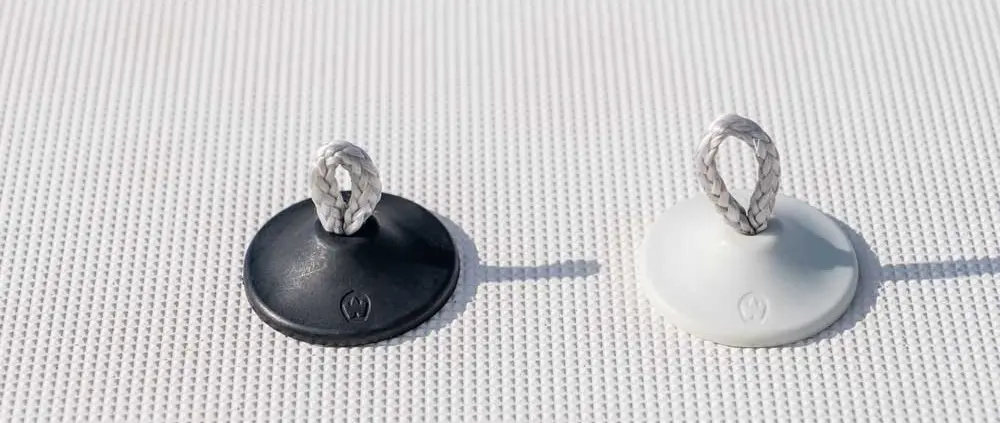
Wichard describes the body as PA6 GF30, a polyamide incorporating glass-fibre reinforcement. The loop is made from three-millimetre Dyneema SK78 rope. The moulded part has a diameter or nominal dimension of 45 millimetres, while the loop is specified at 20 millimetres. Black and white are the two colours shown in the supplied product photograph.
These dimensions are useful for considering the space occupied by the product. A person intending to use a fitting beside a cockpit locker, for example, must consider not only the area of the base but also the space required by the loop and any line or connector passing through it. The relationship with adjacent fittings can be as important as the dimensions of the item itself.
The material combination also means that the base and loop should be considered separately when assessing condition. A visible change in the rope does not necessarily occur at the same time as a change in the attachment beneath the moulded part. Owners should follow Wichard's inspection and replacement guidance.
Working load and breaking load
A working load is intended to describe the limit for normal service under specified conditions. Breaking load refers to the level at which failure is expected under the relevant test conditions. The figures published by Wichard are not interchangeable. The fact that the breaking load exceeds the working load does not provide permission to use the fitting above its working rating.
The release reports both values in kilograms. In practical engineering assessments, the forces applied to an attachment and their directions are important, particularly if the load is transmitted by a moving line. Shock loading can create peak forces considerably different from the weight of the object that a line appears to support.
The published figures also cannot establish the capacity of the complete attachment on every substrate. A sound fitting bonded to a poorly supported or deteriorating surface remains part of a potentially inadequate assembly. The manufacturer’s instructions for compatible substrates, installation and loading directions should govern the decision.
The role of adhesion
A stick-on fitting differs from a fitting secured by bolts or screws. Its suitability depends in part on the bond with the surface, and the nature of that surface is therefore central to the installation. Gelcoat, paint, textured finishes and other materials may have different properties. A coating that is not firmly attached to its substrate may itself become the weak part of the installation.
The September press statement does not identify the complete adhesive specification, the preparation required for each substrate or the conditions under which the bond should be allowed to develop. A prospective purchaser should obtain those details from the product instructions before proceeding. Improvising with a different adhesive or assuming that a familiar household bonding product will be adequate would go beyond the information supplied.
A boat used in salt water may also be exposed to repeated washing, temperature changes and periods of storage. These conditions should be considered in accordance with the manufacturer's guidance, rather than inferred from the initial appearance of a newly installed fitting.
Organising light lines
Rope retention is among the applications listed by Wichard. A cruising dinghy or small keelboat can contain several lines whose free ends must remain accessible without interfering with the people aboard. A carefully positioned retainer can make it easier to identify the appropriate line and reduce unnecessary movement of loose equipment.
The owner must distinguish a retainer for a slack line from the fitting through which the principal sailing load is transmitted. A rope that is normally loose may become highly loaded when the sail or another part of its system moves. Each proposed installation should be assessed with that possibility in mind. Simply replacing a stronger conventional eye with a compact adhesive fitting because they occupy similar positions may not be appropriate.
The fitting's small size may be particularly attractive when space is limited, but the practical usefulness depends on the relationship with the surrounding deck layout.
Lazy jacks and equipment holders
Lazy jacks and equipment holders are also identified in the manufacturer's announcement. A lazy-jack arrangement helps manage a mainsail as it is lowered, but the forces within the arrangement depend on the design, the sail and the conditions in which it is used. The advertised application does not establish that every point in every lazy-jack system is suitable for this particular fitting.
The same reasoning applies to equipment retention. A holder intended to keep a light object in place during normal operation might experience more substantial forces if that object moves abruptly. The product rating must be considered alongside the mass and movement of the retained equipment.
A professional rigger or boatbuilder can advise where the complete load path is unclear, especially when the proposed installation involves an existing system whose original design is not documented.
Safety-related uses require particular caution
Wichard includes safety nets in its list of possible applications. This should not be interpreted as approval to use the SoftEye 45 as a personal fall-arrest point, harness attachment, lifting eye or primary lifeline anchorage. Those functions have distinct requirements and can involve forces beyond the stated working load.
An owner considering net attachment should examine the purpose of the net and the consequences if a fitting fails. The fact that an attachment can retain a lightweight net during ordinary sailing does not establish its ability to withstand a person's weight or impact. Where an installation is intended to protect somebody from falling, the relevant safety equipment and approved attachment methods should be used.
Such distinctions are important because similar-looking loops can have entirely different engineering roles. Appearance cannot establish that the product is appropriate to a safety-critical function.
Position and inspection
The official photograph shows the two colour variants on a textured surface. It is a product presentation and does not establish the capacity of an installation on that particular material. A boat owner should consider how the fitting can be inspected after installation and whether adjacent equipment might rub against its loop.
During routine maintenance, changes in the condition of the rope or base and signs of movement at the bond warrant attention. Manufacturer instructions should determine whether continued use is appropriate. A loose or damaged fitting should not continue carrying a load merely because it remains partly attached.
Choosing a location that can be accessed and examined conveniently may be more valuable over the life of the boat than making a fitting as inconspicuous as possible.
A complement to existing hardware
The SoftEye 45 gives owners another option for comparatively modest deck-organising tasks. Wichard presents it as a less costly alternative to the SoftEye 40, but the announcement does not quote retail prices or establish that the two designs have identical performance in every application.
For owners attending METSTRADE, the relevant questions include the applicable installation procedure, the range of compatible surfaces and the availability of product instructions. Regional distribution and replacement arrangements may also be useful to establish before specifying several fittings.
The confirmed development is the introduction of this particular moulded padeye with clearly stated material, dimensions and load ratings. Its advantages for small sailing boats will ultimately depend on appropriate selection and installation rather than the number of fittings that can be added to a deck.
Source and lead photograph
Official source: Wichard exhibitor announcement, 2 September 2026. Lead photograph: Wichard, official exhibitor product photograph showing the black and white SoftEye 45 fittings. Original issuer press asset distributed through the official METSTRADE virtual press room; copyright remains with its owner.