
A larger aperture for a compact fitting
Wichard is using its official METSTRADE 2026 exhibitor catalogue to highlight a range of four large-opening aluminium friction rings. Its September 2 announcement identifies the ability to accommodate more than one line through the central opening as the distinctive development. The company also describes a comparatively narrow external groove intended to help retain the supporting line and manage the direction of loads.
The range was not invented on the opening day of the current Amsterdam exhibition. Wichard's 2025 product preview already described the design among items intended for commercial introduction during 2026. The current exhibitor announcement gives the leisure marine trade a renewed opportunity to consider the hardware in relation to practical deck layouts. METSTRADE runs from 17 to 19 November this year.
For owners of boats below twelve metres, a small fitting can be especially significant when there is limited room around a cockpit or near the base of the mast. A suitable ring can offer an alternative way of directing a line without necessarily introducing a substantial block into the arrangement. Whether it is preferable depends on the function of the line and the actual forces involved.
How a friction ring differs from a sheave
A conventional block usually presents a rotating sheave to a moving rope. A friction ring has no comparable moving sheave. Instead, the rope bears against a shaped surface as its direction changes. A carefully manufactured surface and a suitable line can make this a useful arrangement, but the rope still has to slide across the fitting when it moves.
This is why a ring's apparent simplicity should not be taken as proof that it will be more efficient than a conventional block in every application. A line that remains nearly stationary after adjustment imposes different requirements from one that travels rapidly or repeatedly while the boat is being sailed. The amount of direction change and the tension in the line are relevant to both.
On a smaller yacht the absence of a rotating component may help keep a particular arrangement compact. Conversely, a crew required to make frequent adjustments under load may place considerable importance on reducing friction. The design of the complete system must determine the selection, rather than the appearance of the individual fitting.
Three-dimensional sail trimming
Wichard identifies three-dimensional sail trimming as a principal application of its larger opening. In this context, sailors are concerned with the position from which a sheet or other control line acts on a sail, not simply the length of that line. Moving the effective lead can change the relationship between the sail's foot and leech and influence the way its shape responds to adjustment.
The appropriate arrangement varies considerably with the sail plan. A racing crew may investigate small adjustments in response to changing wind conditions, whereas a cruising crew may prioritise an arrangement that is easy to understand and operate. The product offers an additional means of arranging lines, not a complete specification for either kind of sailing system.
The ability to pass multiple lines through a single opening provides a potential degree of flexibility. It does not imply that every combination of ropes and directions is appropriate. The forces transferred by each rope, the possible interaction between them and access to the control ends all deserve attention.
Several lines through one opening
A larger central aperture may make it easier to accommodate lines that would not fit comfortably together in a smaller ring. That physical advantage should be distinguished from the question of whether those lines can operate independently. Two tensioned ropes passing through a common fitting may interact, especially when their direction of pull changes.
For a boatbuilder or rigger, the useful question is how the system behaves across its full range of operation. An arrangement that appears clear while the boat is alongside may behave differently when the sail is loaded or when one of the control lines is released. A crew should be able to identify which line performs which function without having to disentangle several controls during a manoeuvre.
The manufacturer's announcement does not state a maximum number of lines or a universal combination of compatible diameters for the four models. Those particulars must be established from the detailed model specifications. The larger opening is an identified design feature, rather than permission to exceed the capacity of the fitting or the connected components.
The external groove
The external groove serves a different purpose from the central aperture. It is associated with the support of the ring, while the opening provides the route through which the working line or lines pass. Wichard describes the relatively narrow groove as helping retain the fitting's position and optimise line deflection.
An owner replacing a ring in an existing system should consider the compatibility of the supporting rope and its attachment. A replacement of a similar outside diameter may have a different groove profile, changing the way the support sits against the unyielding part of the fitting. The complete load path should be understood before any substitution is made.
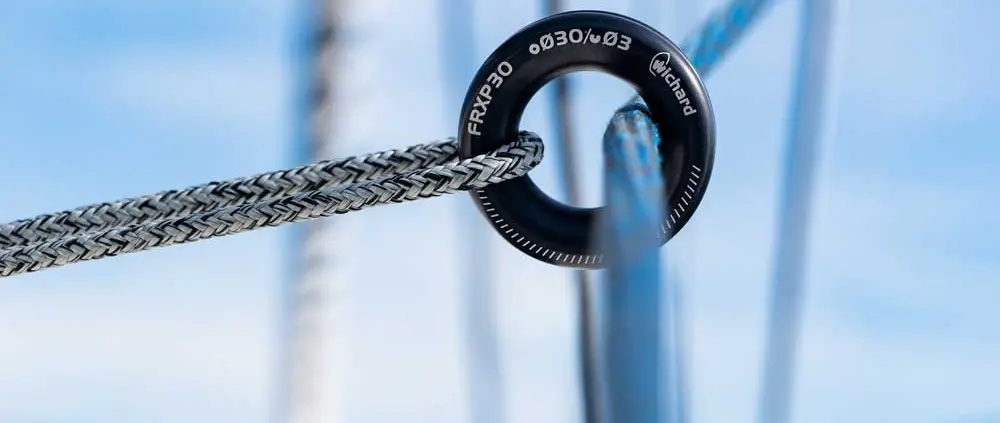
The photograph supplied with the exhibitor announcement shows a dark ring with rope passing through it. It provides an indication of the product's shape and finish, but it is not a diagram of an installation certified for a specific vessel. The appropriate splice, support and termination should be determined from the relevant product instructions and professional rigging advice where needed.
Choosing among the four models
The range comprises four sizes or models, according to the published exhibitor description. Wichard identifies high-strength aluminium as the principal material. It does not include a table of working loads, breaking loads, groove dimensions or rope compatibility in the brief September announcement.
The absence of numerical ratings in that release is particularly important for a buyer contemplating the replacement of essential sail-handling hardware. Outside dimensions alone do not establish a fitting's strength. Even a strong component can form part of an unsuitable system if its supporting line, termination or attachment to the deck has a lower capacity.
A rigger should establish the required loads and the applicable model ratings rather than choose the smallest fitting that will physically accept a sheet. The consequences of a failure also differ between uses. A fitting used in an auxiliary control arrangement should not automatically be specified for the support of a person, for lifting or for another safety-critical function.
Inspecting the working surfaces
The surfaces of a friction ring are relevant to the condition of the rope. A line that slides against an abrasive or damaged area may wear more rapidly than it would against an appropriate smooth surface. Owners should therefore inspect both the fitting and the ropes as part of the maintenance regime established for the vessel.
An apparently undamaged ring does not establish that a rope remains in satisfactory condition. Conversely, the presence of wear on a rope does not identify its cause without examining the routes and attachments through which it operates. A change in the direction of a lead can bring a line into contact with adjacent hardware that was previously clear of it.
Owners sailing in salt water or storing their boats outdoors should follow the manufacturer's care guidance. The November exhibitor information does not include a service interval or detailed environmental test results. Inspection and replacement decisions should reflect the actual condition of the components and the recommendations of the relevant suppliers.
Keeping sail handling understandable
A benefit of additional control possibilities is only realised if the crew understands them. A complex sequence of lines can make sailing less convenient for a person who is unfamiliar with the boat, even when each individual fitting is appropriately selected. Organising controls by their purpose and providing clear access to the ones used most often are worthwhile objectives.
For a small cruising boat, it may be sensible to consider which adjustments are genuinely useful during ordinary sailing. For a boat participating in racing, a wider range of settings may be valuable when crew members know the intended procedures and have practised them. There is no requirement to introduce every conceivable trim adjustment to benefit from the new hardware.
The relevant engineering question is not whether four models allow a particular arrangement to be made, but whether the chosen arrangement provides an improvement while remaining safe and comprehensible. The exhibitor's announcement should be considered a starting point for that evaluation.
What the trade show announcement establishes
Wichard's current product presentation confirms the expanded friction ring range and its focus on accommodating multiple lines, compact construction and flexible sail trimming. The material and general design are stated by the manufacturer. The original 2025 preview provides context for the 2026 commercial programme, while the September exhibitor statement identifies the products being promoted in the lead-up to the current show.
Retail pricing, availability in individual countries and the technical ratings of the separate models are not supplied in the short exhibitor statement. Boat owners interested in the equipment should obtain those particulars through the manufacturer or its distributors before placing an order.
For Leisure Boat Guide, the most important aspect of the development is the possibility of better organisation of the controls on smaller sailing boats. The simplicity of the fitting is appealing, but its successful use depends on suitable rope selection, an appropriate load path and correct installation of the complete system.
Source and lead photograph
Official source: Wichard exhibitor announcement, 2 September 2026. Lead photograph: Wichard, official exhibitor photograph of the large-opening friction ring and rope. Original issuer press asset distributed through the official METSTRADE virtual press room; copyright remains with its owner.