
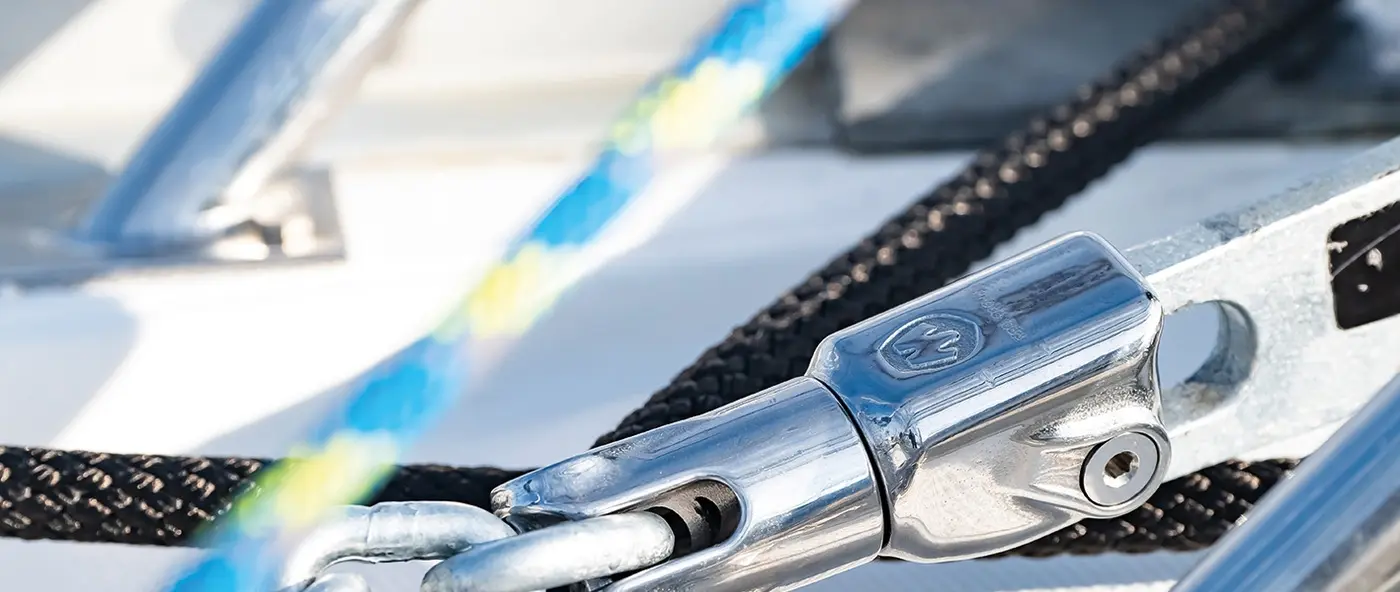
French deck-hardware manufacturer Wichard has gained a 2026 DAME Design Award Special Mention for an anchor swivel that is intended to turn a misaligned anchor into the correct position as it reaches the bow roller. The distinction was announced at METSTRADE on 17 November, recognising a design that tackles a routine problem for small-boat owners: an anchor can arrive at the bow upside down or at an awkward angle, requiring someone to intervene near a loaded chain. Wichard's product combines a stainless-steel swivel with a shaped protective cover to encourage controlled alignment. The idea is useful to investigate, but the correct fit and safe working limits depend on the actual anchor, chain and bow arrangement.
What the DAME award means
The official 2026 results identify Wichard's Anchor Swivel as a Special Mention within the Deck Equipment category. It did not win the overall DAME award or the deck-equipment category outright. The honour nevertheless signals that the jury found its design noteworthy among many nominated products. Wichard had already described the swivel in a September 2026 exhibitor announcement, so the November news concerns award recognition rather than an entirely new device appearing without earlier publicity. A Special Mention is not an independent guarantee that the product will work with every anchor in all sea conditions. Buyers should assess its engineering and compatibility alongside the award.
Why anchors sometimes arrive the wrong way round
When an anchor is retrieved through a bow roller, its orientation may be influenced by the chain's twist, hull motion and the geometry of the shank. The anchor can approach the roller facing sideways or upside down, making it difficult to seat neatly in the stowed position. On a small leisure boat, space near the bow may be limited and handling a heavy anchor by hand can be awkward or dangerous. Some owners use a swivel or other connector in the rode to reduce twisting, but a basic swivel does not necessarily rotate an anchor into its final resting position. Wichard's design specifically addresses the transition from retrieval to stowage.
How the protective cover is intended to work
The manufacturer's product description refers to a shaped protective cover combined with an exclusive swivel arrangement. As the anchor approaches the roller, the cover is intended to guide its orientation so that it flips into the correct position without manually lifting or rotating the shank. That design goal is different from simply allowing the chain to untwist. It still relies on interaction with the actual bow roller and anchor shape, and the force available during retrieval may vary. An owner should ask for the maker's installation instructions and, ideally, see the proposed combination in operation. The product's mechanism cannot be judged completely from a single close-up photograph.
Material selection and corrosion resistance
Wichard specifies 316L stainless steel for the swivel. This alloy is widely used for marine fittings because it offers useful resistance to corrosion in suitable environments, but stainless steel is not immune to corrosion under every condition. Salt deposits, crevices, poor drainage and contact with other metals can still contribute to deterioration. The swivel also experiences repeated mechanical loading as the anchor and chain move, so visual inspections and compliance with the supplier's service recommendations remain important. The grade of material is useful specification information, but it should not be translated into a claim of unlimited working life or freedom from checking the fitting.
Sizing must start with the chain
Wichard says the swivel is offered in three sizes and is designed to accommodate a substantial proportion of anchors used by leisure boats. The manufacturer's separate product information discusses chain sizes in the approximate 6–14 millimetre range for the broader offering, but the correct model still depends on the particular chain and anchor connection. Different chain sizes, standards and link geometries may not be interchangeable simply because their nominal dimensions appear similar. Owners should identify the existing chain's verified specification and ask the supplier to match the exact swivel model to it. The wrong connector can compromise the anchoring system even when its physical dimensions seem close enough.
Anchor shape matters just as much
An anchor's shank, roll bar, flukes and balance point influence how it approaches the roller and where it finally rests. A swivel advertised as fitting most anchors is not proof that it can handle every popular design or a home-modified anchoring arrangement. Owners should request a compatibility list or written confirmation for the specific anchor model and its size. If a boat has a narrow pulpit, complex bow fitting or unusual anchor locker entry, physical clearance may also be an issue. A device that can rotate the anchor in free space is not automatically able to do so inside a constrained roller assembly.
The importance of correct working load
A swivel is a load-bearing connection in a vessel's ground tackle. Its working-load limits and approved installation geometry matter during anchoring as well as retrieval. The manufacturer should provide the relevant technical specification for the selected size, including the attachment method, fastener arrangements and any restrictions. Owners should not choose the smallest unit that happens to fit their chain if the expected loads require a stronger device. Wind, current and wave action can create significant forces, particularly if the anchor is used to restrain a boat in exposed conditions. The complete anchor, chain, connector and deck-fitting system needs compatible capacities.
A rotating fitting does not replace an anchor stop
Once a boat has retrieved its anchor, the device securing the anchor for travel may be separate from the swivel. The bow roller and chain stopper or other specified restraint should keep the anchor from moving when the boat pitches. It would be unsafe to assume the swivel itself can perform every part of that job unless the maker documents it. Many skippers also avoid allowing a windlass to carry the full stationary anchor load when the manufacturer's instructions specify an independent securing method. The swivel's principal proposed benefit is orientation during retrieval, not the elimination of all normal anchor-stowage and sea-fastening procedures.
Manual interventions near the bow
One potential advantage of a self-aligning connector is reducing the need for a crew member to lean over the pulpit and turn the anchor by hand. Such interventions can be hazardous when the boat is moving or the chain is still under tension. The Wichard announcement makes the promise of more convenient, safer retrieval, but the crew should still supervise the anchor carefully. The person operating the windlass needs a clear view of the bow or reliable communication with the person watching the chain. If anything jams, stop the retrieval rather than use extra power to force the mechanism past an obstruction.
Windlass compatibility remains separate
The swivel connects the anchor and chain, while the windlass retrieves the rode according to its own design and chainwheel specification. Fitting a new connector does not resolve an incorrectly matched chain, worn gypsy, damaged roller or poor lead into the locker. Owners contemplating a change should inspect the entire ground-tackle route from the deck to the anchor. The new swivel must pass through the relevant clearances without fouling nearby fittings. A professional dealer may be able to check the dimensions against the manufacturer's technical drawings. Compatibility should include real movement through the bow arrangement rather than only a visual match on a workbench.
Testing the retrieval process safely
A useful acceptance test would demonstrate repeated retrievals on the actual boat, with the bow supervised and with an opportunity to stop before damage occurs. The test should show whether the anchor rights itself from different initial orientations and whether it settles consistently in the intended resting position. It should also examine what happens if the chain is twisted or the anchor is approached at a slight angle. Such evaluation should be conducted under safe, controlled conditions with suitable assistance. It would be misleading to describe the design as universally self-righting without trials across all relevant anchor and roller combinations.
Care and inspection of a swivel
Because the fitting sits between the anchor and chain, it is exposed to abrasion, impact, immersion and changing loads. Owners should inspect the swivel for damage, corrosion, deformation and any loosened locking elements at intervals specified by the manufacturer. A connector that is difficult to access should still be examined rather than left indefinitely because it is described as stainless steel. The condition of chain and anchor connections deserves equal attention. During winter maintenance, a thorough check can reveal wear that is easy to overlook during an ordinary departure. Any uncertain fitting should be examined by a competent marine technician before further use.
Comparing with a plain anchor swivel
A simple swivel may be lighter, less expensive or already familiar to a skipper, and it can help accommodate certain twists in an anchor chain. Wichard's design offers an additional feature aimed at controlled anchor orientation at the roller. Whether that feature justifies a purchase will depend on how often the boat's existing anchor arrives incorrectly and how much difficulty is involved in correcting it. Owners should compare complete prices, required modifications and any change in the dimensions or weight at the end of the chain. A system that already stows the anchor reliably may gain little from an additional mechanism.
Pricing and availability should be confirmed
The manufacturer has introduced the product through its professional marine distribution channels, but the official METSTRADE listing does not provide a universal retail price or guaranteed local stock. A dealer should confirm the variant appropriate to the boat and provide current pricing, lead time and warranty conditions. If a replacement chain or anchor is contemplated at the same time, it may be sensible to design the complete arrangement together. Buying a swivel first and then discovering that it conflicts with a future anchor can create unnecessary expense. The best procurement decision is based on the whole ground-tackle installation and the owner’s real anchoring pattern.
A practical design with a specific purpose
Wichard's DAME Special Mention draws attention to a common inconvenience that can become a safety concern when a crew must work close to moving anchor gear. An appropriately matched self-aligning swivel may make retrieval more predictable for a small leisure boat, particularly where the existing anchor often approaches the roller incorrectly. But the award cannot replace measurements, load data, compatibility checks or safe operating practice. The fitting should be assessed as one component in a working anchoring system. For vessels under twelve metres, the most useful outcome would be a dependable stowage process that reduces manual handling without introducing new points of failure.
Official source: https://www.metstrade.com/exhibitors/wichard-groupe/products/anchor-swivel