
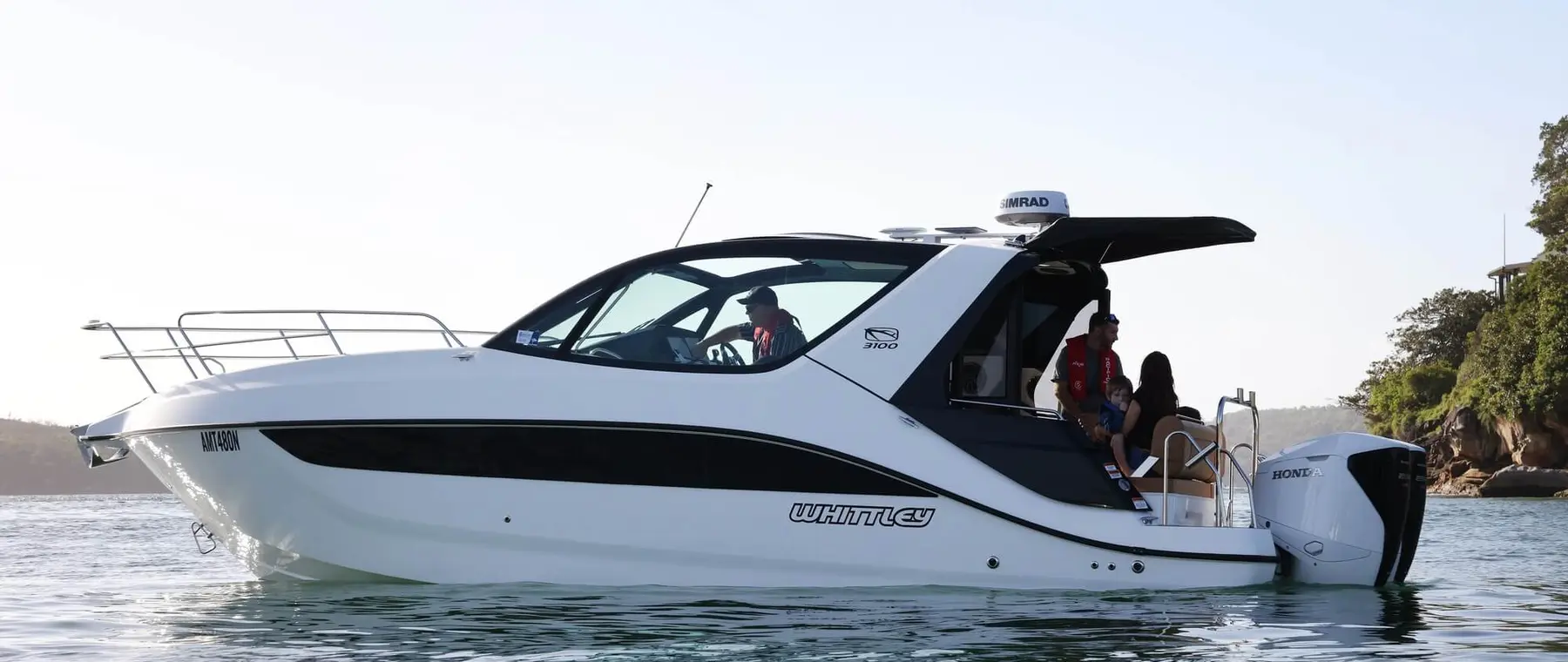
An Australian cruiser with a different layout solution
Whittley Marine Group's CR31 Sports Cruiser has appeared in the 2026 Australian Good Design Awards, bringing attention to a practical dilemma in smaller powerboat design: how to give a family more usable indoor room without making the boat appreciably wider. The project was developed by Whittley Marine Group and Zebra Digital in Australia and presented in the awards' Product, Automotive and Transport category.
The CR31 is conceived as a premium recreational cruiser, not as a miniature superyacht. Its brief combines day boating, overnight comfort and entertaining while remaining within the dimensional constraints of a trailerable production boat. The interesting part is how its designers rearranged the route people take to the bow.
Walking through the windscreen changes the cabin
On many small cabin cruisers, a narrow passage runs along one or both sides of the saloon so crew can reach the foredeck. That access is useful, but the walkway takes space out of the total permitted beam. Whittley's design team instead built a walk-through windscreen, creating a route forwards through the centre of the boat.
Removing the traditional side-deck passage allows more of the available hull width to serve the interior. The award submission says the saloon benefits from a noticeably more open layout without taking the boat beyond its intended trailerable width. Access, of course, still has to be evaluated by owners in the context of guardrails, steps and movement in rough conditions.
A folding door connects inside and out
The project also introduces a watertight, lockable folding saloon-door arrangement. With the doors secured, the cabin can offer protection against weather while under way or when the boat is left unattended. When conditions permit, opening the doors is intended to make the transition into the cockpit feel less like moving between two separate rooms.
For families who use the same boat in the morning for a run along the coast and in the afternoon as a sheltered lunch spot, that flexibility has a direct practical appeal. Buyers should inspect the door seals, latching system and weatherproofing during a demonstration, since those are heavily used components on any weekender.
Three spaces with separate roles
Whittley's design description divides the boat into a forward cabin, central saloon and aft cockpit. Each zone has a different purpose: private accommodation at the front, protected living space in the middle and open-air enjoyment at the stern. The designers emphasise keeping physical and visual links between them rather than treating each as an isolated compartment.
The central saloon offers a place to sit when the weather turns or when passengers want shade. Outside, a convertible seating arrangement named the mega lounge can be altered to suit socialising, cruising or resting. The particular arrangement of loose gear, table positions and usable floor area remains something to judge in person, especially with a full family aboard.
Built around the way owners actually move
The project began with virtual-reality sketches and progressed to three-dimensional CAD modelling. According to the award submission, that process helped the team test proportions, storage, visibility and interior packaging before fixing the final surfaces. It is a logical method for a boat where changes of a few centimetres can affect access, seated comfort and stowage.
Visibility has to work both from the helm and while passengers move around the cabin. A walk-through windscreen introduces its own questions about secure closure, wind protection and structural integration, so design development goes beyond finding a convenient opening. The key benefit is better use of the footprint without simply enlarging the hull.
Trailerability still needs a careful check
The manufacturer positions the CR31 as a trailerable production cruiser. That should not be read as a promise that every family car can tow it or that every slipway will be suitable. A prospective owner needs the actual towing mass in their chosen equipment configuration, trailer specification, beam and height restrictions, and the legal requirements where they intend to operate.
Launching, recovering and storing a larger trailerboat may require specialist assistance even where it meets the relevant width rules. Buyers should also account for fuel and water load, accessories, tender equipment and how frequently the boat will travel by road. The day-to-day convenience of trailerability depends on the whole package, not the design label alone.
Family boating is more than seating capacity
The Australian design brief emphasises extended family recreation as well as social entertaining. The forward accommodation and enclosed saloon can lengthen the usable boating day when a short afternoon cruise becomes an overnight stay. Still, overnight comfort depends on ventilation, cooking and washroom arrangements, sleeping dimensions and the maintenance access that sits behind the visible finishes.
At the stern, a convertible lounge may make the cockpit more versatile without requiring more deck length. For owners who fish occasionally, swim from the boat or spend time at anchor with children, the right balance between clear working space and seating is personal. A sea trial with realistic passenger numbers remains a valuable part of any purchase decision.
What its award appearance says about small-boat design
CR31 demonstrates a broader direction in production powerboating: builders are spending as much design effort on movement between spaces as on the styling of the hull itself. By using a central windscreen passage, a closable folding partition and an adaptable cockpit, Whittley seeks to increase the usefulness of a tightly bounded footprint.
The official 2026 design-award project explains the layout choices and development process. Exact propulsion, weight, dimensions, approved towing arrangements and available options should be checked against the manufacturer's current specification before an order is placed. For buyers comparing compact family cruisers, it is an instructive alternative to a traditional side-deck layout.