
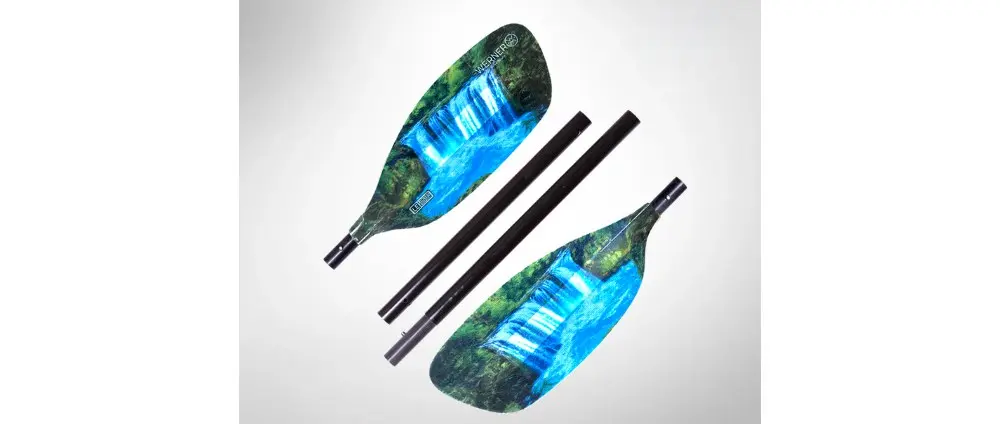
An established whitewater design receives a new finish
Werner Paddles is presenting the Powerhouse Spirit Falls for the Paddle Sports Show's 2027 paddle selection, adding a distinctive design inspired by Spirit Falls on the Little White Salmon River. The model builds on the company's established Powerhouse platform rather than representing an entirely new propulsion concept. Its colourful blade artwork is intended to celebrate a demanding stretch of water where whitewater equipment is regularly tested.
The relationship between a paddle and a particular river can have meaning to experienced paddlers, especially when the place is associated with technical challenges and strong community traditions. A new finish may make an existing model feel more personal, but the relevant purchase considerations remain its size, weight, shaft design and suitability for the paddler's experience.
Full-size blades for powerful strokes
The Powerhouse Spirit Falls is described with fibreglass blades providing a surface area of approximately 720 square centimetres. Werner gives blade dimensions of roughly 48 by 20 centimetres and positions the design for larger or well-conditioned paddlers who want a powerful catch. The broad blade can provide immediate resistance in the water, useful for manoeuvres that require decisive boat control.
That resistance also demands strength and good technique. A high-area blade is not automatically appropriate for a beginner or someone seeking a relaxed touring paddle, and it may be tiring over a long day. Customers should compare different blade sizes on the water where possible, paying attention to shoulder comfort rather than choosing purely on the promise of stronger propulsion.
Dihedral geometry smooths the stroke
Werner employs a dihedral shape that guides water along the blade during a stroke, intended to support smooth handling and reduce flutter. The design also uses a low-profile reinforcement spine to combine manoeuvrability with blade stiffness. These features are relevant when a paddler needs to link strokes and corrections rapidly in dynamic water.
A predictable response is particularly valuable during whitewater moves because the paddler may be adjusting position in a fraction of a second. However, even a carefully engineered blade cannot compensate for poor technique or an unsuitable route. Proper instruction and practice remain central to using the equipment effectively.
Fibreglass as a material choice
Fibreglass laminate blades offer a balance of stiffness, durability and price that differs from both plastic and full-carbon alternatives. The manufacturer's submission describes premium construction intended to retain dependable handling without making the product excessively fragile. Real performance depends on the layup, reinforcement and how the blade is used, not merely on one material name.
A paddle striking a submerged rock can still become damaged, and even a sturdy edge needs periodic inspection. Repairs must follow manufacturer advice because a seemingly small chip may develop into a larger issue under repeated loads. Owners should avoid using a paddle to pry the boat from rocks or support body weight in ways outside its intended operation.
The straight-shaft specification
For this listed version, Werner specifies a one-piece straight shaft with a fixed feather angle. The manufacturer also discusses common feather preferences in river running and playboating, but the buyer must check the actual available configuration because it cannot be adjusted on the water like a variable-angle paddle. A fixed arrangement may appeal to someone who already knows their preferred setup.
A one-piece paddle can provide a continuous feel with no central joint, but it is less convenient to transport and store than a breakdown design. A purchaser should consider vehicle space and whether a separate spare paddle can be carried. A long rigid item needs proper support during transport so that it cannot become an unsafe loose load.
Published weight and fatigue
Werner lists an average weight around 999 grams for the Powerhouse Spirit Falls. A figure below one kilogram may sound modest, but the repeated movement of a full-size blade can still demand substantial effort. The overall swing weight and the distribution of mass between shaft and blade matter alongside the headline specification.
A paddler testing the model should assess how it feels through repeated forward strokes, braces and turns. Short demonstrations may not reveal fatigue that develops after an hour of stronger water. The best equipment improves control without encouraging the user to work beyond their physical capacity.
The Little White Salmon connection
Spirit Falls is recognised within whitewater paddling for a demanding drop, and Werner's new artwork uses the place as an inspiration. The river reference is a design story, not advice for ordinary paddlers to attempt the waterfall or other difficult rapids. Such locations require specialised skills and conditions and should never be treated as casual recreational attractions.
The official photograph accompanying the show entry depicts the actual paddle and its distinctive blade colours, allowing readers to judge the finish accurately. Promotional imagery should not replace clear information about the model's geometry or intended use. Both aspects matter to a customer considering equipment that will face demanding conditions.
A specialist option for the right paddler
The Spirit Falls version demonstrates continued investment in an established specialist paddle rather than a complete redesign. Its entry in the 2027 selection does not mean it won the final award, and availability of the limited finish should be confirmed directly with Werner or an authorised retailer.
For Leisure Boat Guide readers, the model is a reminder that paddle choice should be matched to skill level and boat type. A whitewater specialist may value its immediate blade response, while a family exploring a lake may prefer a smaller, gentler recreational design. The right product is not necessarily the most technically demanding one, but the one that keeps the paddler comfortable and in control.