
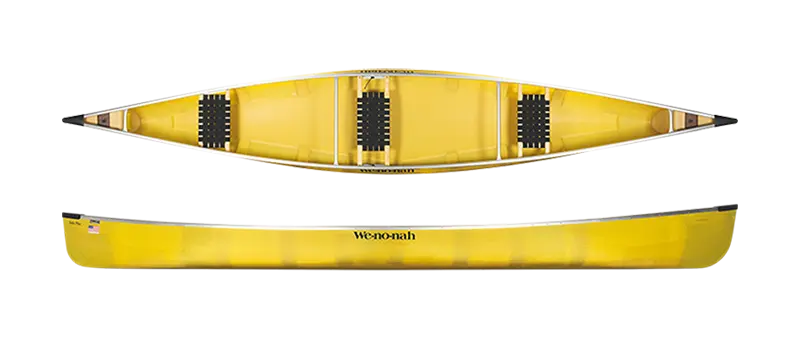
Wenonah's Solo Plus bridges the gap between a dedicated solo canoe and a full-time tandem. Its 5.03-metre hull and configurable seating make it useful for households that alternate between a solo outing and a shared paddle.
Why the seating matters
A solo paddler can work from a central position while suitable fore and aft arrangements support a tandem crew. The hull's 83.19-centimetre maximum width offers a different balance from a narrow race canoe.
Seat position and trim need to match the real load and route. A solo conversion is not simply a question of leaving an empty seat unattended at one end.
Hull dimensions
The maker lists a 73.66-centimetre gunwale width, 33.02-centimetre central depth and straight keel line with zero rocker. Those details help explain the boat's comparatively directional touring brief.
A straight-tracking boat can require more planning in twisting streams or tight approaches. The crew should practise turning and landing before longer passages.
Choosing a construction
Wenonah offers multiple material and trim packages, including a quoted forty-pound carbon ultra-light version. The actual weight depends on the chosen layup and fitted hardware.
Light constructions are convenient on a portage but still need careful handling at rocky launch sites. Owners should compare repair arrangements, storage and budget as well as kilograms.
A boat for changing plans
A flexible seating layout can save storage space at home when two separate canoes are not practical. The trade-off is that no arrangement is perfect for every crew and every waterway.
Paddlers should also check the loading of the actual boat when switching between one and two occupants. A short practice session is a sensible way to establish the trim before taking additional bags aboard.
The product image and dimensions come from Wenonah's official Solo Plus listing. This is a current-model comparison, not an unverified 2026 launch.
Official primary source: Wenonah model specification. Independently written by Leisure Boat Guide.