
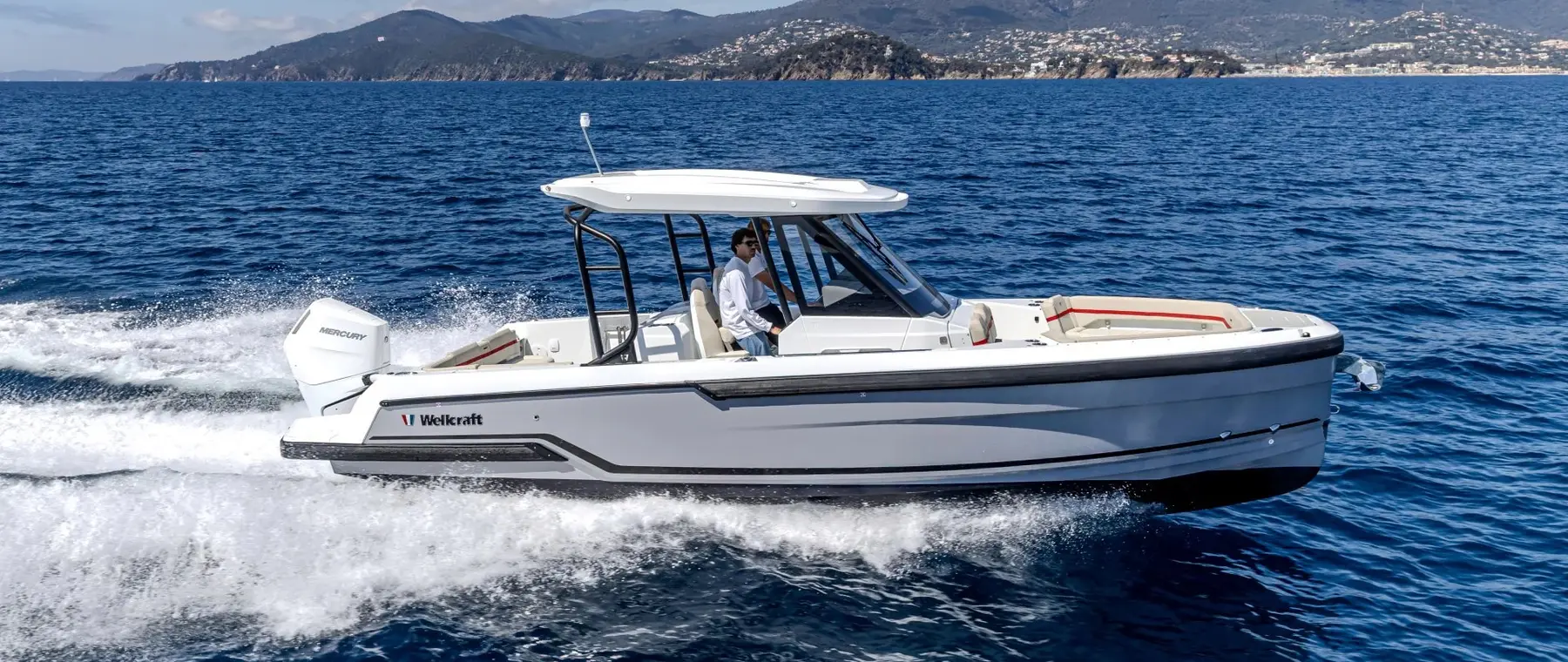
Two 28-foot designs, one North American showcase
Wellcraft is preparing to display both the 28 T-Top and 28 Explorer at the 2026 Fort Lauderdale International Boat Show, giving American leisure-boat buyers a close comparison between open and enclosed versions of a shared 28-foot concept. The manufacturer's official show schedule confirms both models on its display list, while participating dealer information identifies the pair as United States introductions. The five-day event runs from 28 October to 1 November.
The boats answer different ownership questions even though they share major dimensions and engine choices. The T-Top appeals to people who want an immediate outdoor connection while cruising and fishing, whereas the Explorer puts a protected wheelhouse at the centre of the experience. Seeing them alongside each other is valuable because the difference in shelter can be more decisive than small changes in technical specification.
Shared dimensions help clarify the choice
Wellcraft lists both models at 28 feet overall, with a beam of 9 feet 6 inches and hull length of 26 feet 1 inch. Each is specified with a 140-US-gallon fuel capacity and a maximum combined engine power of 400 horsepower. That common foundation offers a useful way to compare layout priorities without being distracted by two dramatically different vessel sizes.
An important caveat is that published light displacement differs between the versions. The enclosed Explorer is listed at about 6,299 pounds, while the more open T-Top is listed at approximately 5,950 pounds in the manufacturer's US specification. Actual ready-to-cruise weight depends on equipment, engines, liquids and passengers, so the difference should not be treated as an automatic performance advantage for either boat.
T-Top: open-air boating with overhead protection
The 28 T-Top uses a rigid roof over the helm, a high windscreen and a broad open deck intended to suit sunny-weather family cruising and recreational fishing. This format offers quick access between the forward seating and aft cockpit while allowing conversations and movement around the boat to feel open. For a family based in a warm climate, that is a strong argument for the less-enclosed alternative.
That openness comes with practical decisions about weather protection. Wellcraft lists a soft enclosure and a sliding roof hatch among relevant configuration choices, so the level of shelter may differ between showroom examples. Buyers should compare conditions at cruising speed as well as at anchor. A T-Top can shade the helm very effectively without making every passenger location dry in gusty rain or cold spray.
Explorer: a wheelhouse for longer seasons
The 28 Explorer takes the same general size into an enclosed-wheelhouse arrangement. Wellcraft describes it as intended for all-season exploration and longer-distance use, an emphasis that will resonate with owners in northern waters or anyone who frequently cruises when conditions are cooler. A more protective helm can make a difference to passenger comfort on early departures and return legs against the wind.
An enclosed wheelhouse also changes how a day boat is used at rest. Interior circulation, ventilation, condensation management and access to the side decks all deserve careful attention. Buyers should step aboard both versions while they are available at the show and consider where wet clothing will be stored, how the doors function and whether the helm view remains good while seated or standing.
A configurable aft deck for several kinds of owner
Wellcraft has made rear-cockpit choice part of the 28-foot concept. The T-Top is offered with Lounge, Relax and Barracuda arrangements, while the Explorer is listed with Lounge, Barracuda and Sleeper versions. These alternatives recognise that a small family cruiser, a day boat for swimming and a fishing-focused craft may need very different furniture and permanent equipment despite sharing a basic hull.
The option names are not sufficient grounds for ordering. An owner should request the current floor plan for the selected arrangement and confirm which seats, tables, fish-storage features or sleeping components are included. Consider how readily the cockpit can be cleaned after a fishing trip and how much uninterrupted deck area remains. A layout that looks inviting in a rendered plan can feel crowded when a full group arrives with bags and coolers.
Side access and practical movement
The manufacturer's standard equipment list for both 28-foot variants includes a dive door, integrated steps in the bulwarks and a telescopic boarding ladder. These are relevant features for a crew that spends time swimming, diving or approaching a floating dock. They can also be helpful during routine marina visits when a stern boarding arrangement is inconvenient.
Each opening should be inspected for secure latching, correct use and suitable clearances. A ladder's actual convenience depends on how it deploys in the water and whether guests can reach handholds comfortably. Families with younger passengers will want to look closely at the barriers and supervision arrangements around doors and boarding areas. Those details matter more than the mere presence of a door in the brochure.
Mercury engine configurations and control options
Wellcraft lists a number of Mercury outboard alternatives for the 28-foot platform, including single 250-, 300- and 350-horsepower engines and a twin-200-horsepower option. This lets buyers choose between different weight, maintenance and handling characteristics within the 400-horsepower maximum. The actual option list and compatibility of helm controls should be confirmed at the time an order is placed.
Engine choice is a useful conversation about ordinary cruising rather than maximum speed alone. Owners should consider loaded acceleration, fuel consumption, low-speed marina handling, local service facilities and the expected annual running hours. A bow thruster and vessel-attitude-control technology appear among options in the Wellcraft specifications; those are additional systems, not assumptions that every display boat or base configuration will include them.
The stepped hull and construction approach
Both designs use Wellcraft's stated W.I.S.E. construction approach, which the company describes as a structural process combining infusion and injection techniques. The builder also emphasises a stepped hull in its marketing of the 28 T-Top. The intention is a confident offshore-oriented boat capable of covering meaningful coastal distances without sacrificing access to the water at anchor.
Those claims are best placed alongside verified on-water performance information. A stepped hull's behaviour is sensitive to setup, engine mounting and trim, while the benefits claimed for a construction method should be considered alongside build quality and inspection access. Owners should compare actual sea trials under similar loads, and check that local dealer technicians are familiar with the chosen machinery and hull systems.
What to inspect at Fort Lauderdale
The 2026 Fort Lauderdale International Boat Show is scheduled to run from 28 October to 1 November at multiple waterfront venues. Wellcraft's official event announcement identifies the Bahia Mar Yachting Center and lists the 28 T-Top, 28 Explorer and 38 T-Top on the display roster. Potential visitors should still check the precise berth and arrange an appointment if they want detailed time aboard.
A practical walkthrough should compare visibility through the windscreens, access from helm to cockpit, passenger shade, storage for lifejackets and the ease of reaching the side boarding door. It is worthwhile to perform the same imagined activities on each model. That side-by-side test will probably tell an owner more than treating the two versions as interchangeable boats with different roofs.
The real question is how the boat will be used
Neither Wellcraft 28 is inherently the right choice for every owner. The T-Top rewards a preference for openness and uncomplicated outdoor social time; the Explorer addresses people who want greater shelter and longer seasonal use. Both put similar fuel and engine choices into a closely related footprint, making this an unusually direct comparison of lifestyle rather than sheer scale.
The manufacturer's Fort Lauderdale event page, T-Top specification and Explorer specification provide the authoritative starting points. Ask a dealer for written as-equipped details and arrange separate sea trials before purchase. An attractive boat-show presentation is an introduction; choosing the version that fits the owner's normal weather, crew and cruising pattern is the substantive decision.