
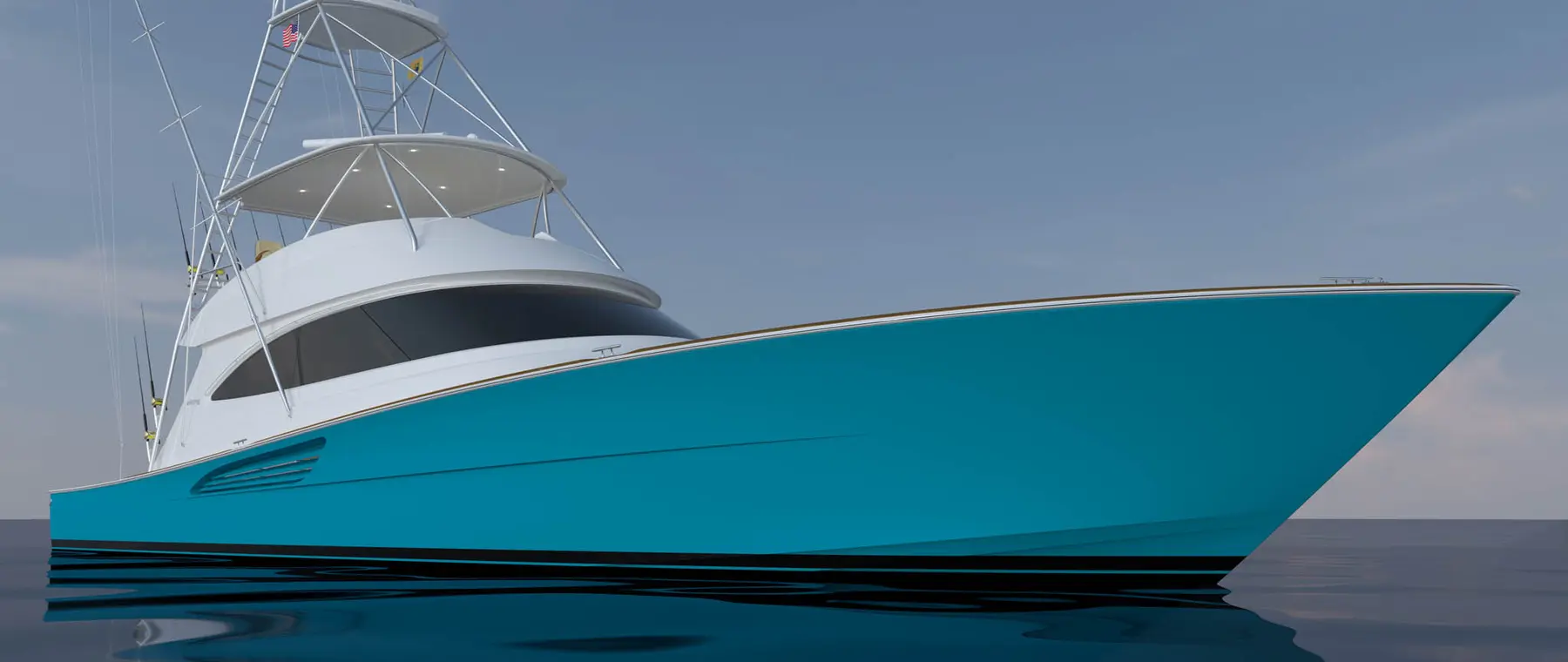
Viking Yachts is preparing to present the second generation of its 70 Convertible at the 2026 Fort Lauderdale International Boat Show, scheduled for 28 October to 1 November. The New Jersey builder describes the 70 C as a four-stateroom, five-head sportfishing yacht designed around the demands of serious offshore use. The world premiere will put a new interpretation of the company's 70-foot class in front of buyers who expect both tournament capability and accommodation for extended cruising.
The launch matters because a large convertible is an unusually complex compromise. It needs substantial cockpit working space, good lines of sight from the bridge and a machinery installation designed for sustained offshore travel. At the same time, the interior must function as comfortable living accommodation, not simply as a place to sleep between fishing trips. Viking says the new yacht has been designed with that complete use pattern in mind.
A different hull for a familiar size class
At 70 feet 10 inches overall, or 21.59 metres, the new Convertible has a beam of 18 feet 11 inches and a stated draft of 5 feet 6 inches. Viking's design team has adjusted the relationship between hull length and beam, drawing on experience from the shipyard's more recent 74, 82 and 90 Convertibles. The builder says the new hull is three inches narrower than its second-generation 68, with revisions to deadrise, chines and strakes intended to refine running behaviour.
These changes may sound small in isolation, but hull geometry can affect spray, trim, fuel demand and the way a boat responds at speed. The yard has not published certified fuel-consumption comparisons for the new 70, and prospective owners should treat efficiency benefits as design intentions until trial figures become available. Its more measurable attributes include a reported standard-fuel displacement of 118,500 pounds and an overall beam of 5.77 metres.
The cockpit was lengthened to provide crews with more room to work while fishing. Viking stresses that the modification was integrated into the machinery arrangement and weight distribution rather than added as an isolated extension. It is a practical point: stern working space is especially valuable when anglers, deckhands and equipment need to move around quickly, while the boat's attitude in the water still matters for offshore comfort.
A bridge designed for the skipper and the crew
Visibility aft has been a particular focus of the open flybridge. The design features a reshaped overhang and a helm console repositioned to improve the skipper's view into the cockpit. Three helm chairs face an arrangement of flush-mounted electronics displays, with lounges forward and on both sides. The aim is to let the person running the boat monitor the fishing operation without isolating the rest of the crew.
The new 70 will also accommodate Palm Beach Towers equipment, a tuna tower, outriggers and omni sonar integration. Those options speak to an owner profile for whom navigation, fish finding and the ergonomics of the fishing deck are central purchasing criteria. The builder has made provision for the systems, but the final installation will depend on the specification agreed for a particular yacht.
Beyond sportfishing, the bridge seating arrangement makes sense on passage. Family members or guests can spend time close to the wheelhouse activity while the vessel travels between destinations. There is a useful distinction between an attractive bridge for show visitors and one that remains comfortable after hours of running; sea trials will provide the best evidence of how the new arrangement performs in that role.
Five heads and four staterooms below
The accommodation layout is unusually generous for a boat whose cockpit is so important. Viking specifies four staterooms and five heads, including a substantial master cabin, a forward VIP, guest spaces and an aft crew cabin with private access to the engine room. The separate machinery access should help reduce movement through guest accommodation when engineers or crew need to check equipment.
On the main deck, a dayhead is placed immediately to starboard of the salon entrance from the cockpit. That position allows anglers to use it without crossing the main living area in wet clothing, an unglamorous but important consideration on a sportfishing yacht. The salon combines a port-side L-shaped seating area, a raised starboard dinette with rod storage underneath and a galley designed to serve both guests and crew.
Two galley configurations are described, one with a peninsula and another with an island. They offer different balances between counter space, seating and circulation; there is no universal answer because a tournament-focused boat may be used differently from one making family passages. Viking highlights in-house joinery and horizontal-grain walnut as elements of the finish, reminding buyers that an offshore platform is still a substantial private residence afloat.
Propulsion options and what remains untested
Viking lists two intended primary engine choices: MAN V12X 2200 diesels rated at 2,200 metric horsepower each and MTU 12V2000 M96Z diesels rated at 2,222 metric horsepower each. The builder is also using its Advanced Propulsion System, which brings together running-gear elements including hydrodynamically aligned components, propeller pockets and electronic power steering. Those features are presented as a package for control and running efficiency rather than separate styling additions.
Importantly, Viking cites an approximately 43-knot result from a previous 68-foot demonstrator as a benchmark for its development ambitions, not a verified top speed for the new 70. It would be premature to give the 70 a confirmed maximum speed or range before independent or manufacturer sea-trial figures are released for the actual boat. The published standard fuel capacity is 2,027 US gallons, with an optional 2,530-gallon arrangement, which gives buyers a starting point for discussing passage planning.
Support systems identified by the yard include water treatment, raw-water management, ventilation and fire suppression, with service access considered in the engine-room layout. These may be less conspicuous than a new hull profile, yet a large offshore boat's practical value depends heavily on equipment maintenance and redundancy. A prospective owner should examine access to pumps, filters, steering gear and electrical systems just as closely as the materials used in the salon.
Why Fort Lauderdale is the proving ground
The late-October show brings this second-generation model into an environment where experienced owners can compare deck layouts and accommodation directly with other new boats. Viking says it has delivered 220 yachts in the 68-to-72-foot range, giving the company a sizeable body of owner feedback on this class. The forthcoming presentation is therefore an evolution of a familiar type, even though the builder has started afresh with significant elements of the hull and cockpit.
The new boat will be displayed in open-bridge form with a Palm Beach Towers tower, while Viking also lists Enclosed Bridge and Sky Bridge variants. Buyers should check which features are fitted to the show yacht and which remain optional or planned for later builds. The most meaningful comparison after the premiere will combine onboard inspection with published sea-trial performance, because styling, layout and measured offshore behaviour all matter to this market.
For Leisure Boat Guide readers, the announcement is a reminder that specialist sportfishing design continues to evolve around very practical tasks. The new Viking 70 is bigger than a typical owner-operated day boat, but its cockpit workflow, bridge visibility and accommodation planning offer useful lessons for the wider motorboat market. Its world debut at Fort Lauderdale is confirmed by both the builder and show organiser; delivery timing and final performance figures remain matters for further official updates.