
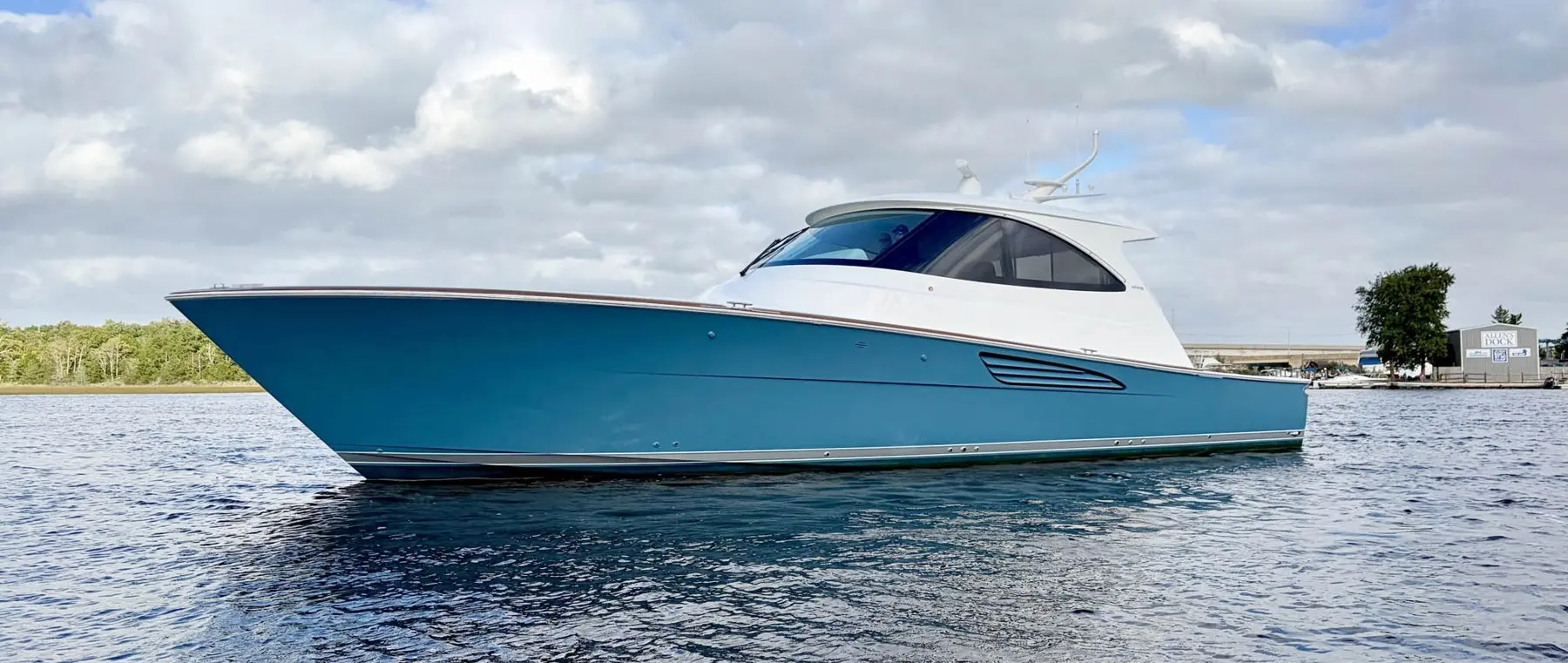
Viking's 50 Sport Coupe joins the Fort Lauderdale lineup
The Viking Yacht Company is putting its 50 Sport Coupe in the spotlight at the 2026 Fort Lauderdale International Boat Show, which takes place from 28 October to 1 November. The show organiser lists the model among the Viking and Valhalla introductions visitors can examine during the event. Viking itself introduced the 50 Sport Coupe programme in 2025, so its Florida appearance should be understood as a fresh show opportunity rather than the first public announcement of the design.
The 51-foot-eight-inch model occupies the middle ground between a tournament-oriented fishing boat and a coastal cruiser with protected accommodation. It combines the fishing equipment expected from Viking with a three-sided command deck and two cabins. That balance is likely to matter to owners who want substantial offshore capability without dedicating every weekend or every square foot of deck area exclusively to a fishing programme.
Sport Coupe or Sport Tower: the first choice
Viking offers the 50 Sport Coupe alongside a Sport Tower variant. The Coupe has a clean, lower profile intended for yacht-style cruising, while the Tower adds a tuna tower for offshore fishing and elevated spotting. Both share the builder's sportfishing hull platform, so the decision between them is principally about how an owner intends to use the boat rather than whether the underlying design is suited to open water.
The tower option can be appealing when fishing visibility matters, but buyers should ask how the added structure affects bridge clearance, maintenance, access and possible storage in a covered facility. The Sport Coupe's lower shape may prove simpler for routine marina and family use. Vessel configuration, rather than marketing labels, will ultimately determine how convenient either choice is on a particular route.
A fishing cockpit developed for serious use
The aft cockpit retains much of Viking's fishing equipment even though the boat also targets cruising owners. The manufacturer specifies in-deck fish boxes, a raised-transom live well and freezer and cooler storage below mezzanine seating. The published cockpit area is approximately 131 square feet, or 12.2 square metres, giving a meaningful working platform for anglers and a separate outdoor gathering zone for families.
How the cockpit is arranged matters more than the number of fittings in a specification. Rod access, drainage, live-well controls, safe footing and the route from the transom to the helm should all be assessed aboard the finished yacht. Owners who rarely fish should confirm whether the freezer and live-well arrangements can serve alternative purposes, and what maintenance those systems require when unused for long periods.
A sheltered command deck for changing weather
The Sport Coupe's command deck is enclosed on three sides, with an optional aft bulkhead to provide greater protection from wind and spray. Port and starboard dining areas and a raised helm combine the roles of navigation station and daytime saloon. Viking highlights a single-piece windscreen, good outward visibility and flush-mounted electronics, with Palm Beach-style helm controls reflecting the company's sportfishing experience.
For owners, the ability to remain near guests while steering is an important part of the design. Yet visibility to the aft quarters, ventilation, the possibility of air-conditioning and noise levels at normal cruise should be assessed together. The option of an aft bulkhead can change how enclosed the command deck feels, especially in hot climates, so prospective buyers should compare the actual configuration they intend to order.
Two cabins below the working deck
The lower level places a forward master cabin and a guest room with stacked bunks around a compact cruising interior. Viking offers queen or crossover berth arrangements in the forward space, allowing customers to choose a layout suited to couples or more flexible sleeping requirements. An ensuite bathroom for the forward cabin and alternative day-head or tackle-storage arrangements contribute to the vessel's dual cruising and sportfishing identity.
An L-shaped galley sits to starboard, with Viking describing Sub-Zero refrigeration, a microwave and cooktop among the selected appliances. The nearby dinette faces a television, while an optional Pullman berth or rod storage can occupy the outboard area. These choices are genuinely useful only when matched to intended usage: a family spending nights aboard may value another bed, while a committed angler could prize protected storage for expensive tackle.
Resin-infused construction and integrated systems
Viking says the 50 Sport Coupe uses a resin-infused fibreglass hull, with fuel tanks made using related techniques and positioned with weight distribution in mind. Lightweight resin-transfer moulding is used for selected hatches, doors and components, allowing the builder to manage structural consistency and fit. The construction is presented as an evolution of the yard's established production engineering rather than an experimental new material programme.
The company also integrates electronics and optional tower arrangements through its own specialist businesses, Atlantic Marine Electronics and Palm Beach Towers. Having installation work managed alongside the build can simplify equipment compatibility, but owners should still ask for a detailed wiring diagram, an accessible systems inventory and clear warranty contacts. A well-organised technical handover is particularly valuable on a boat with demanding navigation and fishing systems.
MAN diesel power and the published dimensions
Viking lists a pair of MAN V8 engines rated at 1,200 metric horsepower each as base power. Its model figures give an overall length of 15.75 metres, a beam of 5.21 metres and a draft of about 1.45 metres. Standard fuel capacity is approximately 3,785 litres, with an optional increase to around 4,542 litres. The figures make this a substantial owner-operated powerboat rather than a small weekend day cruiser.
Engine output and fuel capacity alone do not establish range, speed or running cost in real conditions. Those results depend on loading, sea state, selected equipment, hull condition and operating speed. Buyers should obtain up-to-date sea-trial information for the power package in question and confirm whether additional machinery space, generator choices or other options alter access for service and routine checks.
What to study at the boat show
The Fort Lauderdale International Boat Show offers a chance to assess the Sport Coupe's combination of fishing capability and sheltered family cruising in person. An inspection should begin with the sightlines from the main helm, movement between cockpit and cabin and the practical access to fuel, water and machinery equipment. These features determine whether a boat remains comfortable to operate when the novelty of a new model has faded.
Owners should then compare the options they actually need: tower or no tower, aft bulkhead, fuel capacity, forward berth choice, rod storage and day-head arrangements. A quotation that specifies each configuration will be more useful than comparing headline model names. The 50 Sport Coupe stands out because its cruising accommodation has not displaced the fishing DNA; the final judgement is whether that compromise fits the owner's most frequent days afloat.