
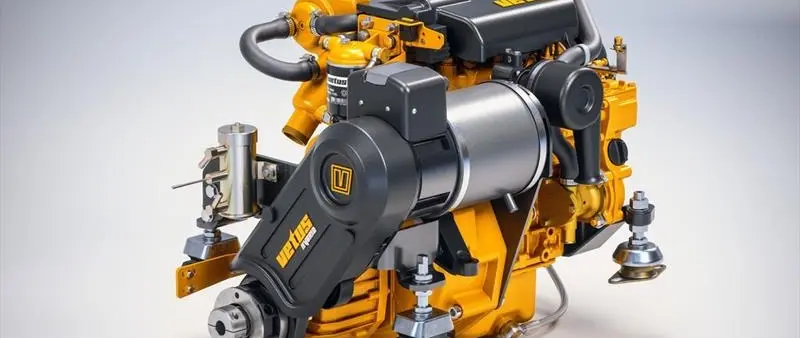
VETUS adds a hybrid route for existing small-boat engines
VETUS has introduced the M2HSET hybrid propulsion package for its M-Line two-cylinder marine diesel engines. Announced on 19 October 2026, the new system allows a compatible boat to manoeuvre quietly under electric power without abandoning the diesel engine that provides longer-range cruising.
The announcement is particularly relevant to inland-waterway boats, smaller cruisers and older craft undergoing refits. Instead of replacing an existing propulsion installation with a completely different engine, an owner may be able to add the electric-drive components to a compatible VETUS diesel arrangement. That can change how a boat is used in a harbour or canal, although feasibility depends on the specific installation.
Compatibility with the M2.13 and M2.18 diesels
The initial kit is engineered for VETUS M-Line two-cylinder diesel models M2.13 and M2.18. VETUS says the system was developed in-house with attention to engine speed, reduction ratio, shaft speed and the other parameters that influence smooth operation. Future hybrid sets for larger engines are planned, but the current announcement should not be taken as universal compatibility with the full M-Line family.
The electric motor works with the existing shaft arrangement, using a belt-and-pulley connection to transfer power. VETUS also says suitable retrofit installations can retain existing compatible engine mounts and propeller shafts. That matters because wholesale replacement of shaft lines, mounts and engine beds can add significant work to an otherwise straightforward upgrade.
The manufacturer gives the electric section a power figure of 2.1 kilowatts and torque of 17 newton-metres, operating on a 24-volt basis. These figures describe the electric component, not the output of the underlying diesel engine, and they are most useful when interpreting the low-speed duties for which the additional drive is intended.
Electric-only running in ports and canals
In electric mode, the boat can move at modest speed without running the diesel engine. The intended operating situations include entering and leaving marinas, passing through built-up waterways and travelling through areas where reducing exhaust, engine noise or vibration is particularly desirable. The propulsion system produces no exhaust emissions at the point of electric operation, but that is not equivalent to a claim of zero environmental impact over the battery's full energy cycle.
For some boaters, a quieter departure from a mooring is more valuable than the ability to cruise under battery power for hours. The final electric speed, range and endurance depend on the hull, propeller, battery bank, weather, current and installed configuration. VETUS has not supplied one range figure that applies to every boat fitted with this package.
Whenever greater speed or prolonged operation is needed, the skipper can switch to the diesel engine. This distinction is central to the hybrid approach: it adds a quieter option for particular parts of a voyage while retaining the familiar fuel-based propulsion for passages where battery capacity alone would be limiting.
Battery charging while the diesel runs
The M2HSET's electric machine can operate as a generator when the diesel engine is in use. VETUS says the arrangement can supply up to 30 amps back to the connected battery system, allowing owners to replenish battery energy during ordinary diesel-powered running. That reduces dependence on access to shore charging points, although it does not create free energy or eliminate fuel use.
Charging time will vary with the size and condition of the battery bank, other onboard electrical loads and how the motor-generator is being operated. Owners considering the kit should ask their installer to calculate expected energy consumption and charging performance for their particular hull, rather than relying on a broad marketing statement about electric cruising.
There is also an installation decision to make about the batteries themselves. The official announcement does not specify a single mandatory battery size or a universal runtime, so advice on cable sizing, protection, ventilation and monitoring should come from competent installers following the approved VETUS documentation.
A dedicated hybrid control lever
Alongside the propulsion package, VETUS has introduced a dedicated side-mounted controller called the ELPS2H. The V-CAN control lever is designed to make changing between electric and diesel modes more intuitive. It incorporates a neutral safety switch, helping prevent engagement when the system is not in a safe operating condition.
A dedicated controller may sound like a minor accessory, but helm ergonomics can determine whether a hybrid system is pleasant to use. On a busy small-boat helm, clearly identified modes and predictable responses are essential. Skippers should become familiar with the manufacturer's operating sequence before attempting close-quarters manoeuvres with passengers aboard.
What owners should confirm before ordering
The first question is whether the boat already has one of the two compatible M-Line diesel engines. A further review must cover available machinery space, the condition of the shaft and coupling, battery accommodation, electrical protections and what the installer needs to change. Even when the manufacturer describes the set as retrofit-friendly, the actual work cannot be assumed identical on every craft.
VETUS has not published a single installation price, all-inclusive package cost or independently verified speed and range table in the launch announcement. Buyers should therefore seek an itemised quotation, the applicable specifications and a realistic estimate of the electric-only operating envelope for their boat.
The new kit sits between two established options: a traditional diesel system and a full electric conversion. It provides the prospect of quiet harbour operation without expecting every cruising day to be powered solely by batteries. Whether it is a worthwhile change will depend on how much of an owner's normal boating takes place at slow speed, how frequently the boat can recharge under diesel and the total installation cost.