
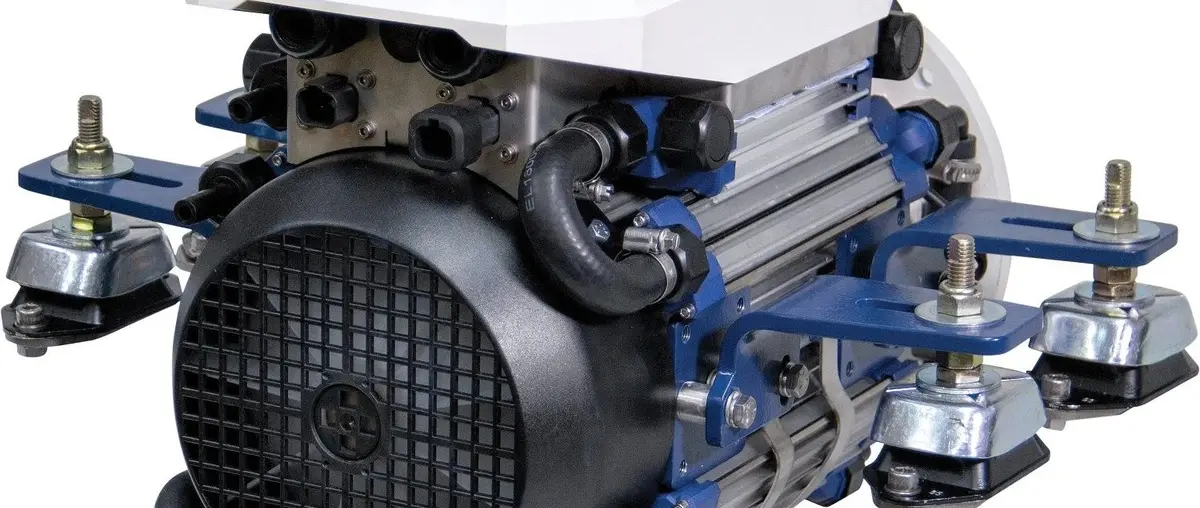
VETUS is continuing to promote its compact E-Line electric inboard propulsion range through the METSTRADE marine-equipment catalogue, emphasising adjustable Swap & Go engine mounts that can help a boatbuilder or refit specialist reuse an existing propeller-shaft arrangement. The manufacturer describes mounting brackets capable of being set to suit shaft angles of zero or eight degrees, together with height adjustment that can reduce the amount of structural alteration needed in a suitable engine compartment. This is a current review of an established range, not a claim that the entire E-Line platform launched for the first time in November 2026. For owners of modest sailing cruisers and displacement motorboats, its relevance lies in the complicated practical decisions behind replacing a diesel engine with electric propulsion.
The challenge begins with an existing engine bed
An older small cruiser may have an engine compartment shaped around a particular diesel engine, complete with mounting beds, shaft coupling, exhaust components, fuel lines and ventilation. Removing that engine creates an opportunity to change propulsion technology, but it does not automatically create suitable space for a different motor. A replacement may be narrower or shorter yet still require different mounting heights and alignment. VETUS designed its E-Line mounting arrangement to address part of that problem. Before assuming that a repower is straightforward, owners must have the present compartment measured and the structure inspected by a competent marine engineer.
What the Swap & Go arrangement is intended to do
The maker's METSTRADE product listing states that the E-Line can use specially developed adjustable engine brackets and mounts, permitting shaft alignment at zero or eight degrees. These positions refer to the mounting arrangement described by VETUS, not permission to fit any shaft at any angle. Height adjustment may help align the motor with an existing propeller shaft without rebuilding the entire engine foundation. A new propulsion installation still requires checks of thrust loads, coupling compatibility, shaft condition, vibration and movement under load. Even carefully engineered brackets cannot correct a worn bearing or an unsuitable hull structure by themselves.
Electric inboard power retains the familiar shaft drive
The E-Line is an inboard electric propulsion system intended for conventional shaft-driven boats. That distinguishes it from an electric outboard mounted on the transom, a pod drive beneath the hull and a waterjet. Owners who value the handling and underwater layout of their existing shaft may prefer to keep it. Yet the propeller's size and pitch still need assessment against the torque and operating-speed characteristics of the replacement drive. A propeller chosen for a diesel may not be optimum for an electric motor operating over a different power curve. A qualified designer should compare actual propulsion demand rather than make a simple engine-nameplate substitution.
Repowering is more than an engine swap
The diesel engine is only one part of a conventional propulsion system. It is connected to controls, fuel, exhaust, cooling and electrical equipment, and some of those components may serve other functions aboard. An electric conversion can eliminate certain diesel-specific systems but introduces batteries, charging equipment, protection devices and energy monitoring. If the previous engine supplied heat or charged an auxiliary battery, the owner needs a replacement plan for those services. A well-scoped project identifies every function of the equipment being removed before work begins. Missing one connection can turn an apparently simple motor installation into an unexpectedly expensive refit.
Battery capacity determines the useful operating programme
An electric inboard system requires enough stored energy for the boat's intended use, with an allowance for conditions that are less favourable than an ideal demonstration. A sailing cruiser may need only modest propulsion when entering or leaving harbour, whereas a canal boat or displacement launch may run its motor for several hours every day. These two duty cycles create radically different energy requirements. Owners should base battery capacity on measured or realistically estimated shaft power at representative speeds, not on a headline motor rating alone. Charging opportunities, reserve power and the consequences of unexpected delays belong in the same calculation.
The 48-volt architecture deserves serious design work
VETUS presents E-Line products within its electric-drive offering, which includes 48-volt motor configurations and associated control systems. Low-voltage compared with some larger installations does not mean low risk: substantial current can flow through battery conductors, and wiring faults can generate dangerous heat. Cable cross-sections, fuses, isolation, contactors, protective enclosures and suitable connections must be engineered for marine service. Owners should not improvise a battery bank from mismatched cells or chargers simply because the components advertise the same nominal voltage. A specialist installer should verify electrical protection and document commissioning checks before the boat is returned to normal use.
Engine mounts have to manage thrust and vibration
Electric motors may operate more quietly than combustion engines, but they still transmit torque, vibration and propeller-related loads into the hull. Engine mounts need to control these forces while maintaining alignment. VETUS's adjustable mounts are intended to facilitate installation, not eliminate the need for engineering calculations. A small cruiser with ageing beds or previous repairs may require strengthening before either an electric or diesel replacement can be installed safely. Mounts should be inspected after initial operation and according to the maker's service schedule, because movement or looseness may affect a coupling and stern gear over time.
Shaft alignment must be checked afloat
Alignment achieved while a boat is supported ashore may change when the hull is floating in its usual condition. Loading, hull flex and the movement of machinery can affect the final relationship between the drive coupling and shaft. That makes afloat checks an important part of many repower projects. The process should be tailored to the boatbuilder's and propulsion manufacturer's instructions, particularly where flexible couplings are used. Owners should not treat the ability to adjust a mounting bracket as a substitute for verifying runout, bearing condition and seal integrity. A satisfactory sea trial includes examining vibration and sound at different operating points.
Electric control changes how manoeuvring feels
One attraction of electric drive is precise torque control during low-speed manoeuvres. VETUS promotes responsive handling within its electric propulsion range, but the actual result depends on motor type, propeller, controller configuration and vessel behaviour. A skipper accustomed to a diesel gearbox may need time to learn the new throttle and reverse response. Training should include slow approaches to a pontoon, stopping under way and the correct response to a power-system warning. A motor's ability to change direction quickly does not guarantee that a heavily loaded boat can stop within a fixed distance in all conditions. Real handling remains affected by wind, current and hull momentum.
Quiet cruising needs realistic expectations
Electric propulsion can reduce engine-room noise and eliminate local diesel exhaust when operating from batteries, making slow cruising more comfortable for some owners. However, the propeller, shaft bearings, water movement and onboard hotel equipment may still produce sound. The level of improvement depends on the original engine and the installation quality. A poor mount or misaligned shaft can undermine the acoustic advantage of a smooth-running motor. Buyers should seek demonstrations in comparable boats, ideally at speeds they expect to use often. A silent workshop demonstration does not prove that the complete propulsion system will be quiet under load.
Charging facilities must match where the boat travels
A berth with reliable shore power may support regular electric cruising, especially when the boat returns to the same location each evening. A vessel that visits remote anchorages or travels long distances under power faces a different problem. The time required to replenish energy depends on battery capacity, charge rate and available electricity, and charging equipment itself must be marine-suitable. An owner should map likely overnight locations and determine how many hours of charging will realistically be available. If the vessel must operate without shore access for extended periods, the energy plan needs additional sources or a modified itinerary.
Cooling and service access remain important
Electric motors and their control electronics generate heat, and marine propulsion designs use specified cooling arrangements to keep components within operating limits. The precise E-Line model and its installation manual determine the applicable coolant, pump or heat exchanger requirements. Replacing a diesel should not result in inaccessible electrical modules or cooling components behind sealed cabinetry. Owners should confirm that service technicians can reach terminals, coolant connections, mounts and any diagnostic interfaces. Routine maintenance may differ substantially from a combustion engine, but there is still a need for periodic inspection of bearings, cooling, electronics and protective devices.
The product photograph identifies real equipment
The accompanying first-party VETUS webshop image is a studio photograph of an actual E-Line electric inboard motor with its metal housing, mounting hardware and connection points. It is not a photograph of a completed repower or a vessel underway, so it provides no independent evidence of speed, range or installation suitability. The technical mounting claims in this report originate from the VETUS-authored METSTRADE E-Line catalogue entry and the company's published electric-propulsion information. This distinction prevents a product portrait from being mistaken for proof that a particular owner installation has been successfully completed.
Why total cost includes more than motor price
A realistic comparison between retaining a diesel and adopting electric propulsion should include equipment purchase, batteries, charger, mounting work, shaft and propeller changes, controls, survey, electrical distribution and commissioning. It should also address insurance implications and the value of the boat after the conversion. Electricity may cost less than diesel per unit of energy in some places, but battery replacement and the cost of a major refit can alter lifetime economics. Owners who make short frequent journeys may value quiet operation and ease of use more than a rapid financial payback. A clear budget should separate tangible operating savings from personal preferences.
The right boat is the one with a suitable duty cycle
The E-Line concept is particularly attractive where a boat has a conventional shaft arrangement, sufficient space for a properly protected energy store, and regular access to charging. A small displacement launch used for predictable local trips may present a simpler energy problem than a cruiser expected to motor into strong headwinds across long passages. Sailing boats may also vary widely in how much auxiliary propulsion they require. The owner should write down an annual operating profile before requesting an equipment quote. An installer can then select the correct E-Line model, battery capacity and charging design, or advise when a different propulsion approach is more appropriate.
What to verify before ordering an E-Line system
The first steps are to inspect the engine foundation, measure the compartment, document the shaft geometry and establish required propulsive power. Next, obtain written compatibility information for the exact E-Line model, mounts, propeller, batteries, controls and charging components. Request a quotation that includes all structural and electrical work and an afloat sea trial. VETUS's Swap & Go mounting approach may remove one significant barrier to electric repowering for compatible compact cruisers, but it cannot turn every diesel-to-electric project into a bolt-on exchange. Good results come from sound engineering, realistic range planning and dependable ongoing support.
Original industry sources and image credits
Lead image: VETUS E-Line compact electric inboard with Swap & Go mounting hardware — official physical motor photograph. © VETUS. Original supplier image.
