
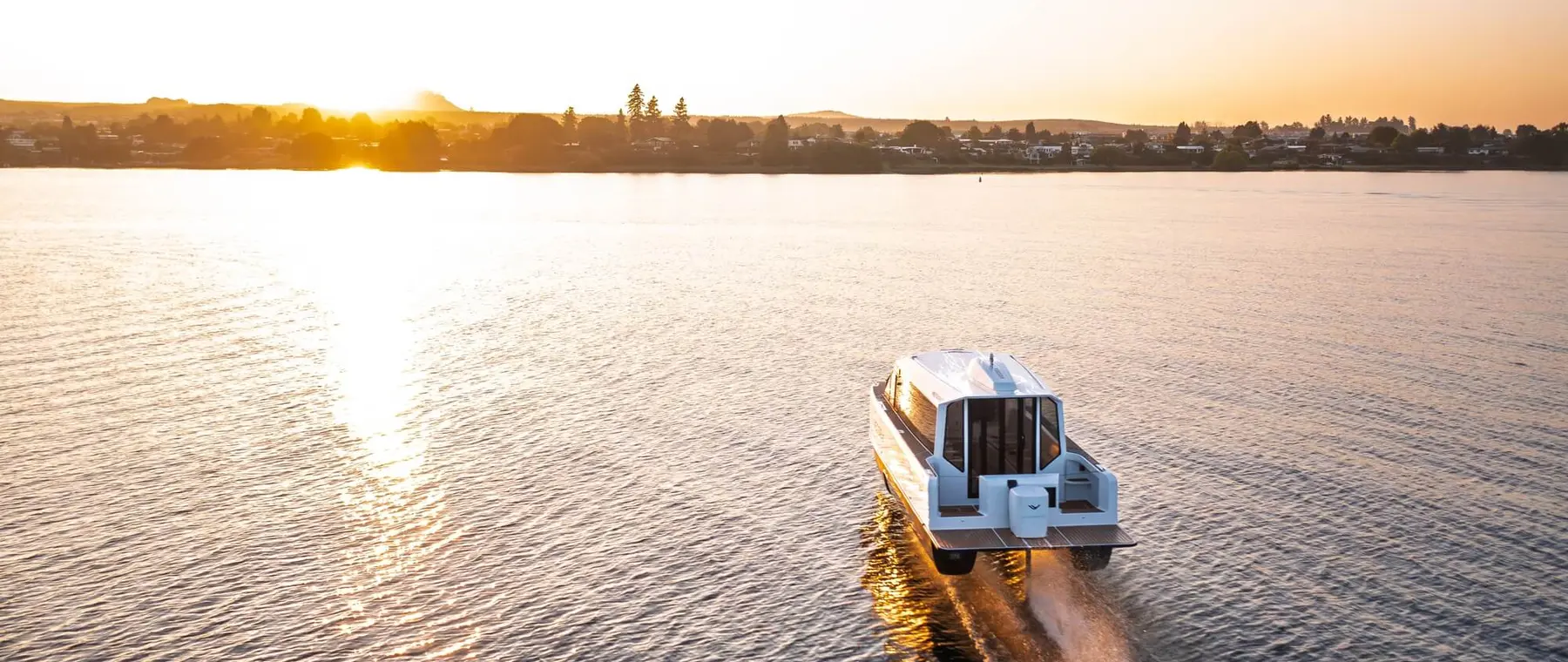
Design recognition for an operating electric vessel
New Zealand company Vessev's VS–9 has earned a Gold award in the Product, Automotive and Transport category of the 2026 Australian Good Design Awards. The ten-passenger electric hydrofoil is not a newly announced boat: the developer says it entered commercial passenger service in January 2025. The new recognition concerns the way that an operating vessel brings hull, foils, electric propulsion and passenger accommodation together.
The distinction matters in a market where electric-boat announcements often describe prototypes or proposed services. Vessev is presenting an existing commercial craft as a platform for routes where low wake, quiet operation and efficient energy use matter, while the award evaluates the design thinking behind that approach.
Hydrofoils tackle the drag problem
A conventional displacement craft pushes a substantial part of its hull through the water throughout the journey. VS–9 is designed to lift the hull clear on actively controlled carbon-fibre hydrofoils once operating conditions allow. Reducing the wetted area can cut resistance and thus the electrical energy required to maintain speed.
The company's award submission states energy consumption can be reduced by up to 90 per cent through its hydrofoiling approach. That is a manufacturer-reported upper-end claim, not an independent guarantee that all routes, speeds or sea states produce the same saving. Loading, weather, time spent in displacement mode and service patterns remain relevant to a real-world assessment.
Ten passengers in a purpose-designed cabin
The full standing-height cabin has seating for ten passengers arranged longitudinally. Vessev describes the layout as encouraging interaction between travellers while preserving views of the water. Two continuous curved-glass elements wrap the cabin and taper towards the stern, creating a comparatively clean profile around a working passenger vessel.
The carbon-fibre construction is intended to keep weight down, an important factor when the available energy must lift a loaded boat onto its foils. Integrated roof grab rails, generous gunwale width and access to the bow are among the practical details highlighted in the design documentation. Such decisions are particularly important for a vessel that spends each working day boarding and disembarking people.
An electric driveline developed in-house
Below the waterline the VS–9 combines its controlled foils with Vessev's proprietary VS–Drive. The developer describes this as a direct-drive podded electric motor system rated at 65 kilowatts. The electrical installation uses lithium iron phosphate batteries identified in the award entry as DNV type-approved, giving a useful indication of the approach to equipment selection.
At the helm, a display pod holds two 16-inch navigation screens and separates the main displays from physical controls below. Vessev says the layout was arranged for operation when seated or standing. The emphasis is on clarity and ergonomics during repeated short passages rather than a recreational helm designed solely around occasional private trips.
Passenger service offers an early proving ground
According to the 2026 award submission, the VS–9 fleet has covered more than 10,000 nautical miles in commercial service. The company also attributes more than 51 tonnes of avoided carbon dioxide emissions to its operations. Those numbers are presented as its own operating and impact figures; methods, baselines and route conditions are necessary for detailed comparisons.
The company points to interest in applications such as tourist journeys and local water transport, including Tasmanian, Perth and Northern Ireland settings. A shallow-wake passenger craft can be attractive around sensitive shorelines, but any specific operating route still requires suitable permissions, safety arrangements, infrastructure and a realistic assessment of the sea conditions.
How it differs from a small leisure boat
At under ten metres, VS–9 is within the physical size range familiar to many recreational boat owners, yet the purpose is distinctly commercial. Passenger capacity, certification, charging cycles and operator economics drove the specification. It would be misleading to frame it simply as a luxury dayboat or a universally available private cruiser.
For leisure boat enthusiasts, its importance lies in the lessons that may eventually cross into smaller craft. Efficient foiling, the handling of large curved glazing, an uncluttered helm and an integrated electric drive offer a glimpse of what designers are solving. Equally, a successful ferry does not automatically establish that the same arrangement works for fishing, wake sports or a rough-weather coastal run.
A measured view of zero-emission claims
While running on battery power the boat has no onboard exhaust emissions from a combustion engine. That is a clear benefit for air quality and local experience, especially on a route with frequent journeys. The wider environmental impact also depends on electricity generation, battery production, construction materials, maintenance and eventual disposal.
Similarly, Vessev's descriptions of minimal wake refer to the hydrofoiling operating condition and should not be interpreted as an unconditional absence of wash near docks or during acceleration. The appropriate comparison is measured performance along a defined route, with local speed restrictions and operational limitations respected.
The next test is repeatable transport
The Australian Good Design Gold award highlights an integrated answer to a difficult engineering brief: how to provide useful passenger service while reducing the power normally needed to move a boat across water. Vessev's contribution combines foil control, carbon construction, propulsion and a practical passenger cabin in a single design.
Further adoption will depend on route economics, certification, reliable charging and maintenance as much as styling. Readers can inspect the official 2026 award project and Vessev's own documentation to distinguish verified operating information from forward-looking ambitions. For the wider small-craft market, VS–9 is a useful real-world development to watch.