
An inflatable designed to feel like a canoe
Verano has presented its Calgary among the Paddle Sports Show's 2027 inflatable products, seeking to combine the familiar open layout of a canoe with the storage and transport advantages of an inflatable craft. The manufacturer describes a design intended to accommodate one to three paddlers and their gear, making it a possible option for families or users who cannot keep a rigid canoe at home.
Portability is not the only consideration. An inflatable that carries several people still needs a suitable hull shape, secure seats and enough stiffness to track in a predictable manner. The Calgary's construction is intended to address those needs without requiring a permanent trailer or a large storage building.
Four metres long with generous capacity
The Calgary measures approximately 4.06 metres long and 1.05 metres wide. Verano specifies a maximum payload of 350 kilograms, which includes all occupants and the equipment aboard. The beam provides substantial interior room compared with a compact single-person kayak, but owners must consider how the load is distributed along the hull.
A maximum figure is not a recommendation to operate the craft fully loaded in every environment. Passengers, dry bags and paddling equipment affect trim and handling, and wind may influence a broad inflatable more strongly than a rigid narrow hull. A family should begin with a short outing on sheltered water and learn how the boat responds to its normal load.
A drop-stitch floor provides structure
At the centre of the Calgary's design is a high-pressure double-layer drop-stitch floor inflated to a stated ten PSI, or around 0.7 bar. Closely connected internal threads help the floor maintain a relatively rigid shape when correctly inflated. Larger PVC side chambers provide buoyancy around the paddlers and contribute to the canoe-like outline.
Correct inflation is essential. The owner should use a suitable pressure gauge and follow the manufacturer's recommended procedure rather than relying on how firm the surface feels by hand. Temperature changes can alter internal pressure, so users need to understand how to monitor and adjust it. Overinflation or neglect of a valve can cause unnecessary damage.
A central tube and removable fin
Verano describes a dedicated central tube intended to support the hull geometry, while a removable fin can improve directional tracking on flatter water. This approach reflects an effort to give the inflatable more of the predictable movement expected from a conventional canoe, especially during longer straight sections.
The fin may need to be removed or protected in shallow water and during some landings. Its benefit depends on the route, and it does not provide the control of a rudder or replace effective paddling technique. Owners should practise turning and correcting direction with a full complement of passengers before beginning a longer journey.
Why an inflatable appeals to small households
One of the principal attractions is that the Calgary can be packed away when not in use. A household without a garage or roof rack may find this easier than storing a four-metre rigid canoe. The design could also suit travellers who use a vehicle with limited carrying space, provided they account for the packed weight and accessories.
The convenience should be evaluated using the complete package, including seats, paddles, a suitable pump and any drying equipment. A craft may fold into a manageable bag while still being heavy to carry over a long distance. Buyers should compare the manufacturer's packed dimensions and realistic setup time rather than assume an inflatable is effortless to transport.
Use by a family of varying ages
Verano's submission presents the Calgary as suitable for solo paddling, couples and small groups, giving it more flexibility than a fixed single-seat kayak. That may appeal to families whose outings vary according to the number of people available. When paddled by fewer occupants, luggage placement and seating position become particularly important.
Young children require appropriate flotation equipment, active supervision and a layout suited to their size. A family should not assume that three designated places make the craft appropriate for every age. The boat's own operating instructions and local boating rules must guide the choice of passengers and conditions.
Maintenance remains important
An inflatable hull is less demanding to store in one sense, but it introduces fabric, seams, valves and fittings that require attention. The owner should rinse away salt or grit, dry the boat thoroughly and inspect for abrasion after contact with rocks or a launch ramp. Repair materials must be compatible with the actual construction.
Storage pressure and temperature should be managed according to the manufacturer's instructions. Leaving the craft wet in a tightly closed bag can create odour and damage, while sharp objects packed near the hull may cause punctures. These habits are especially important for a boat used repeatedly by families or rental businesses.
A genuine image of the Calgary in use
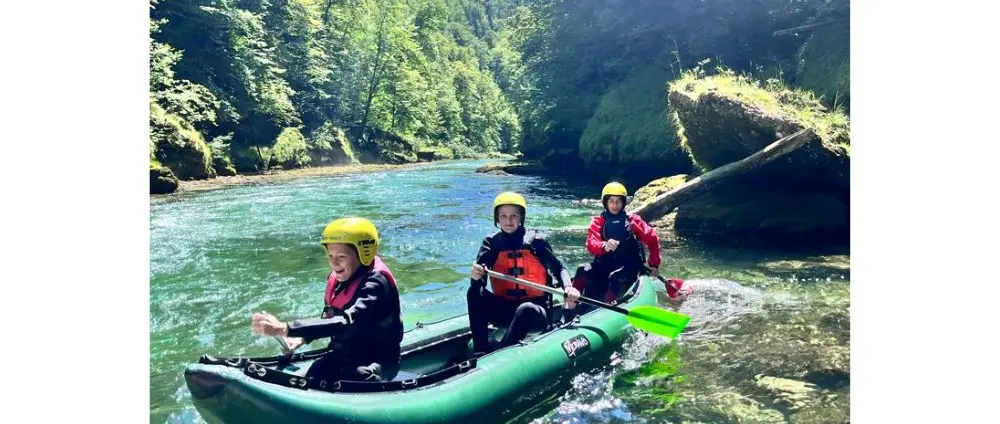
The official show photograph accompanying the product depicts three paddlers travelling in a green inflatable canoe on a river. It is a relevant demonstration of the actual type of outing being described, not a generated mockup or an unrelated boat. The scene also indicates why paddlers may value a shared open layout for a relaxed scenic journey.
The 2027 product entry confirms Verano is presenting the Calgary to the industry, not that it won a category award. Interested owners should confirm current configurations, price and warranty through the manufacturer or authorised retailer. The most useful decision is whether the craft's actual inflation routine, loaded handling and transport arrangements match the trips the household will undertake.
Preparation before the first family launch
A family considering the Calgary should establish which seats, carry bags, pumps and repair items are included in the offered package. The demonstration craft may contain equipment not supplied in every regional configuration. Different inflatable chambers can have different pressure limits, and a valve adaptor that suits one product may not work with another. A complete trial inflation at home is a practical way to learn the manufacturer's sequence.
Deflation and storage deserve similar attention. The crew should know how to remove excess air without trapping grit, fold the material without unnecessary strain and dry the boat after returning home. A portable canoe remains convenient only if its routine setup and packing are realistic for the people using it. These details often matter more than the shortest possible advertised inflation time.