
Twin Disc reports growth in fiscal first quarter
Marine drivetrain and propulsion supplier Twin Disc has reported sales of $88.7 million for the first quarter of fiscal 2027, an increase of 10.9 per cent from the comparable period a year earlier. The figures were released on 4 November 2026 for the quarter ended 25 September. The Milwaukee-based company's products serve pleasure boating, commercial vessels, defence and industrial markets, so the results offer a view of several marine supply chains rather than a direct measure of recreational boat sales alone.
The company also reported a return to attributable net profit, with income of $3.4 million compared with a loss of $0.5 million a year before. Its gross margin remained at 28.7 per cent, despite changes in the mix of products sold. This combination suggests that more revenue reached the business without a corresponding improvement in the gross margin percentage. The distinction is important when assessing whether growth reflects stronger activity, better pricing or changes in operating costs.
Marine and propulsion sales rise 14.4 per cent
The Marine and Propulsion Systems group generated $55.153 million in quarterly sales, up from $48.226 million in the first quarter of fiscal 2026. That is a year-on-year increase of 14.4 per cent, according to the company table. The group accounted for approximately 62 per cent of Twin Disc's total quarterly revenue, calculated from the published figures. This substantial proportion explains why developments in marine propulsion remain central to the company's financial performance even though it serves other industries.
Twin Disc attributed part of the revenue improvement to continuing strength in its Veth product line, alongside increased defence demand and more favourable conditions in other end markets. Veth is associated with marine propulsion equipment, including systems relevant to vessel manoeuvring and power delivery. That does not establish how much of the growth came from privately owned pleasure boats. The company's reporting groups multiple marine customers together, and no separate figure for leisure craft demand was presented in the announcement.
Profitability improves from last year's loss
Gross profit for the quarter was $25.4 million, compared with $22.9 million a year earlier, while gross margin held steady at 28.7 per cent. The company reported attributable earnings of $0.24 per diluted share, against a loss of $0.04 per diluted share in the corresponding period. Those are distinct measures: gross profit reflects the relationship between revenue and direct costs, while net income also includes other operating, financing and tax items.
Twin Disc also reported EBITDA of $7.7 million, an increase of 62.6 per cent year on year. EBITDA is an alternative performance measure and should not be treated as interchangeable with net income or cash generated during the period. The company said the improvement in attributable earnings was associated with higher operating income and lower interest and other expenses. Readers assessing the durability of the improvement should examine the full statements and the definitions used for adjusted or non-standard financial measures.
Backlog gives a six-month demand indicator
Twin Disc's reported six-month order backlog reached approximately $190.6 million, up from $178.3 million at the end of fiscal 2026. Management described the backlog as supported by ongoing demand, with defence-related orders becoming a more important component. A backlog is a measure of orders expected to ship within a specified window, rather than revenue already earned or cash already collected. Some orders can also change timing depending on customer requirements and manufacturing constraints.
The company highlighted increasing defence activity in Europe and the United States, including its Finnish subsidiary Katsa and early orders associated with an American unmanned-vessel programme. That provides a reminder that marine suppliers may benefit from defence procurement even while leisure-boat markets follow different cycles. For a boatbuilder choosing components, the practical implication to monitor is capacity across shared supply chains. The announcement itself does not claim that recreational buyers face shortages or revised delivery dates.
Industrial and land-based groups move differently
Sales in the company's Industrial product group rose to $14.038 million from $10.378 million, a gain of 35.3 per cent. By contrast, Land-Based Transmissions revenue declined 14.7 per cent to $14.973 million from $17.558 million. The Other group recorded $4.581 million compared with $3.834 million. Together with marine sales, these figures reconcile to the consolidated total of $88.745 million provided in the company's detailed first-quarter table.
The business also changed part of its internal sales classification from the beginning of fiscal 2027. It said $4.7 million of Katsa revenue that previously would have been shown in Land-Based Transmissions was instead assigned to Industrial. This matters for anyone comparing segment growth because a reporting-category change can influence the apparent movement between divisions. Analysts should use the company's explanatory notes rather than assume that every increase or decrease represents a comparable change in underlying product demand.
European activity and global markets
Twin Disc said quarterly sales grew at double-digit rates in Europe and Asia-Pacific, including the effects of acquisitions, while its geographic revenue mix remained broadly consistent. Europe accounted for the largest regional contribution, followed by North America, Asia-Pacific and Latin America. The company also supplied an organic growth figure of 11.8 per cent, which excludes acquisition and currency effects. That measure is different from the headline 10.9 per cent change in reported revenue.
Regional sales do not indicate exactly where a vessel will ultimately operate, because equipment may move through distributors, original-equipment manufacturers or vessel builders before reaching an owner. Nor can the company's figures be read as a forecast for every regional boat market. They do, however, demonstrate the international reach of specialist drivetrain and propulsion equipment. For leisure-marine readers, such manufacturers can be useful indicators of developments in the wider supply system without serving as a substitute for boat registration data.
Cash, debt and financial flexibility
The quarterly release put cash at $26.7 million and total debt at $39.8 million. Management reported net debt of $13.1 million, a reduction of $16.4 million from the comparable first quarter a year earlier. Cash had increased 87.7 per cent year on year, while total debt was 9.0 per cent higher. These measures should be understood together; a business can increase borrowing and still reduce net debt if cash rises by a larger amount.
The company stated that it is seeking to maintain financial discipline while investing in manufacturing and international growth. It mentioned expansion of its European footprint, work to enhance production capability in Racine and ongoing evaluation of acquisition opportunities. Those are stated strategic priorities, not confirmation that a specific purchase has been agreed. For suppliers and marine equipment buyers, continued balance-sheet strength can be relevant to long-term support, but the release does not guarantee future financial performance.
What the results mean for boatbuilders
Boatbuilders source propulsion systems, transmissions and related components long before a customer takes delivery. A supplier reporting stronger sales and a larger order backlog may indicate healthy activity somewhere in its markets, but it cannot automatically establish stronger new orders for the leisure fleet. Twin Disc's figures mix defence, commercial marine and pleasure-craft demand. Therefore, an increase in the Marine and Propulsion Systems segment should not be portrayed as evidence that recreational boat registrations have risen by the same percentage.
Manufacturers and their dealers should consider both technical fit and lifecycle support when selecting equipment. Availability of spare parts, service expertise and compatibility with an individual hull are often as important as the equipment's headline specifications. The reporting period provides no new product compatibility information or blanket delivery lead-time promise. It does, however, offer a useful financial backdrop for an established name in the marine equipment supply chain, which serves diverse vessel types and operating conditions.
Management sees defence as a growth driver
Twin Disc's chief executive John Batten described accelerating orders from defence customers as an important contributor to momentum. The release highlighted the Katsa subsidiary's demand and work connected with the US Navy's initial unmanned-vessel activity. These developments belong to defence and commercial programmes, even though some technical capabilities may overlap with products used by recreational craft. There is no evidence in the release that a particular leisure-boat model has gained a new propulsion option as a result.
The company's broader strategy includes manufacturing investment and examination of potential acquisitions, alongside efforts to manage its financial position. Those comments reflect management's expectations and plans, and future outcomes can differ from the statements made at a quarterly results event. Leisure-boat owners should therefore avoid interpreting them as direct promises about price, inventory or delivery of individual systems. The value of the report is in its detailed, attributable numbers and the clear separation between completed financial results and outlook.
The key figures to follow next
For the fiscal first quarter, the central figures are $88.7 million in revenue, $55.153 million from Marine and Propulsion Systems, a 28.7 per cent gross margin and $3.4 million in attributable net income. The six-month backlog of $190.6 million adds a forward-looking order measure, while the company's cash and net-debt figures provide context for financial flexibility. All relate to Twin Disc's reporting calendar, which labels this the first quarter of fiscal 2027 even though it ended in September 2026.
The results show a business improving its quarterly earnings while receiving demand from several sectors with different economic drivers. Future filings will reveal whether that pattern continues and how much remains attributable to marine propulsion, defence and industrial activity. For the recreational boating industry, the responsible conclusion is more measured than a market-wide boom claim: one significant equipment supplier has reported stronger sales and profitability, but its diversified customer base means the figures cannot describe every part of the boating market.
Primary release and photograph credit
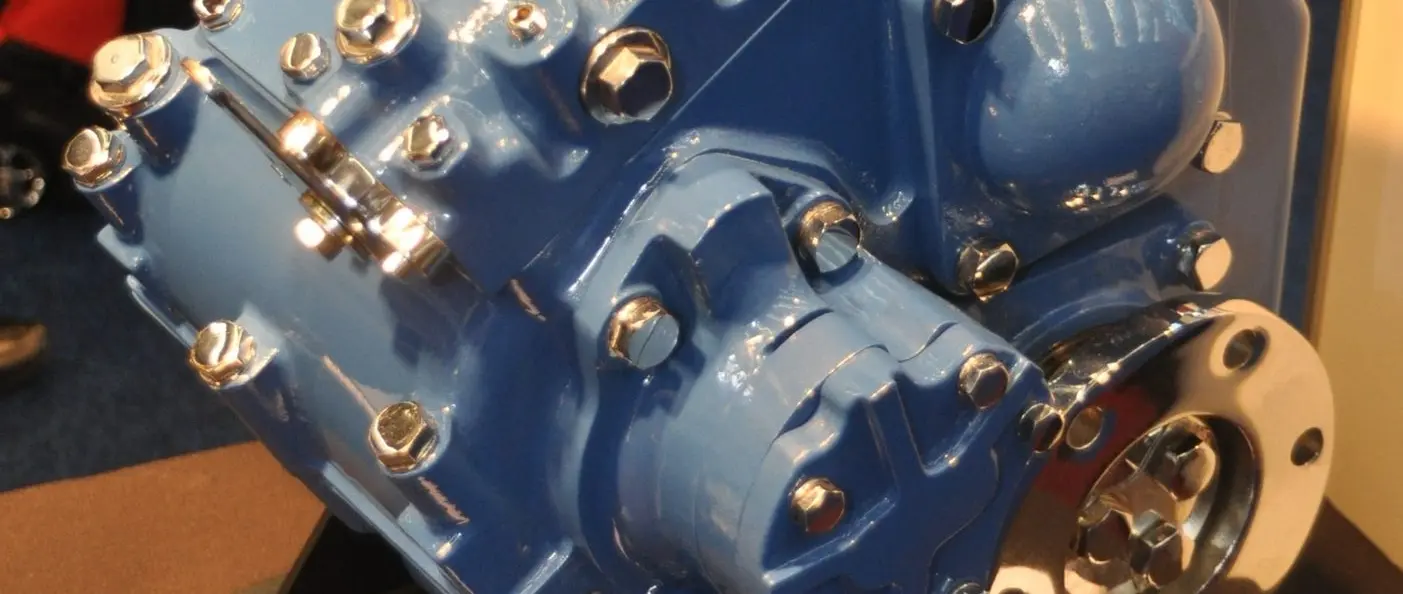
Original issuing organisation. An archival photograph of a PRM marine gearbox exhibited at METS in 2011; it illustrates the propulsion equipment sector and is not claimed to be a Twin Disc product. Photograph: S.J. de Waard, Wikimedia Commons, CC BY-SA 3.0; resized without cropping.
