
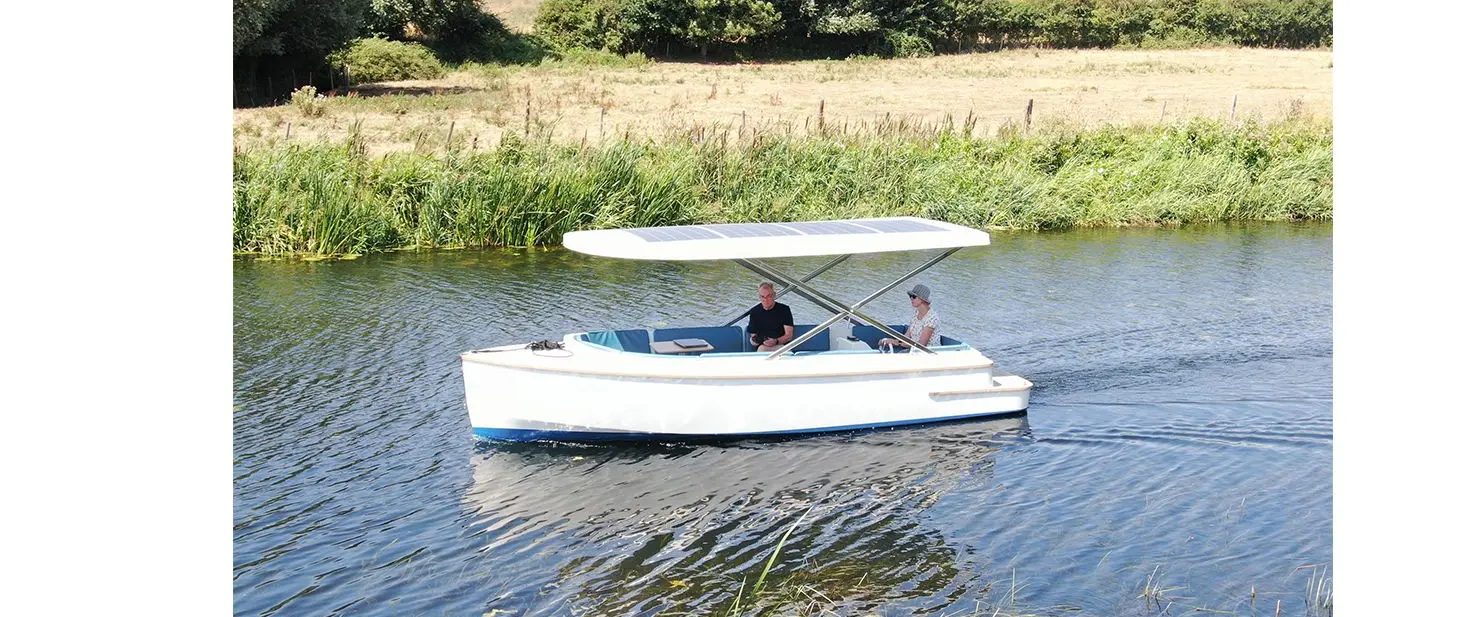
Torkmar co-founder Tim Knox and his wife Sue have completed a 124-mile passage down the River Thames aboard the DB1 solar-electric dayboat, relying on solar charging throughout the five-day trip. The route ran from Lechlade to Teddington and, according to the company’s published log, used neither a generator nor shore-power top-ups.
The passage took place during a period of hot weather and drought restrictions, adding operational constraints at locks along the upper Thames. Torkmar says the trip was intended as a practical test of the boat’s 5kWh lithium battery bank and 756W overhead solar array rather than a laboratory endurance demonstration.
Low-speed cruising kept energy use modest
The published figures show the DB1 drawing around 0.25kW while cruising at roughly 3.5 to 3.8mph. When speed increased to around 4.2 to 4.8mph for lock approaches or stronger pushes, consumption rose to approximately 0.5 to 0.6kW.
That relationship is useful for small electric-boat owners because modest changes in speed can have a large effect on endurance. Torkmar’s figures apply to this particular boat, route and loading, so they should not be treated as universal performance numbers for every solar-electric craft.
Solar input supported the full passage
Torkmar reports midday solar input of around 350W during the run, with the overhead array replenishing the battery while the boat was underway and between movements. The company is releasing the full power log so the trip can be examined in more detail rather than relying only on a headline distance.
The achievement does not mean weather or energy management can be ignored on longer inland passages. Cloud cover, current, lock delays, crew load and cruising speed can all change the energy balance, so trip planning remains central to practical electric boating.
What the run demonstrates for small boats
The DB1 passage shows how a lightweight inland dayboat can combine a relatively small battery with continuous solar input for low-speed river cruising. It also provides a real-world example of how carefully managed power demand can matter as much as headline battery capacity.
For Leisure Boat Guide readers, the significance lies in the operating data rather than a claim that solar power suits every use case. Fast coastal work, towing and high-speed planing demand very different power levels, but displacement-speed inland boating remains one of the most credible applications for solar-electric propulsion.