
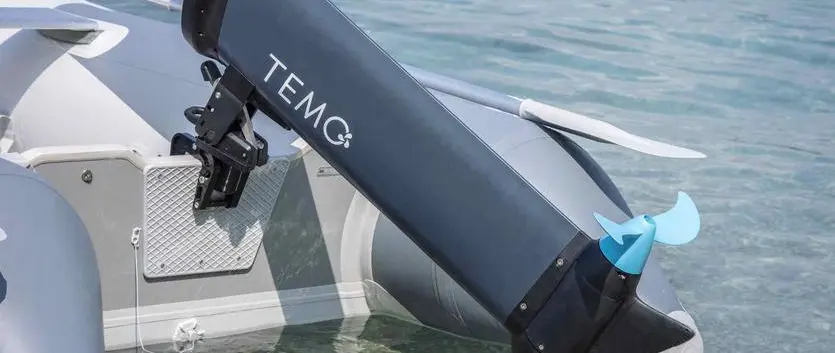
A portable propulsion system built around easy handling
French manufacturer TEMO is presenting its TEMO·1000 electric outboard in the current METSTRADE exhibitor catalogue, describing a portable motor intended for dinghies and smaller sailing boats. The original producer entry highlights a rotating mounting bracket, a retractable handle and a removable 5.5-kilogram battery. It reports a total motor weight of approximately 16 kilograms with the battery fitted and says the system can propel appropriate dinghies or sailing craft with a displacement of around 1.5 tonnes. The concept is particularly relevant to recreational boaters who frequently carry a tender, move a motor between vessels or operate from a small marina berth with limited access to charging. A lightweight electric drive may simplify certain parts of that routine, but the manufacturer description does not provide a universal speed, range, runtime or sea-state limit. Owners should treat the listed figures as product information that needs to be matched to their actual boat, load and planned voyage.
What TEMO's official listing establishes
The METSTRADE product page names the TEMO·1000 and describes it as an electric powered outboard with a rotating bracket intended to simplify mounting. It identifies a 5.5-kilogram removable battery, an overall product weight of 16 kilograms and a retractable handling arrangement. The reference to a boat of approximately 1.5 tonnes provides a broad indication of the supplier's intended application, but it is not a performance test under every condition. The catalogue does not identify the exact battery chemistry, voltage, energy capacity, available charging options or numerical operating range. Readers should not infer those specifications from the model number or the weight alone. Before ordering, a buyer should request the current technical data sheet, owner's manual, warranty terms and the maker's guidance on suitable boat displacement and mounting structures.
Why removable electric propulsion appeals to tender owners
A yacht tender may be used for short transfers between an anchored boat and a nearby landing, or for occasional excursions along sheltered water. In such situations, owners can value a motor that is relatively easy to carry, fit and remove. The advantage depends on how the tender is stored and whether the user can lift equipment safely. A petrol outboard introduces fuel, exhaust, noise and maintenance considerations; an electric unit shifts attention toward energy storage, charging and electrical care. Neither option is automatically ideal for every trip. Electric propulsion may be particularly attractive for frequent short passages, while longer distances and uncertain conditions demand careful endurance planning. A tender must remain capable of returning safely even when a trip takes longer than expected. The simplicity of fitting the motor is only one part of its suitability.
The significance of a 16-kilogram complete assembly
TEMO's stated total weight includes its removable battery. Sixteen kilograms may be manageable for some users but is still a substantial object to lift and position, especially from a moving dinghy or a slippery pontoon. Owners should not assume that the marketing description makes lifting risk-free. The shape, centre of gravity and available grip points matter as much as the scale reading. A rotating bracket may reduce awkward movements, but the exact safe installation procedure should come from the manufacturer. Older crew members or people with limited mobility may need help even with a lighter motor. The proposed mounting location should allow the equipment to be handled without leaning beyond the transom or placing fingers near pinch points. Portability is useful only when the system can be handled safely during normal operations.
Why a removable battery changes the routine
The battery is described as a separate 5.5-kilogram component, potentially allowing the energy pack to be removed for storage or charging. This can be convenient where a dinghy is kept outdoors or where the charger is located on a larger yacht. Yet removing a battery introduces additional handling and connector requirements. The owner should know how to isolate the motor, release the pack and protect the electrical terminals from water and contamination. A removable pack should not be stored loose where it can fall or suffer impact. The supplier must identify the correct charging equipment, permitted temperature conditions and any restrictions on transport. Battery safety depends on following the product's exact instructions, not on assuming that all small electric outboards use identical energy-storage technology.
What a rating of about 1.5 tonnes means
The manufacturer mentions sailing boats or dinghies around 1.5 tonnes, but this should not be interpreted as a guarantee of a particular speed or ability to make progress against wind and current. A displacement figure is only one part of vessel suitability. Hull shape, wetted surface, propeller, loading and operating conditions also influence propulsion requirements. A small sailboat may use an auxiliary electric motor to manoeuvre into a berth on a calm day, yet need additional reserve when facing adverse tide or weather. Owners should ask TEMO for guidance specific to their vessel and intended use, including maximum recommended displacement and any restrictions. A practical demonstration on a similar boat is valuable. A motor that moves one craft effectively may feel underpowered on another of the same approximate weight.
Speed is not the same as endurance
An electric motor can deliver a useful response at low speed, but the energy used over time determines how far a boat can travel before recharging. The TEMO·1000 exhibition summary does not provide enough figures to calculate a defensible runtime at various throttle settings. Owners should avoid borrowing range estimates from other models or treating nominal power as a fixed prediction of distance. The battery's usable capacity, the boat's resistance and weather conditions are crucial. A trip against a current may take longer and consume more energy than an outward journey with the flow. A skipper should begin with a conservative route and reserve capacity, then gain experience with actual consumption in safe conditions. It is essential to know the manufacturer’s low-battery warnings and how the motor behaves as energy becomes depleted.
The rotating bracket and transom fit
The producer describes a rotating bracket intended to make mounting easier. The design may reduce the need to lift the motor through an awkward angle, but the transom must still be compatible with the approved fastening arrangement. An inflatable tender may have a different transom construction from a rigid dinghy or small sailing boat. Owners should check mounting height, thickness, material and the clearance required when the motor turns or tilts. The bracket must remain secure under thrust and movement, and it should not interfere with the boat's tubes, rudder or boarding ladder. A poorly fitted motor can move unexpectedly, damage the transom or affect steering. Installation should follow TEMO's measurements and approved methods rather than improvised spacers or attachments.
A retractable handle and small-craft ergonomics
TEMO identifies a retractable handle as part of the TEMO·1000 design. This could help with storage or carrying, but its functions should be distinguished carefully: a carrying or positioning handle is not necessarily a steering tiller or a safe lifting point in every configuration. Owners should consult the manual before applying force to it. In a compact dinghy, controls need to be accessible from a suitable seating position without requiring the operator to lean dangerously or obscure visibility. The position of the throttle and emergency-stop arrangement are important questions to resolve during familiarisation. A motor may look simple but still have specific procedures for starting, stopping and reversing. Clear instruction reduces the risk of mistakes when transferring between boats or allowing a guest to operate the tender.
Noise and environmental considerations
An electric outboard can avoid local exhaust emissions from a combustion engine during operation and may feel quieter at certain speeds. However, noise from water movement, propeller loading and the hull still exists. The product's overall environmental impact depends on manufacturing, battery production, charging electricity, service life and end-of-life handling. The short manufacturer listing does not quantify emissions savings or prove that the entire product is carbon-neutral. Buyers can reasonably value reduced fuel handling and local exhaust while remaining cautious about broader environmental claims. Battery disposal and recycling should follow the supplier's guidance and local rules. An honest assessment recognises operational differences without promising that electric propulsion has no ecological footprint.
Charging aboard a larger yacht
A tender carried by a yacht may be charged from the mother vessel's electrical system, but compatibility must be confirmed rather than assumed. The owner should obtain the approved charger, its input requirements and the maker's instructions for safe storage during charging. A crew should not connect a battery directly to an unsuitable circuit or leave charging equipment exposed to spray. It may also be necessary to consider where the pack is placed during a passage and how the charging area is ventilated or protected according to the instructions. Keeping a battery charged can be straightforward when the workflow is organised, but forgotten charging can leave a tender unavailable at an inconvenient time. A checklist for battery state, installation and function before departure is a sensible part of tender operations.
Planning coastal and inland journeys
The right use case for a portable motor may include sheltered harbour transfers, short lake outings or auxiliary manoeuvring on a small sailing yacht. Those situations still require attention to weather, currents, local restrictions and the distance to a safe landing. Owners should not plan an extended exposed passage based only on the motor's apparent convenience. A small craft may have limited freeboard and little protection against deterioration in conditions. Safety equipment and appropriate communication devices must be carried according to the voyage, regardless of propulsion type. If the route involves frequent current or long stretches against wind, the battery reserve and motor capability should be assessed conservatively. The absence of a petrol tank does not make a small boat immune to the usual navigation risks.
Maintenance without the fuel system
Electric propulsion can remove some tasks associated with carburettors, spark plugs or petrol storage, but it does not eliminate maintenance. The propeller, shaft, brackets, controls and battery connections remain exposed to use and the marine environment. Salt deposits can affect metal fittings and electrical contacts, while fishing line may become wrapped around the propeller. The owner should follow TEMO's instructions for rinsing, inspection and storage, particularly before a long period of disuse. Any unusual resistance, vibration or loss of response should be investigated before the next trip. The motor should be isolated appropriately before any inspection near the propeller. Owners should also confirm service availability and approved replacement parts in their region. A convenient portable motor is most useful when it can be maintained without improvising repairs.
Comparing electric and combustion alternatives
A compact petrol outboard may offer a familiar refuelling routine and established service networks, while an electric alternative can simplify local operation and reduce the need to carry fuel. The trade-off depends on the distance travelled, available charging and the weight that must be handled. A buyer should compare complete systems, including battery, charger, mount and any spares, not just the motor's headline weight. The cost of replacing an energy pack may also matter over a longer ownership period. Owners should identify whether their primary need is quiet short-distance transport, an auxiliary propulsion system or repeated operation for several hours. No single format is automatically superior in every case. A rational comparison starts with the boat's typical journeys and credible endurance figures.
The relevance of TEMO·1000 in the current catalogue
TEMO's product page presents a recognisable portable electric outboard with a rotating bracket, retractable handle, 5.5-kilogram removable battery and a quoted complete weight of 16 kilograms. These are useful facts for owners assessing a tender or compact sailboat, but the source does not justify invented figures for range, top speed or charging time. For boats under twelve metres, the TEMO·1000 is worth evaluating when easy handling and short-distance electric propulsion fit the operating programme. The final decision must include suitable mounting, realistic energy reserves, correct battery care and a safe plan for every journey. A portable motor can make routine boating more convenient, provided its limitations are understood and it is treated as part of the vessel's complete propulsion and safety arrangement.
Original industry sources and image credits
Reporting based on TEMO France first-party TEMO·1000 electric outboard technical product catalogue entry with specified 16kg total weight, 5.5kg removable battery and rotating bracket..
Lead image: TEMO 1000 Compact Electric Outboard Targets Dinghies and Small Sailing Boats — producer original product photograph. © TEMO France. Original supplier image.
