
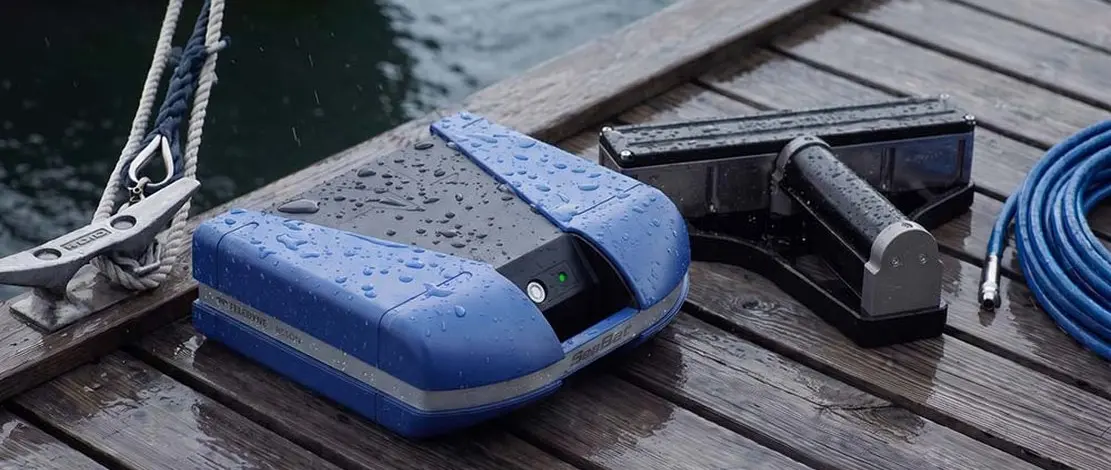
A survey sonar designed for open boats
Teledyne Marine has introduced the SeaBat T51-P, a portable version of its T51 multibeam echosounder built around a splash-resistant processor. Announced on 27 October 2026, the new configuration targets survey teams that work from open boats rather than enclosed hydrographic vessels. It brings a specialist instrument into a more flexible installation format, potentially allowing operators to collect detailed seabed information from smaller craft close to shore and around port infrastructure.
The development is relevant to the small-boat market because professional survey work is not limited to large dedicated ships. Shallow approaches, enclosed marinas and restricted waterways can be better reached from a compact vessel, provided the crew and instruments can operate safely. Teledyne's announcement does not turn the T51-P into a recreational fishfinder; it remains a high-specification survey system designed for hydrographic operators with demanding accuracy and data-processing requirements.
What changes in the portable version
The T51-P combines the established SeaBat T51 sonar with Teledyne RESON's portable sonar processor, known as the PSP. Teledyne describes the processor as IP-rated and splash-proof, allowing it to work in exposed marine environments where spray and occasional water contact are realistic considerations. The company does not assign an exact ingress-protection number in this announcement, so users should obtain the formal equipment rating before designing an installation.
One practical detail is the processor's acceptance of 24-volt direct-current power, which can make battery-based operation possible on a small survey platform. That does not mean any convenient battery is suitable. Electrical demand, supply stability, fusing, connectors and runtime still need to be calculated for the actual instrument package. In a small craft, where space for heavy auxiliary machinery is limited, a compatible portable power arrangement can be a meaningful operational advantage.
Wide-swath mapping remains the central capability
Teledyne says the SeaBat T51 offers 800-kilohertz operation and a full-swath sector extending to 170 degrees. A multibeam echosounder measures many points across a wide section of seabed rather than taking only the single depth line familiar from a basic recreational sounder. This can help a survey team build a more complete picture of bottom shape, objects and changes around coastal structures.
The 170-degree figure describes the potential angular coverage of the sonar system, not a guarantee of complete seabed coverage in every water depth or environmental condition. Survey geometry, acoustic conditions, vessel motion and positioning all affect usable data. Similarly, a high operating frequency can support detailed measurements but comes with trade-offs in propagation and effective working distance. Buyers should evaluate the instrument against their actual survey depth and required resolution.
Small craft can access different survey areas
Open boats and dinghies are commonly used where draft, width or access makes a larger vessel impractical. Teledyne expressly identifies those working conditions as the motivation for the portable processor. An operator may need to launch from a beach, use a small berth or work within a harbour that remains active throughout the day. A transportable sonar package can support such assignments without requiring a dedicated enclosed survey cabin.
That flexibility is not the same as eliminating the challenges of collecting high-quality hydrographic data from a small platform. Open craft are more exposed to waves, vessel movement and changes in trim, all of which may affect the measurements. Surveyors still have to manage mounting geometry, sensor alignment, position and motion compensation where required. The more portable instrument is therefore an enabler, not a replacement for professional survey procedures.
Automatic settings reduce adjustment workload
The manufacturer lists automated sonar controls among the T51-P's retained capabilities. Its SeaBat tracker system is intended to adjust settings automatically as conditions change, helping an operator maintain useful returns without constant manual intervention. That could be especially valuable when the small crew aboard an open boat must manage the vessel, communications and equipment at the same time, rather than staffing a dedicated survey control room.
Automation deserves realistic expectations. It can reduce repetitive adjustments, but it cannot independently validate every survey requirement or decide whether a noisy return is safe to use. Operators need to review the output, calibrate and check the system as directed, and maintain awareness of interference or changing conditions. A feature that saves attention during collection should leave more capacity for quality control, not weaken that discipline.
Adaptive gates follow changes in the seabed
Teledyne describes adaptive gates as a feature that can follow variations in the bottom profile. In practice, seabed terrain may include depressions, ripples and raised features that complicate the selection of reliable acoustic returns. A processing system able to follow these changes is intended to help retain good data across an uneven survey area while reducing the amount of manual adjustment required during the run.
That matters in a marina entrance, around a dredged channel or near a quay where the depth can vary over short distances. The announcement does not state that automated processing removes the need to inspect the recorded data afterward. Hydrographic deliverables still depend on meeting the client’s specified standard, documenting survey conditions and identifying any gaps. A practical gain is quicker collection of usable information, subject to verification after the boat returns.
Vertical detection is useful near structures
A further feature retained from the T51 range is vertical detection mode, which Teledyne highlights for identifying upright structures such as quay walls. Conventional bottom mapping focuses on the seabed beneath and around a vessel, but infrastructure surveys may also need to describe faces, obstructions and irregularities that rise through the water column. A suitable sonar mode can make the same instrument more adaptable across different jobs.
For harbour authorities, such information may support inspection planning and awareness of underwater conditions near berthing structures. However, sonar returns are not a substitute for a complete structural assessment, and the system's field of view must be checked against the survey geometry. A boat that can approach the target safely is useful only when the data can be positioned, interpreted and presented in a form that answers the original inspection question.
A practical alternative to enclosed installations
The principal appeal of a portable package is a different balance of size, protection and deployment. An enclosed survey vessel can provide protected workspace, reliable equipment mounting and extensive onboard power, but it also brings higher operating commitments. A splash-proof processor and 24-volt supply give smaller operators another configuration to evaluate, especially when their jobs involve shallow water and modest transit distances.
Portability does not necessarily mean plug-and-play interchangeability between boats. A professional setup still needs compatible transducers, mountings, cabling, power and positioning equipment. If a survey team changes platforms frequently, the value of the T51-P will depend on how reliably the system can be installed, checked and removed without compromising repeatability. Prospective buyers should ask for a complete deployment workflow, not only the weight of the processor.
Availability and the intended market
Teledyne says the SeaBat T51-P is available for ordering and delivery now. The October announcement includes comments from its hydrography and regional leadership, with particular reference to operations in parts of Asia where small survey vessels are widely used. The company presents the new version as an expansion of an established professional sonar family, rather than an entirely new acoustic principle or a consumer electronics accessory.
Price, bundled equipment, complete processor dimensions and a detailed installation bill of materials are not given in the release. Those are significant omissions for a purchasing decision because a survey system is assembled around more than the headline sonar. The cost of mounting, positioning, training and processing can be as important as the instrument itself. Operators should obtain a formal system quotation tied to the exact work they intend to undertake.
What the T51-P means for small-boat operations
The announcement highlights a useful direction for marine technology: instruments originally associated with dedicated survey vessels are being packaged for more flexible platforms. A compact boat can bring a sensor close to the area of interest, while improved protection and electrical compatibility may make deployment less complicated. That is especially relevant to operators whose contracts alternate between harbour inspections, coastal mapping and short surveys in inaccessible locations.
The next test is how the product performs in the field: how long setup takes, how well the mounting maintains alignment, and whether the resulting data meet the required standard in real sea conditions. Those practical details should determine procurement, not the word portable alone. For now, the verified development is Teledyne's release of the SeaBat T51-P with a splash-proof processor, 24-volt power acceptance and retained T51 survey functions for open-boat work.
Source: Teledyne Marine – SeaBat T51-P launch announcement, 27 October 2026.