
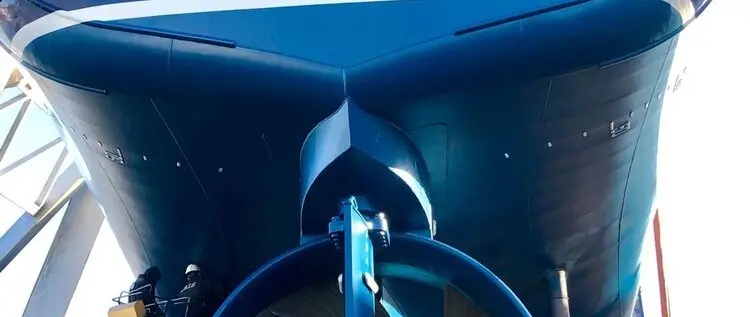
Teignbridge Propellers International has been named a joint Overall Winner at the 2026 DAME Design Awards for its T-CPP controllable-pitch propeller, a system that adjusts the effective pitch of a marine propeller by moving sections of the blade trailing edge rather than rotating complete blades within a large hub. The announcement was made at the opening of METSTRADE in Amsterdam on 17 November. Teignbridge also won the Propulsion and Dynamics category, sharing the overall distinction with Garmin's Signal VHF system and Scanstrut's wireless-powered navigation light. For small-boat readers, the story is an illustration of how marine propulsion efficiency is being reconsidered. The product is not advertised here as a confirmed fit for every under-12-metre boat, and award recognition is not equivalent to an independent sea trial on a particular vessel.
A three-way result at METSTRADE
The DAME Design Awards has a long history of recognising marine product design. In 2026, the jury departed from its usual pattern by naming three joint overall winners. Teignbridge's T-CPP appeared alongside communications and lighting products with very different functions. The organiser says the jury could not distinguish between the leading entries, so it recognised all three. This provides useful context for the accolade: the award concerns design quality across different categories, not a claim that one propeller is inherently more important than all other marine equipment. The jury's assessment is valuable, but it should be attributed to the awards rather than treated as measured operating performance.
The idea behind controllable pitch
Propeller pitch describes how a blade is shaped to move through water, influencing the relationship between engine load and the thrust produced. A conventional fixed-pitch propeller has a geometry chosen as a compromise between different speeds and conditions. Controllable-pitch systems can adapt that geometry while operating, but typical designs move the whole blade within the hub. Such mechanisms can be mechanically complex. Teignbridge's T-CPP seeks to achieve an adjustable effect differently, using a fixed main blade with a movable trailing-edge section. The concept resembles the way some aircraft wings use flaps to alter their aerodynamic characteristics.
What the trailing edge changes
The DAME jury explains that the T-CPP alters blade camber by moving sections near the trailing edge. The primary blade remains fixed rather than turning as a complete assembly in the hub. Changing camber can affect how the blade interacts with flowing water, allowing the system to respond to different operating demands. This is an engineering principle, not a promise that every vessel will achieve the same gain. The exact control method, permitted operating limits and required maintenance depend on the installed equipment. A technical rendering may make the idea easy to understand, but only testing can establish its behaviour over time.
A slimmer hub is among the intended benefits
Conventional controllable-pitch propellers often require internal mechanical arrangements to rotate full blades. That can increase the size and complexity of the hub. The jury says Teignbridge's approach uses fewer moving parts and can retain a slimmer hub more closely associated with a fixed-pitch design. Those features could offer hydrodynamic and manufacturing advantages, but their value will vary with the propeller and vessel. A smaller hub alone does not establish improved fuel economy. The overall assembly, drive arrangement and hull resistance still matter. The jury praised the engineering approach while making clear that it was recognising product design.
Blade winglets are also part of the system
Teignbridge's design incorporates winglets at the blade tips, according to the official DAME report. Their purpose is to reduce losses associated with water movement around the tip of a propeller blade. This concept is related in broad terms to the use of tip treatments in other fields, but marine propellers operate in water rather than air and face distinct cavitation and loading conditions. It would be inaccurate to predict a numerical efficiency gain solely from the presence of winglets. The design needs to be evaluated as a complete system, with the interaction among blade geometry, hub and drive considered together.
The twenty-percent efficiency claim
The manufacturer and DAME documentation discuss potential efficiency improvements of up to about twenty percent compared with a fixed-pitch propeller. That is a notable figure, but readers need to understand its status. It is an engineering and award-entry claim associated with the product, not a verified saving for every boat. An owner's actual fuel consumption depends on the engine, gearing, hull condition, speed and duty cycle. A propeller optimised for one operating regime may behave differently in another. No universal cost saving can be calculated without information about the particular vessel and a reliable comparative test.
Pitch control could help with changing loads
A boat's operating load can change as fuel is consumed, passengers embark, equipment is carried or conditions deteriorate. The best propeller geometry for one load may not be ideal for another. An adaptive system is intended to provide another way of matching propulsion to those conditions. That can be valuable on vessels with varied duty cycles, although the suitability of a specific design must be established by its manufacturer. For small recreational craft, load variation is familiar, especially when a boat alternates between a light crew and a full family outing. The T-CPP is relevant as a technical development, not proof that it is available or appropriate for every such craft.
Retrofitting is part of the manufacturer's proposition
The DAME jury says the T-CPP concept could be fitted to vessels using conventional shafts and fixed-pitch propellers without changing the stern gear or gearbox, subject to correct specification. This is an important part of the design argument, because major modifications can make a propulsion upgrade expensive. However, the wording should not be interpreted as a universal retrofit guarantee. Shaft dimensions, available clearance, engine torque and regulatory requirements vary substantially. Any conversion requires a properly engineered assessment. An award citation cannot replace the detailed compatibility work of a propeller specialist.
Shaft drives differ from outboard arrangements
Many under-12-metre powerboats use outboard motors, while others have inboard engines with conventional shafts or sterndrives. Teignbridge's retrofit discussion concerns shaft-propelled installations, not a straightforward accessory that can be attached to every outboard. Owners should avoid confusing these categories. A propeller designed for one drive system may be entirely unsuitable for another. The product's relevance to small boats will depend on the sizes and configurations offered when commercial specifications are confirmed. The DAME result is an industry design story; it is not a shopping recommendation for a small outboard motor.
Reliability is part of the ownership equation
An adjustable propeller may offer benefits if it performs consistently, but additional mechanisms bring inspection and service considerations. Operators should know what happens if a component fails, whether the system can continue working in a safe mode and which specialist parts are required. The official design-award release does not establish a complete lifetime maintenance record. Claims about fewer moving parts should be examined alongside the complexity of control and actuation. Good engineering must balance efficiency, reliability, repairability and cost. The value to a boat owner comes from the complete experience over time rather than a single performance figure.
Cavitation and vibration remain important
Propeller performance depends on pressure changes and flow around the blades, which can influence noise, vibration and cavitation. A new geometry may affect these behaviours, but its advantages cannot be inferred automatically from drawings. Vessel-specific testing is necessary to identify how the design behaves at different engine speeds and loads. The manufacturer's development programme may include such work, but the DAME announcement does not provide every result required for an independent assessment. A properly matched conventional propeller may already perform well on a given boat. Changing it should be justified by clear goals, not simply by the novelty of a mechanism.
Manufacturing cost is one of the claimed advances
The jury notes that Teignbridge's design is intended to achieve adjustable pitch with fewer complex hub components, potentially lowering manufacturing cost compared with conventional controllable-pitch systems. That may broaden the situations where such technology makes economic sense. However, a product's manufacturing cost is not the same as its final installed price. Dealers, installation, controls and ongoing maintenance contribute to the owner's expenditure. No fixed retail quotation for a particular under-12-metre vessel is established by the announcement. Buyers should request a full proposal and compare it with the cost of optimising an existing propeller.
The company has a manufacturing background
Teignbridge is an established specialist in propellers and associated stern gear. Its experience provides context for a new propulsion concept, but a long history in manufacturing does not prove that every new product will work equally well. Independent trials, customer experience and available service remain important measures. The DAME jury praised the research and design effort behind the T-CPP. That recognition is meaningful as a professional opinion about engineering innovation. The next questions concern production scale, suitability for different shaft arrangements and the performance observed after sustained use.
What the award does and does not certify
The DAME accolade is a design award, not a complete type approval, class certificate or universal declaration of compatibility. It can draw attention to a product worth investigating, but it does not replace installation standards or official safety requirements. The award organiser also selected nine category winners and a number of special mentions from a wider field of nominated products. Teignbridge's recognition should be described accurately as both an overall joint win and the Propulsion and Dynamics category award. Calling the system the sole overall winner would be incorrect, as would assuming all shortlisted equipment received equal honours.
Environmental implications require evidence
If a propulsion system enables a vessel to operate more efficiently, there may be opportunities to reduce fuel consumption and associated emissions for some journeys. Yet the actual benefit depends on how a boat is used and the energy required to build, maintain and replace components. A claimed twenty-percent efficiency improvement is not a lifecycle emissions calculation. Environmental reporting should avoid treating a single engineering figure as proof of a universal reduction. For owners, a reliable comparison would include representative operating speeds, loads and actual fuel use, with the cost and service implications made clear.
Practical questions for an owner or designer
Someone considering an adjustable propeller should ask whether the system is available for their shaft diameter, power and operating profile. They should also investigate controller requirements, installation space, failure behaviour, warranty and specialist service availability. For a small cruising boat, the answer may be that a conventional fixed-pitch propeller remains the best choice. For another vessel with varied loads, the economics may justify deeper investigation. The DAME award is a reason to ask those questions, not a substitute for the answers. Suitability must be demonstrated for the actual boat.
Why this matters below twelve metres
Leisure Boat Guide focuses on smaller powerboats and sailing craft, where cost, equipment space and reliable service are often decisive. The Teignbridge T-CPP has not been shown here as a guaranteed product for that entire market. Its relevance is the broader direction of marine propulsion engineering: designers are looking for ways to adapt thrust to different conditions without requiring the full mechanical arrangement of a conventional adjustable-pitch propeller. Those ideas could inform future equipment choices even when the present product targets different installations. The distinction between technical progress and consumer suitability is important.
The November 2026 result
Teignbridge's controllable-pitch propeller received the Propulsion and Dynamics category award and shared the DAME 2026 overall honour with Garmin and Scanstrut at METSTRADE on 17 November. The independent jury highlighted an unusual trailing-edge approach, slimmer hub, winglets and the possibility of retrofit on suitable shaft-propelled vessels. Claims about efficiency and cost remain subject to verification in actual applications. For Leisure Boat Guide readers, the award is a useful glimpse of propulsion innovation that may influence future marine design. Its practical merit for any particular boat will be established by installation compatibility, operating results and long-term support.
Official source: DAME Design Awards, 17 November 2026, *DAME Design Awards celebrates 35th anniversary with unprecedented triple win*; METSTRADE official Teignbridge T-CPP exhibitor product listing. Lead image: Teignbridge product rendering hosted in the METSTRADE exhibitor catalogue. Original small-boat technical analysis by Leisure Boat Guide.