
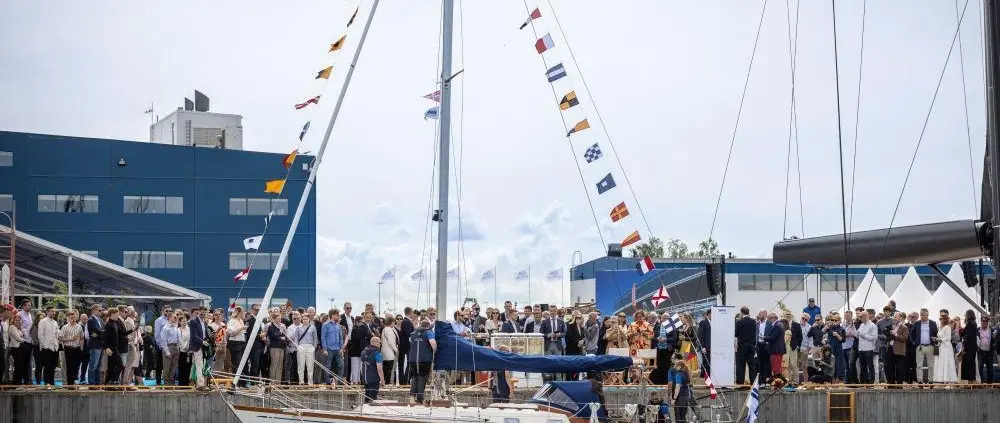
When the restored Tarantella returned to the water at Pietarsaari in June 2026, Nautor Swan was revisiting the boat that had introduced its name to the sailing world. Tarantella was the first Swan 36 built by the Finnish yard, originally launched in 1967. Nearly six decades later, the small Sparkman & Stephens-designed sailing yacht was placed at the centre of the builder's sixtieth-anniversary programme. The story is not a new model launch: it is the recovery of a particular historical boat whose construction helped establish modern Scandinavian performance cruising.
The original Nautor Swan announcement, circulated to the marine press on 16 June 2026, describes a complete restoration carried out in the same Finnish maritime community that produced the first boat. It also outlines an ambitious sailing programme involving classic events and the wider Swan owners' community. Tarantella is significant for a different reason from a modern superyacht: at around eleven metres overall, she embodies the days when a well-designed fibreglass cruiser was still a relatively new proposition and when an ambitious small boat could change the reputation of an entire shipyard.
The first boat and a new Finnish shipyard
Pekka Koskenkylä founded the business that became Nautor Swan in 1966. A year later, Tarantella emerged as the first of the Swan 36 yachts. The company was established in the coastal Finnish town of Pietarsaari, also known as Jakobstad, where local boatbuilding skills were brought together with a modern design and construction ambition. The choice of a Sparkman & Stephens design gave the first Swan a recognised naval architecture pedigree, while the yard set about establishing its own standards for craft and finish.
At a time when wooden construction remained familiar to many sailors, glass-reinforced plastic was becoming a serious alternative for cruising and racing yachts. It offered opportunities for repeatable moulded forms, robust structures and production that could be scaled more effectively. But the material did not automatically make every yacht good: the laminate schedule, joint detailing, structural supports and finish still demanded judgement. Tarantella's role as the first Swan reflects the moment these capabilities were combined with a design intended to perform at sea.
Why the Swan 36 acquired a following
The original Swan 36 is a relatively compact offshore sailing yacht with long, low lines and a purposeful sail plan. Published specifications for the design vary slightly according to measurement convention and source, placing its length overall at approximately 10.9 to 11 metres. That is well below the 12-metre leisure boat threshold and makes Tarantella a natural subject for Leisure Boat Guide rather than a superyacht fleet record.
Owners valued the balance between the ability to sail seriously and the practical requirements of being aboard for a passage. Small cruising racers need arrangements that remain usable when heeled, secure places for equipment and a deck layout that makes sail handling possible for a modest crew. The boat's appeal is not reducible to nostalgia. Sailors can still recognise the value of a coherent hull form, a dependable rig and an interior that pays attention to movement and stowage, even if modern racing boats achieve very different speeds and proportions.
What a genuine restoration has to preserve
Nautor Swan described the 2026 programme as a complete refit at Pietarsaari. Restoring a historically important fibreglass boat presents a different problem from building a lookalike from new. The purpose is to retain enough of the original vessel's physical and visual identity for the boat to remain recognisable, while ensuring that structures, systems and equipment are suitable for continued sailing. A successful project must make decisions about which finishes to repair, which components can remain and which safety or mechanical items require renewal.
Public announcements do not supply a detailed independent inventory of every replaced fitting, and this article does not invent one. Instead, the significance is the yard's decision to take responsibility for the oldest yacht bearing its brand and to return that particular hull to the water. The work connects the boatbuilder's current technical resources with the standards and ambitions of its earliest production years, making the restored yacht an unusually direct piece of company history.
The relaunch at Pietarsaari in June 2026
The shipyard's June press release presented Tarantella's return to the sea as an anniversary milestone. The timing was deliberate: Nautor Swan had begun operations in 1966, and 2026 marked sixty years of that history. The restored boat had first been launched in 1967, so the relaunch occurred fifty-nine years after her introduction. These two numbers refer to different dates. Calling it both the yard's sixtieth anniversary and the yacht's fifty-ninth year is accurate; describing the boat herself as sixty years old at her 2026 relaunch would be imprecise.
The official press document contains photographs of the restored Swan 36 around the launch and departure ceremony. These are the appropriate images for a historical news article because they actually relate to Tarantella and the event. They also provide evidence of the boat's restored outward appearance. The supplied photographic material is retained with the original email, allowing the caption and image source to be checked later without substituting a generic sailing yacht or an unrelated Swan model.
A sailing programme rather than a museum piece
Nautor Swan's plan was to make Tarantella an active ambassador, participating in established regattas and visiting sailing communities. The original 2026 schedule included Gotland Runt, the Rolex Swan Cup and Les Voiles de Saint-Tropez, with further ambitions extending into 2027. These were the intentions announced at the time of the June relaunch. They should not be mistaken for a certified list of races completed unless separate event results confirm participation.
This distinction is important for the history of small cruising yachts. A restored classic can be more than a static exhibition, but undertaking an offshore sailing programme calls for practical seamanship, safety equipment and maintenance. The conditions faced during a race place different demands on an older design from those encountered on a short demonstration sail. By planning public sailing appearances, the builder sought to show that its original yacht still belonged on the water, while giving owners and crews a direct connection with the company's earliest chapter.
What a 1967 cruiser tells modern designers
Some of the most successful features of Tarantella's design were responses to universal sailing problems. A hull must carry its rig, keel and crew loads while offering a predictable balance at different angles of heel. Deck gear needs to be positioned so that sail controls can be operated safely. Accommodation must support life aboard without using so much weight or space that the yacht ceases to perform as intended. The materials and detailed solutions have changed enormously, but those underlying questions remain familiar today.
Modern Nautor Swan yachts may employ carbon structures, sophisticated appendages and hybrid-electric systems, yet they still aim to combine performance with a form of usable elegance. Tarantella is an accessible way to trace that shared philosophy. Her restoration makes it possible to compare the first Swan's restrained size and traditional sailing arrangements with the much more complex equipment of contemporary models without claiming that the two are mechanically equivalent.
The people and places behind the Swan story
The company itself is strongly associated with Pietarsaari, and the anniversary drew attention to the skills present in the town when the first boat was constructed. Finnish boatbuilders, designers, technicians and the crews who later sailed Swan yachts helped establish the brand's reputation. A single hull can serve as a powerful reminder of that collective effort, because it is tangible evidence rather than an abstract date in a company timeline.
The original Sparkman & Stephens connection also matters. International design ideas travelled to Finland and were interpreted by a new manufacturer prepared to invest in construction quality. Tarantella shows how successful boatbuilding has often depended on collaboration across national and professional boundaries. An owner's experience of a yacht may feel intensely personal, but the vessel is the product of many disciplines whose combined decisions are evident each time it goes sailing.
Preserving identity across decades
The name Tarantella refers to the particular first Swan 36, often identified in historical sources as Swan 36-001. That hull identity matters because later Swan 36 examples are not automatically the same boat, however similar they look. Nautor Swan's official statement identifies Tarantella as the original; the 2026 restoration attaches to her history, not generically to all examples of the model. This prevents old images, contemporary market listings and heritage reports from being merged under one inaccurate record.
The distinction extends to the interpretation of photographs. A press photo from the 2026 restoration should be credited and dated as such, while a historical image from 1967 would require a separate source. The two can be placed in the same chronological story if each is accurately identified. For readers researching classic yachts, source provenance is the difference between a credible boat history and a collection of attractive but potentially misleading images.
An anniversary worth recording accurately
The relaunch of Tarantella gave Nautor Swan's sixtieth anniversary an exceptionally concrete centrepiece. Rather than simply announcing new models or hosting a show, the yard restored the very first yacht associated with its production history and set out to sail her again. That decision bridges a period of major change in materials, design technology and the global ownership of yacht brands. The appeal is not that Tarantella can match every modern racer, but that the vessel remains capable of expressing why serious sailors valued the first Swan.
For Leisure Boat Guide, the relevant record is clear: Tarantella is an approximately eleven-metre Swan 36 designed by Sparkman & Stephens, originally launched in 1967, and restored and relaunched at Pietarsaari in June 2026 as part of the builder's sixtieth-anniversary programme. Her original press release and embedded photographs establish the event without requiring a new yacht launch in November 2026 or an unsupported statement about later race results. Preserving those boundaries allows the historic boat to be appreciated on its own terms.
Photograph © Nautor Swan, official 2026 original press-release PDF. Sources: https://www.nautorswan.com/news/2026/06/tarantella-returns-to-the-sea-the-first-swan-sails-again/; full EML source in Nautor Swan CRM SYMS ID872.