
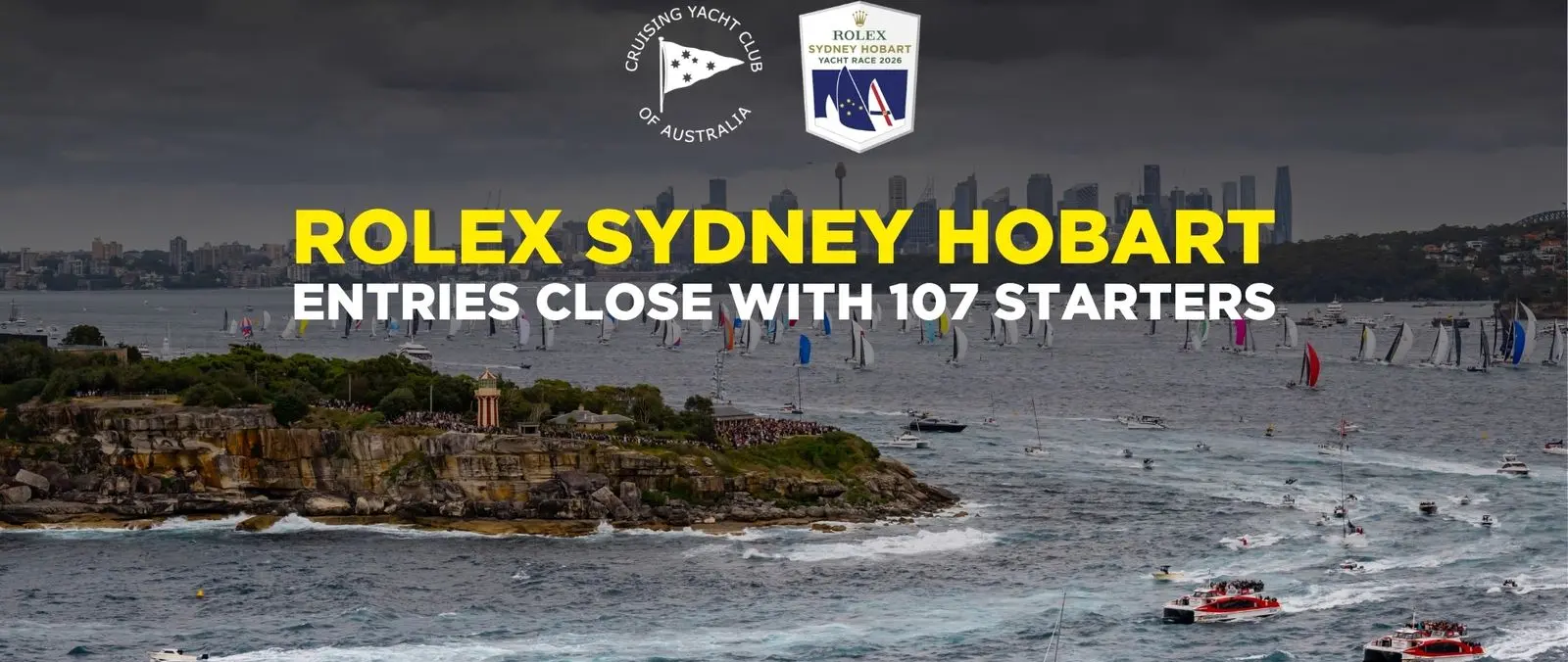
A confirmed Boxing Day fleet takes shape
The Cruising Yacht Club of Australia has closed entries for the 2026 Rolex Sydney Hobart Yacht Race with 107 yachts confirmed for the Boxing Day start on Sydney Harbour. Its 23 October announcement brings the shape of the fleet into focus: returning winners, large line-honours challengers, specialist offshore crews and smaller boats preparing for a demanding passage to Tasmania.
The race is scheduled to start on 26 December and follows a course of approximately 628 nautical miles from Sydney to Hobart. That distance can obscure the range of decisions required in the days after leaving the harbour: sail selection, weather routing, crew endurance, watch systems and the competing demands of outright speed and a favourable corrected-time result.
Entry closure is not the same thing as a final starter count. Weather, equipment checks and last-minute withdrawals can still alter the boats that actually cross the line, so the figure describes the organiser’s confirmed entries on 23 October. The complete published start list and official race communications should be checked again closer to Boxing Day.
Four large yachts target line honours
The biggest visual contest is expected to involve four 100-foot maxis. The organiser names Christian Beck’s LawConnect, Anthony Bell’s Loyal, Mark Richards’s Palm Beach XI and Grant Wharington’s Wild Thing 100 among the entries competing for the honour of being first into Hobart. Their size and power promise an absorbing spectacle, but line honours cannot be awarded before the boats have sailed the course.
Each large campaign faces a different challenge from a pure straight-line speed exercise. Offshore racing rewards disciplined manoeuvres, reliable systems and the ability to keep a boat moving through changing winds and sea states. A small decision about sail changes or positioning can multiply over a race of this length, while damage or an unsuitable weather window can erase a theoretical performance advantage.
The CYCA identifies the Australian Maxi Championship in early December as an opportunity for these crews to test form before the main start. A good result there may provide useful evidence of preparation, yet it cannot settle the Sydney Hobart outcome because the offshore route introduces a different mixture of weather, fatigue and navigation.
A handicap defence with a different boat
Jiang Lin, the defending overall winner, is returning with co-skipper Alexis Loison aboard Min River, a JPK 10.50. The partnership is compelling because the race’s premier overall trophy is awarded through the IRC handicap system, not simply to the fastest yacht across the water. A smaller, efficiently sailed boat can outperform a much larger rival on corrected time.
The organiser recalls that Lin’s previous success made her the first woman and first double-handed competitor to win the Tattersall Cup overall. Her return in a newly acquired design creates a genuine sporting question: can a partnership repeat its consistency while learning the particular demands of another hull and sail plan under a very different set of conditions?
Lin’s published comments emphasise enjoyment and the knowledge that a previous victory offers no entitlement to the next. That attitude reflects the appeal of offshore handicap racing, in which crews work against the course, weather and their own performance targets rather than watching the largest yachts and assuming the race has already been decided.
Past winners and the deeper fleet
The entry list also contains substantial experience beyond the fastest boats. Matt Allen returns with Ichi Ban, now a Volvo 70 with a history under other names, while the Tasmanian Reichel/Pugh 66 Alive is back with Duncan Hines and experienced navigator Adrienne Cahalan. These campaigns add depth to a contest in which tactical judgment and ocean-racing routines can prove decisive.
Love & War, a classic yacht with multiple overall victories in the race’s history, offers a striking contrast to the contemporary offshore designs. Its continued presence is a reminder that a distinguished yacht can remain part of a major racing culture for decades, connecting current sailors and spectators with the event’s long history.
The organiser also highlights the competitive TP52 group and the strong double-handed field, as well as women owners and skippers across the entry list. These boats will not all share the same handicap prospects or operating conditions, and there may be separate class and divisional outcomes. Readers should therefore distinguish the overall Tattersall Cup competition from victories awarded within individual categories.
The race south is a navigational examination
The official course begins with the highly visible spectacle of Sydney Harbour before the fleet turns south along Australia’s east coast and ultimately across the waters approaching Tasmania. The route is famous not only for its length but for the way conditions can change quickly between sections, creating different opportunities for light, powerful or carefully positioned boats.
For leisure sailors watching from a distance, the fleet’s choices offer practical lessons. A modern offshore boat is a system of sails, rigging, electronics, structural equipment and human decisions; performance depends on how consistently the crew operates all of them. Racing at this level also makes fatigue management, clear responsibilities and early maintenance checks especially important.
Spectators should never assume that a boat leading on the screen is necessarily leading on overall handicap. The first boat home competes for line honours, associated with the Illingworth Challenge Cup, while the Tattersall Cup rewards the IRC-corrected overall result. Tracking both contests makes the race easier to understand and avoids treating two distinct achievements as interchangeable.
What happens next for teams and followers
With entries closed, attention now turns to training, equipment inspection, crew logistics and the remaining documentation deadlines. The organiser’s competitor hub details several staged requirements leading into December, including rating certificates, communications arrangements and briefings. These are administrative obligations with real safety and competitive implications, not formalities to leave until the final week.
The CYCA plans live coverage of the start, with broadcast and streaming information available from the official race site. For followers who cannot be in Sydney Harbour on Boxing Day, that is the reliable starting point for schedules, yacht profiles and eventual results. On-water spectators should follow maritime authority instructions and keep well clear of racing yachts and official course arrangements.
After the start, provisional positions, retirements and weather developments may change rapidly. The confirmed facts at this stage are the organiser’s published entry announcement and scheduled race programme; no result has yet been achieved. The 2026 fleet has the ingredients for several compelling contests, from the maxis at the front to the smaller boats pursuing a disciplined corrected-time performance.
Official sources and event information
The fleet and named entries are documented by the race organiser’s 23 October announcement, cross-checked with the Cruising Yacht Club of Australia’s publication and official course information. The organiser’s summary and detailed list give different counts for double-handed entries; this report therefore does not assert a precise total for that division. See our 2026 Sydney Hobart event listing for the scheduled start. Hero image: official Rolex Sydney Hobart / CYCA 2026 entry announcement photography.