
A manufacturing story behind the outboard
Suzuki's Edge-eCoat outboard treatment has received the Best Sustainable Product distinction in the Innovation Route Awards connected with the 2026 Cannes Yachting Festival. The award, reported by Suzuki on 7 October, puts attention on an area of boat technology that is rarely visible when a vessel is launched: the protective finish applied inside components through which engine cooling water flows. For owners of small powered craft, the important point is not that a new engine has suddenly appeared or that fuel consumption has changed. It is that the manufacturing treatment of some existing outboard-engine parts is evolving. Suzuki says the process increases resistance to corrosion by seawater while reducing carbon dioxide associated with that particular production process. Those are distinct claims, each worth understanding in context.
What Edge-eCoat actually treats
Outboard motors used in seawater must move cooling water through internal passages and later discharge it. The parts forming those passages are exposed to a corrosive environment over time, so manufacturers apply treatments and design features intended to resist damage. Edge-eCoat is Suzuki's name for an anodizing process applied to engine components that carry that water. Anodizing changes the surface condition of certain metallic materials through an electrochemical process, producing a protective oxide layer. It is not a spray-on hull coating or a product an owner pours into a cooling circuit. Nor does the name suggest an after-market treatment that a workshop can apply to any old engine. The announcement concerns treatment of components at the manufacturing stage and the company's adoption of the process across selected production models.
The 68% figure needs a careful reading
Suzuki states that the carbon dioxide emitted during the relevant manufacturing treatment is approximately 68 per cent lower than the emissions associated with the painting processes previously used to improve corrosion resistance. That sounds impressive, but it is not a claim that the complete outboard motor has a 68 per cent smaller lifetime footprint. It is also not a measured 68 per cent reduction in fuel use or a prediction of engine efficiency on the water. Those would require entirely different evidence and system boundaries. A small-boat buyer comparing engine brands should distinguish the environmental effect of a component-production process from the whole engine's manufacture, transport, service life, fuel consumption and disposal. The award recognises a meaningful industrial development without settling every sustainability question.
Which Suzuki engines use it
The company says Edge-eCoat entered production on the DF140B in August 2024, with sales beginning the following September. It subsequently expanded adoption to DF140BG, DF115BG, DF115B and DF100C models, with further applications planned. These are the kinds of mid-range outboard families that can be important for smaller fishing and leisure craft. However, the existence of an engine designation on that list is not a substitute for checking a particular unit's specification, manufacturing date and market availability. Engine codes, rigging packages and local supply can differ. Prospective buyers should ask an authorised Suzuki dealer which model and production version carries the process. The company's October 2026 announcement establishes the programme, not an unconditional statement that every Suzuki outboard on sale has the coating.
Why saltwater resistance is a useful focus
Owners tend to notice external paint, propeller condition and the state of anodes because they can be seen during routine maintenance. Cooling passages are less visible, even though they are essential to the engine's operation. Corrosion, scale, contamination and blocked flow can all become maintenance concerns in a marine powertrain, depending on design and use. A more protective internal finish could therefore be significant as a durability measure, but Suzuki's press statement does not publish a universal extension of service intervals or a quantified reduction in breakdowns. Those operational outcomes would require long-term comparisons under defined conditions. The sensible reading is that the company has developed a production method intended to resist seawater corrosion and has gained an industry award, not that owners can reduce inspection or flushing.
A prize from the Cannes show
Suzuki says this is its first win in the Cannes Yachting Festival's Best Sustainable Product category of the Innovation Route Award. The recognition is notable because outboard-component treatments are not the most conspicuous technology at a boat show dominated by complete craft and visible equipment. A visitor may spend time comparing cabins, cockpit layouts, propulsion displays and prices without thinking about what happens inside cooling channels after hundreds of hours. Manufacturing processes can nevertheless influence product quality and industry emissions at scale. Awards are indications of expert recognition within a defined event, not independent life-cycle certifications. The award should encourage readers to ask technical questions of suppliers rather than be treated as a complete environmental verdict.
Why small boats have a stake
Outboards are the main propulsion choice for a wide range of boats below twelve metres, from modest open fishing craft to family RIBs, dayboats and small cabin cruisers. Many owners remove the boat from the water frequently, but others leave it afloat for extended periods and accumulate significant seawater exposure. Corrosion protection is therefore a relevant long-term consideration regardless of whether the vessel is used for a few summer weekends or regular local trips. Even when an owner buys a complete boat package, the engine's internal treatment, warranty and service support can be worth investigating. The technology is especially pertinent to the LBG audience because the nominated engine families operate in power bands commonly considered for smaller hulls. Boat and engine compatibility remains a separate engineering question.
Anodizing does not replace maintenance
A more corrosion-resistant component finish should not change the basic responsibilities of an outboard owner without explicit manufacturer instructions. Follow the correct flushing guidance for the actual engine, service cooling components at the prescribed intervals and keep an eye on anodes, water flow and operating temperature. Have unusual warning alarms investigated promptly. Never assume an award-winning surface treatment makes an engine immune to saltwater, galvanic corrosion or neglect. Storage conditions, water quality, electrical installation and the correct materials elsewhere in the system also matter. When comparing service costs, ask the dealer which operations are specified for the model rather than extrapolating from a general technology announcement. A boat's reliability comes from the whole maintenance system, not a single part coating.
What the announcement does not say
Suzuki's release does not provide a retail price premium for Edge-eCoat, a separate warranty term attributable to the treatment or field-service data comparing coated and uncoated engines. Nor does it offer a broad claim that the treated engines deliver more speed or less fuel consumption. Such omissions should not be filled with guesses. It is possible for a factory process to have both industrial and durability value without altering the performance characteristics measured in a sea trial. Prospective owners should continue to compare installed weight, shaft length, controls, local servicing, fuel use and hull compatibility in the usual manner. The most useful new question is whether the particular engine's cooling-system components have the treatment and what Suzuki's technical documents say about it.
The scale of manufacturing matters
A process improvement implemented on multiple production families can have greater aggregate significance than a demonstration confined to a single prototype. Suzuki's adoption sequence, beginning in 2024 and expanding to further engines, points to a manufacturing method being applied beyond a show stand. However, the public statement does not supply the total number of treated components or enough data for a complete annual carbon-savings calculation. Nor does it break out upstream energy, material supply or end-of-life effects. These limitations do not invalidate the announced 68 per cent comparison for the treatment process; they simply define what can responsibly be inferred from it. A future detailed sustainability report could provide a clearer picture of system-wide impact.
The importance of precise environmental language
Environmental claims in boating can become muddled when reduced emissions, lower fuel consumption, quieter operation and improved service life are presented as interchangeable. Edge-eCoat is a useful example of why each improvement should be identified precisely. In this case, the stated benefits are seawater corrosion resistance in coated components and lower emissions from the specified production step. A boat owner deciding between petrol outboards, electric propulsion or different hulls is comparing much broader effects than that one process. Industry publications have a responsibility to say which claims come from manufacturers, which have been independently measured and which remain subjects for longer-term assessment. Specific information allows better buying decisions than an unqualified label of green technology.
What owners should watch next
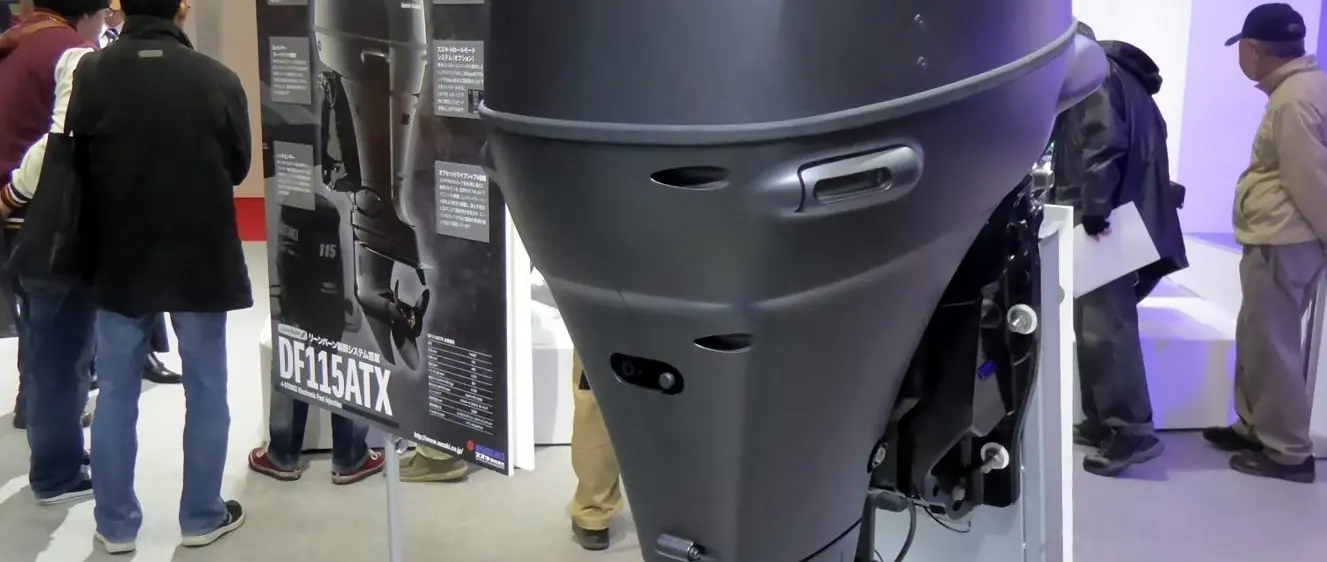
The practical next steps are the extension of Edge-eCoat to further Suzuki models and the appearance of more technical information about durability over time. Small-boat buyers looking at the DF100, DF115 or DF140 families can ask authorised dealers to confirm the treatment on the exact engine offered, together with service and warranty conditions. Meanwhile, the award shows that innovation can involve hidden engine parts as well as cockpit screens and high-profile propulsion changes. The photograph illustrating this report shows an older Suzuki DF115A displayed at the 2015 Osaka Motor Show, not a verified Edge-eCoat component. The distinction matters. The actual news is Suzuki's production treatment and industry recognition, with possible longer-term implications for many ordinary leisure craft.
Primary sources and photograph credit
Global Suzuki, 7 October 2026; Suzuki Japan announcement. Archival illustration only: Suzuki DF115A at Osaka Motor Show 2015, photographed by Tokumeigakarinoaoshima, Wikimedia Commons, CC BY-SA 4.0. The illustrated engine is not represented as an Edge-eCoat-treated product; image resized without cropping.
