
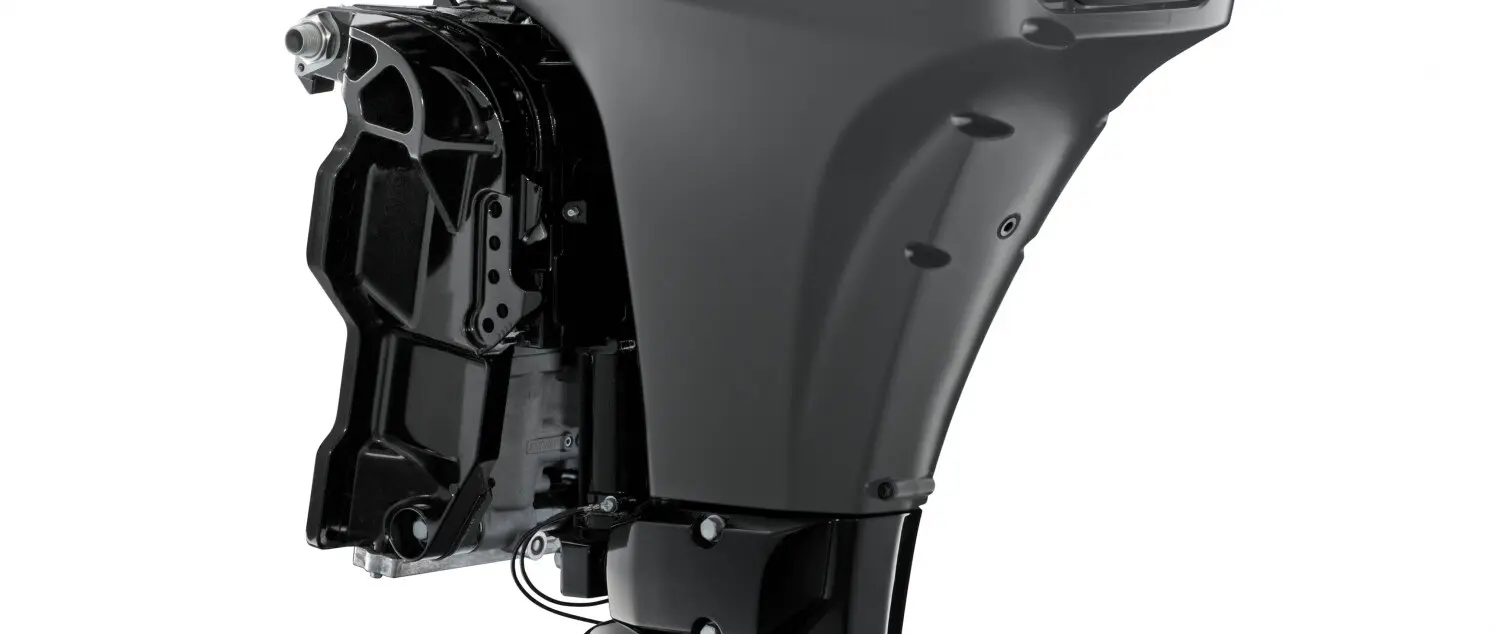
Suzuki Marine France has extended its matte-black Stealth Line treatment to the DF60A, introducing the DF60ATL in the distinctive finish at the 2026 Grand Pavois de La Rochelle. The announcement matters to owners of compact coastal and inland leisure boats because it brings the look previously associated with larger engines in the French range to an established 60-horsepower platform. Suzuki says the first examples will reach its French dealer network during autumn 2026.
The important distinction is that this is a change of finish and range positioning, not an announcement of a new 60hp powerhead. Beneath the matte-black cowling is Suzuki's familiar three-cylinder DF60A family, already known for electronic fuel injection, its Lean Burn fuel-control strategy and compact installation. That makes the practical buyer question less about headline speed and more about whether the finish, rigging and support package suit a particular boat.
The launch at La Rochelle
Suzuki chose Grand Pavois, the established French in-water boat show at La Rochelle, to present the Stealth version to the market. The manufacturer's French press material identifies the DF60ATL specifically and says that matte black had previously been restricted to higher-output engines, starting at 115hp, within the French selection. It describes the arrival of the 60hp model as taking that national selection to eight Stealth Line engines.
The French qualification is worth preserving. Suzuki's product naming and Stealth Line line-up differ between territories, and the American catalogue has included other low-horsepower Stealth products. A model seen in a brochure or at a show elsewhere should not be assumed to be offered with precisely the same shaft, controls or warranty in France. The domestic announcement is the reliable basis for French availability, while owners in other countries should consult their local importer.
The press photographs released with the French announcement show a fully dressed outboard in a muted dark finish rather than a polished-black presentation. On a small centre-console, open fishing boat or modern tender, that understated appearance could blend with dark rails, upholstery and console fittings. It is a design choice; Suzuki has not announced additional output, a new propeller or an acceleration advantage as part of this finish change.
What sits beneath the finish
The standard DF60A described by Suzuki's global marine division is an inline three-cylinder, four-stroke outboard displacing 941 cubic centimetres. Its published maximum output is 44.1kW, equivalent to the nominal 60hp class, and the manufacturer specifies a recommended full-throttle operating band of 5,300 to 6,300rpm. Those figures explain the engine family, but do not by themselves certify a particular hull-and-propeller combination.
Suzuki uses multi-point sequential electronic fuel injection to meter fuel and describes the Lean Burn Control System as adjusting the air-fuel mixture to operating demand. Lean Burn is an engine-management approach intended to improve economy across relevant speeds; it is not a promise that every installation will use less fuel than every competing motor. Hull weight, loading, sea state, trimming and propeller selection still strongly influence consumption.
The powerhead also uses double overhead camshafts and 12 valves, plus a self-adjusting timing chain. Suzuki's French announcement highlights the chain because it removes the routine replacement interval associated with some belt-driven layouts, but owners still have normal oil, lower-unit lubrication, cooling-system and other scheduled maintenance duties. Calling the timing chain self-adjusting is not the same as claiming the whole outboard is maintenance-free.
The DF60A family also carries Suzuki's Easy Start system and a tilt-limit function. The first simplifies the starting sequence; the second can help an installer set a useful protection boundary where an engine is mounted close to a splashwell, transom structure or other obstruction. Neither feature changes the need for correct mounting-height checks, safety-switch testing and routine inspections of steering and controls.
Why 60hp is an important size
Sixty horsepower is a practical class for a broad variety of modest leisure craft, including light open dayboats, aluminium fishing boats, RIBs and some sailing-club support boats. The appropriate engine, however, is dictated by a hull's approved maximum power, transom load limit, intended operating water and real all-up weight. Owners should follow the boatbuilder's plate and documentation rather than choose a motor solely because its styling complements the hull.
Weight and shaft configuration deserve particular attention on a repower. Suzuki's global specification table lists different dry weights by transom-height version for the underlying DF60A, and market equipment can vary. Those figures cannot safely be transferred to the French DF60ATL without checking the exact local model, fitted controls, battery, steering arrangement and propeller. A dealer should provide an installation-specific quotation and confirmed rigged weight.
Propeller sizing matters at least as much as the paint. The correct propeller must allow the loaded boat to run within the manufacturer's specified full-throttle rpm band while providing acceptable acceleration, reverse response and low-speed control. Testing a lightly loaded boat on flat water alone can disguise an over-propped combination that struggles when crew, luggage and fuel are added.
For owners who frequently manoeuvre at crowded marinas or use shallow launch sites, the full installation also matters. Trim range, engine tilt clearance, propeller protection, steering effort and ability to reach service items can alter the everyday ownership experience. The Stealth finish is visible immediately; those less photogenic details determine whether a repower actually improves the boat.
Buyer's checklist: finish, service and fit
Matte finishes look distinctive, but they require thoughtful care. The safest approach is to follow Suzuki's specific cleaning guidance for this version instead of assuming that polishing compounds, abrasive pads or strong degreasers suitable for some glossy surfaces will be appropriate. A buyer should ask the dealer how to wash, protect and repair the finish before the first trip, particularly if the boat is stored outside or runs in salt water.
Buyers should also confirm whether the advertised engine arrives with mechanical or remote controls, a tiller option, instruments and any digital monitoring equipment. Regional brochures sometimes describe options across a family rather than inclusions on a particular stock unit. An accurate written quote separates engine price, rigging kit, installation labour, propeller, battery work, commissioning and any removal of an old outboard.
Service support has equal importance. A local authorised dealer should be able to explain the maintenance schedule, corrosion-protection checks and warranty conditions that apply to the exact serial-numbered engine. Suzuki's announcement from France says availability is planned for autumn 2026, but it does not provide a definitive dealer-stock count or a universal retail price. Those details should be verified directly at purchase.
Someone comparing a new DF60ATL with an already functioning DF60A should be especially realistic. A cosmetic update is unlikely to justify the labour and total cost of a repower by itself. On a new boat build, however, choosing the dark finish at order time may produce a more coherent appearance without requiring later repainting or aftermarket cowling treatments.
A design-led addition, not a performance revolution
The new DF60A Stealth Line should be understood as a more accessible styling option within Suzuki Marine France's catalogue, anchored by familiar 60hp engineering. It gives buyers a factory-finished alternative where visual consistency matters, particularly alongside darker hulls or deck hardware, while leaving hull compatibility, rigging and maintenance as the decisive technical questions.
Suzuki's French release and own product announcement establish what has been presented and when the local market is expected to receive it. The manufacturer's global DF60A technical page provides the baseline engine-family specifications. Owners should treat those as complementary sources and obtain the final local specification from an authorised Suzuki Marine dealer before ordering.