
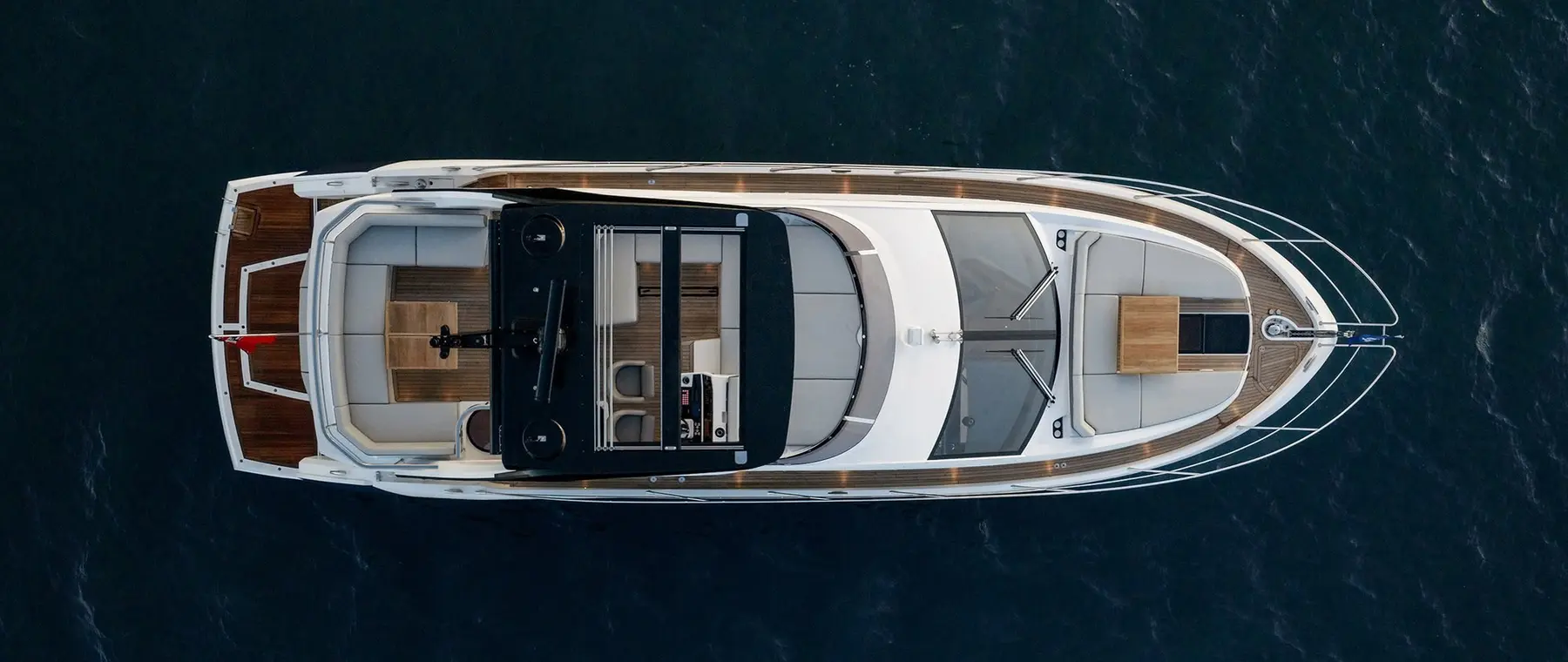
An American introduction at Fort Lauderdale
Sunseeker placed the Manhattan 56 at the centre of its display for the 2026 Fort Lauderdale International Boat Show, held from 28 October to 1 November. The appearance was billed as the model's United States debut, a meaningful distinction from a world launch because the boat was already part of the builder's current range. For American owners assessing a new flybridge cruiser, a local presentation gives a practical opportunity to examine the layout, finish and movement between deck levels instead of judging the design solely from renderings or specifications.
The Manhattan 56 joined Sunseeker's Predator 55, Manhattan 68, 76 Yacht, Predator 75, 82 Ocean Enclosed and 100 Yacht in the announced Fort Lauderdale line-up. Those models cover different sizes and styles, but the smaller Manhattan's appeal lies in making social space flexible within a manageable overall length. Sunseeker's show material highlights its two fold-down aft balconies, a feature that changes the experience of the cockpit at anchor. It is a design intended to make the water feel closer, rather than simply making the yacht look larger from the quayside.
Balconies change the aft-deck experience
When opened, the two fold-down side terraces widen the usable area around the aft cockpit. That can make a substantial difference during a quiet afternoon at anchor, when guests move between seating, the swim area and the edges of the yacht. It may also create more room for socialising without asking everyone to climb to the flybridge. Sunseeker describes the arrangement as a waterside terrace, and the important point for owners is how the feature connects the established cockpit seating with open views and direct access to the marine setting.
The cockpit itself is designed to switch between dining, lounging and a broad sunpad arrangement. Such flexibility is valuable on a cruiser used by family and friends because no single activity dominates the entire day. Nevertheless, owners should inspect the real operating sequence of the balconies and furniture. The exact clearances, safety barriers, loading limits and restrictions during manoeuvring are details to confirm with the builder or dealer. Folding structures are most useful when they are straightforward to operate and do not interrupt safe movement between the side decks and stern.
Seventeen metres with three cabins
Sunseeker lists the Manhattan 56 at 17.21 metres overall, with a beam of 4.87 metres and a draft of 1.37 metres. The accommodation plan comprises three cabins, including a full-beam owner's suite, and the current published specification lists two bathrooms or heads. This gives a family or two couples room to spend several nights aboard without allocating the whole lower deck to sleeping space. It also makes the boat easier to consider for marina berths and cruising grounds where a substantially larger yacht would bring additional handling or berth constraints.
Large windows and a modern interior finish are key parts of the design language. The builder emphasises daylight and uninterrupted views through expanded glazing, while the lower-deck arrangement offers privacy for guests when the main saloon is busy. A prospective buyer should still examine the particulars of the individual layout, including storage, ventilation, noise and the steps between living spaces. Three cabins on a 56-foot boat can be an attractive specification, but long weekends expose different needs from a quick demonstration: accessible luggage storage, a practical galley and comfortable places to retreat are just as important as the photograph of the saloon.
Performance figures require context
The manufacturer's online technical table gives a top speed of up to 31 knots and a range of up to 230 nautical miles at 21 knots. Those are useful reference figures for planning a coastal cruising pattern, but they should not be treated as a guarantee for every engine or loading configuration. Sunseeker also lists a 2,200-litre fuel capacity, 600 litres of fresh water and a displacement of about 27,000 kilograms. The dimensions and capacities provide a starting point for judging likely operating needs rather than a substitute for a detailed specification and sea trial.
Sunseeker's different marketing sections refer to different propulsion descriptions, so buyers should confirm the exact engine package and drive arrangement offered for the vessel they are considering. The published specification notes shaft or pod propulsion configurations, while particular marketing copy mentions named engine options. It would be misleading to assume that all advertised figures apply to every package. For owners, questions about actual fuel burn, service access, manoeuvring aids and noise at cruising speed matter at least as much as the maximum speed printed in a brochure.
How the design might fit everyday boating
The balance of cockpit, saloon, flybridge and sleeping accommodation is intended for a yacht that can host day guests as well as make comfortable short cruises. A family might use the aft balconies at a sheltered anchorage, the upper deck for the view and the saloon for dinner once the evening cools. The flybridge format also allows social areas to be separated when some guests want open air and others prefer shade or a quieter interior. The practical benefit depends on access, weather protection and the owner's preferred pattern of use.
At a boat show, the most revealing inspection often involves walking a route several times: from the helm to the side deck, from the cockpit to the swim platform, and from the saloon to a lower cabin. Visitors should also consider where wet equipment will go and how food, rubbish and luggage move aboard. Sunseeker is making a case for a more open connection with the sea, but every clever piece of furniture adds operational questions. A thoughtful sea trial should include moving slowly in a marina as well as operating at the intended cruising speed.
What American buyers should verify next
The Fort Lauderdale presentation has put the Manhattan 56 directly in front of the US market, but the show appearance itself does not establish a universal sale price, delivery date or final package specification. Those details vary with equipment and commercial arrangements and should be confirmed in writing. The official model page is the right place to begin with current dimensions and deck plans, while a dealer can explain the specification actually available to an individual buyer. The builder's online figures are helpful, but the sea trial and build contract remain the decisive documents.
The Manhattan 56's distinctive proposition is a familiar flybridge-cruiser arrangement made more adaptable at the waterline. The twin side balconies, changeable cockpit and three-cabin layout offer a clear lifestyle story without pretending the yacht is something other than a 17-metre motor cruiser. For prospective owners, the American debut is a prompt to inspect the real balance between space, movement, performance and maintenance. If those elements work together in practice, the design could make everyday coastal boating feel notably more connected to the sea.