
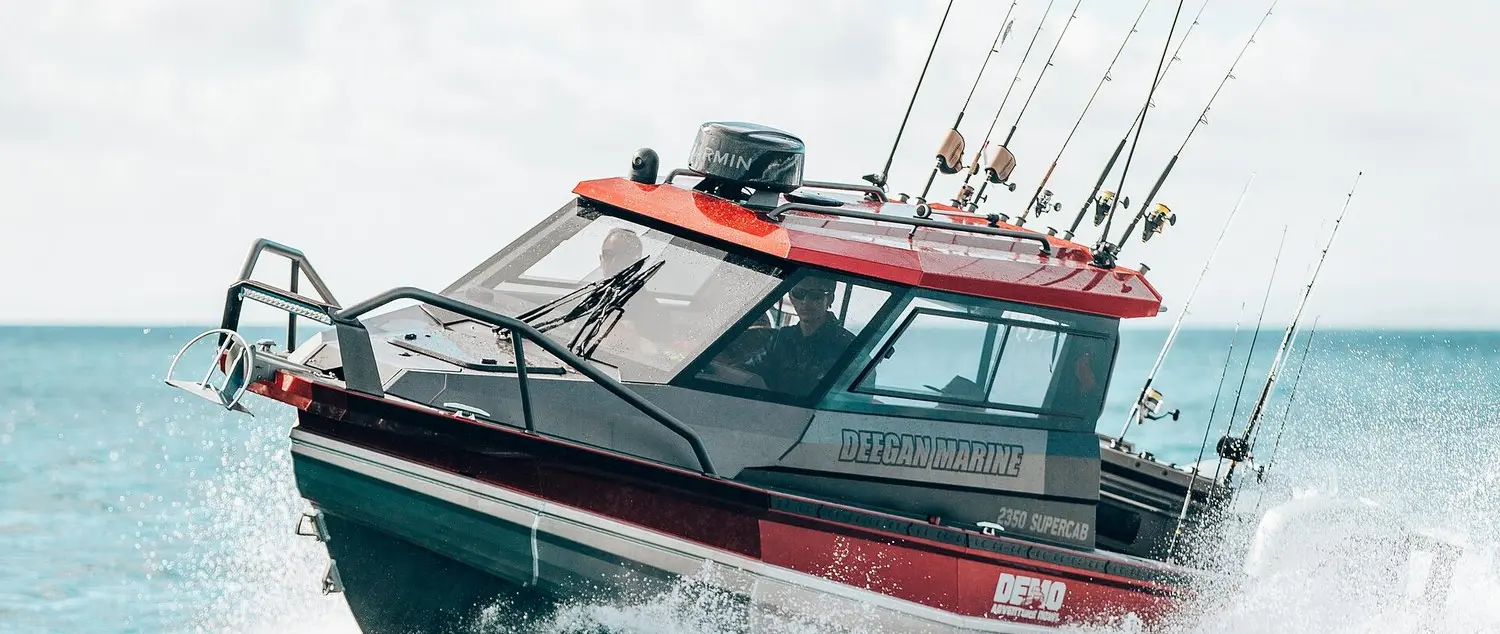
A new 6.75-metre boat with a familiar purpose
Stabicraft has introduced the 2200 Supercab as a successor to its long-established 2100 Supercab, with a new cabin-and-cockpit arrangement intended to serve fishing crews and families in the same compact aluminium boat. The New Zealand builder's 1 November announcement describes a model shaped by twelve months of work and customer feedback, rather than merely a fresh colour or trim package. Its official specification confirms a 6.75-metre hull, comfortably within the under-12-metre leisure-boat category.
That makes the launch relevant to people choosing a boat they can operate without a large crew. However, the company's language about capability and confidence remains promotional until the new hull has been tested by an owner under representative conditions. A responsible comparison starts with its actual dimensions and engineering limits, not the prestige associated with an earlier model.
What the published specification establishes
The manufacturer lists a 2.31-metre beam, a dry hull weight of 1,275 kilograms, a maximum of seven persons and a 250-horsepower engine ceiling. It recommends at least 150 horsepower and specifies a 250-litre fuel tank. These figures are valuable because they give buyers a starting point for checking practical suitability and comparing quotations. They are not the weight of a fully equipped road trailer or a guaranteed range at sea.
An outboard, batteries, full tanks, electronics, safety equipment and personal gear change the actual operating displacement. Similarly, the model name should not be treated as an exact measure of length over the trailer or rig. A prospective buyer needs the final build sheet, the installed engine details and a genuine weight estimate before making commitments about towing or marina storage.
Cockpit and cabin must share limited space
Stabicraft says the 2200 has gained useful volume in the cabin and cockpit compared with the preceding design, while its enlarged glazing is intended to brighten the enclosed helm area. The trade-off is central to every hardtop in this length class: space spent on a sheltered cabin cannot simultaneously become open fishing deck. A prospective owner should stand at the helm, test the view when seated, and physically move around the cockpit with the usual number of passengers.
Fishing rods, an anchor, a cooler and emergency equipment can rapidly consume available lockers. For occasional overnight stays, genuine berth dimensions, ventilation and access to washing facilities matter more than a general claim of comfort. Owners using the boat mainly for day trips may value secure seating and easy boarding over the ability to sleep aboard.
Aluminium construction and flotation figures
The official specification describes a five-millimetre hull thickness, a 20-degree deadrise aft and 820 millimetres of internal gunwale height at the stern. It also identifies 1,700 litres of total sealed chamber volume and 1,140 litres in the life-ring chambers. Those figures are design information, not a promise that an overloaded or damaged boat is safe in every situation.
Buoyancy performance depends on the integrity of the hull, the installed equipment, passenger loading and the nature of any accident. The builder's chambered aluminium construction is a defining characteristic, but owners still need sound inspections, proper use of lifejackets and conservative weather decisions. An inspection should include weld finish, drain points, access to relevant compartments and the condition of all openings that could affect the vessel's watertight integrity.
Choosing power within the recommended limits
A 250-horsepower maximum is not an instruction that every buyer should choose the largest possible outboard. The 150-to-250-horsepower range permits different arrangements, and the appropriate package depends on expected loads, local conditions, fuel economy, servicing access and the intended balance between acceleration and quieter cruising. A family carrying several passengers on frequent short runs may favour different characteristics from a two-person fishing crew travelling farther offshore. The chosen propeller matters, too: engine speed, trim and loaded performance must be checked together.
Ask a dealer to demonstrate realistic acceleration onto the plane and a settled cruise with the boat loaded as it will ordinarily be used. Manufacturer descriptions do not establish an independently measured top speed or consumption figure for every installation. Buyers should reject precision that the available source material does not substantiate.
Why a 250-litre tank is not a range claim
The published fuel capacity helps with voyage planning but cannot answer the distance a particular boat will cover safely. Fuel consumption changes with engine type, hull condition, trim, speed, current, wind, waves, passenger numbers and how much fishing or trolling is planned. Skippers need a realistic cruising-consumption record, a route with possible diversion points and a reserve that covers changes in conditions. An apparently generous tank is of little use when an optimistic maximum-distance claim leaves no margin for adverse weather or an unexpected return against a head sea.
On a test trip, record fuel used at several sensible cruising speeds rather than extrapolating from a brief high-speed run. The resulting numbers will be more relevant to ownership than the capacity printed in the brochure. Range remains the skipper's calculation.
Safety standards require the right context
Stabicraft's specification identifies New Zealand CPC boat-safety standards, Australian builders-plate requirements, US Coast Guard standards and EU CE category C. These references are useful for understanding the markets in which the design is intended to operate, but individual supplied boats need the correct documents and equipment for their jurisdiction. A CE design category is associated with defined design conditions; it is not permission to proceed in any weather or to exceed loading guidance.
Equally, the advertised seven-person maximum does not mean seven adults with unlimited equipment can be carried regardless of total mass. Buyers should inspect the actual compliance plate, understand passenger and weight limits, and ensure that the ordered engine and options remain within approved specifications. Safety relies on both a suitable design and competent operation.
Trailering changes the ownership equation
Many owners considering a craft of this size will be interested in keeping it ashore, but a dry hull figure is inadequate for deciding whether a car can tow it. The correct total must include the trailer, chosen outboard, batteries, anchor, fuel, accessories and equipment. Height and beam affect road access and storage as surely as weight does. A suitable trailer must support the hull at approved points and be rated for the real load, with braking and lighting that meet local rules.
Launch-and-recovery conditions also matter: a steep or slippery ramp can be demanding even when a boat is manageable at sea. Before ordering, seek a confirmed trailer-ready package weight, overall dimensions and guidance on storage, maintenance and corrosion protection. This avoids discovering after delivery that convenient weekend boating requires a much more expensive vehicle or facility.
What to inspect on a real sea trial
The announcement highlights revised helm ergonomics and space for modern electronics. On an actual boat, check whether screens remain legible in sunlight, whether switches can be reached safely in a moving sea, and how easily a skipper can operate throttle, steering and communications without losing sight of surrounding traffic. Test the boat with a representative load, not an empty promotional demonstrator. Observe spray protection, the view over the bow as the hull begins to plane, steering effort in turns, noise in the cabin and the vessel's response when throttling back.
Evaluate storage access while passengers are seated. A cabin that looks spacious at rest may be less convenient when crew need secure handholds or access to emergency gear. The best trial is a repeatable practical assessment, not a single maximum-speed run.
The proper conclusion for prospective owners
The verified story is that Stabicraft has added a new 6.75-metre 2200 Supercab with stated seven-person capacity, a 2.31-metre beam and a 250-horsepower maximum. The model offers a clear evolution of the builder's hardtop concept, with more emphasis on usable space, visibility and multiple recreational roles. Its release does not establish one universally appropriate engine, fitted price, fuel consumption or offshore operating range. Those questions require a current build quotation and a properly configured on-water evaluation.
The manufacturer's warning that specifications may change over the production life makes checking the exact hull and equipment list particularly important. For a small-boat buyer, the 2200 deserves attention as a new option, but its merits must be judged against the intended crew, launching routine, waters and ownership costs. That is a sounder basis for selection than launch-day superlatives.
Sources: Stabicraft model specification and NZ Marine's 1 November 2026 announcement. Photograph: an earlier Stabicraft 2350 Supercab, not the new 2200; Stabicraft87, Wikimedia Commons, CC BY-SA 4.0. Image resized for this report. Original photograph and detailed author credit (Wikimedia Commons). Licence CC BY-SA 4.0.
