
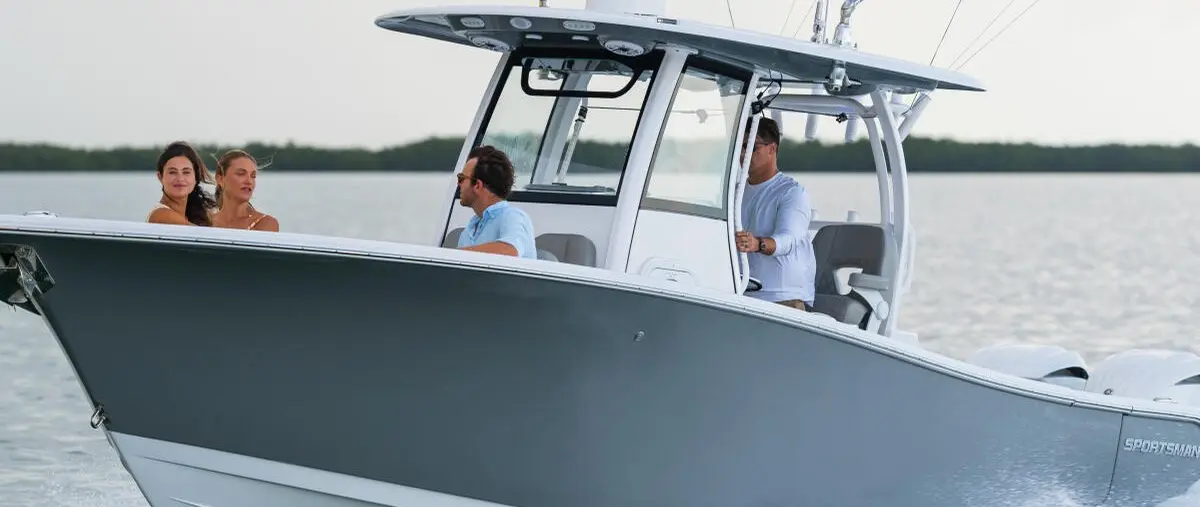
A centre console built for two different kinds of day
The Sportsman Open 282 sits at the intersection of offshore fishing and family cruising, a market in which owners rarely want to surrender the entire cockpit to one activity. Its deep bow seating, open walk-around layout and twin side-entry doors suggest that boarding and social use were considered alongside fish storage and open-deck movement. The result warrants attention from buyers who bring both anglers and non-anglers aboard.
Sportsman lists an overall length of 28 feet 5 inches and a beam of 9 feet 10 inches for the model. Those numbers describe a substantial centre console but do not tell the whole story of its berth requirement: the buyer must add the selected outboard installation and any overhanging fittings when discussing storage. An actual marina measurement can prevent an expensive mismatch between the chosen vessel and its home.
The builder presents a 2027 configuration as well as published 2026 owner information, so exact equipment and capacity should be tied to the build year. That detail matters here because manufacturers update electronics, upholstery and specifications as a range evolves. Buyers should insist on a dated specification for the actual hull, not assume every photograph or online option applies to every boat with the Open 282 name.
Family access and cockpit flexibility
Two side-entry doors give the Open 282 several ways to manage an ordinary boating day. Boarding at a dock on either side, helping a guest return from swimming and loading food or gear can all be easier when traffic is not forced through one transom opening. The doors should be inspected for secure latches, sealing and their position relative to the waterline under different loading conditions.
At the bow, insulated stowage boxes can hold dry gear or serve as coolers and fish boxes. Sportsman describes removable cushions, bolsters and a filler-board option that changes the forward layout. This dual use is attractive because a group can spend a morning at anchor and prepare the same section for a more active afternoon without moving heavy loose furniture around the cockpit.
The oversized hardtop and integrated glass windscreen provide a degree of helm shelter, while the manufacturer notes an opening upper windscreen section for airflow. That arrangement can help a skipper balance ventilation with spray protection as weather changes. It remains an open boat, however; passengers still require appropriate clothing, secure handholds and an itinerary suited to the prevailing conditions.
Fishing spaces and useful quantities
The 2026 Sportsman owner's manual specifies two 30-gallon livewells and two 140-quart in-deck fish boxes. The 90-quart console cooler adds another area for food or equipment, helping the crew keep catch storage separate from guest provisions. Those capacities are useful because a fishing boat must manage several different types of wet and dry load without obscuring access to pumps and drains.
Actual usability is more revealing than a list of capacities. Anglers should open every hatch, stand in the cockpit with rods at realistic angles and check whether livewell lids interfere with passengers or seating. Storage can be abundant on paper but inconvenient when the deck is crowded. The ability to clean and inspect a fish box is just as important as the amount it holds.
Sportsman's bow bolsters can serve as a backrest with cushions fitted or as leg support for someone working forward. Such details show how a single section can support distinct activities. Yet fishing remains a task requiring careful routines: rods, knives, hooks and lines must be secured before family members use the same space as a lounge or swimming platform.
The fuel figures deserve careful reading
The 2026 owner's manual states a total fuel-tank capacity of 235 US gallons and approximately 210 gallons of usable fuel, while the current online model overview highlights the 210-gallon figure. This distinction is important, because capacity and usable supply are not interchangeable for range planning. Owners should use the documented usable figure for their particular hull and retain a deliberate operational reserve.
The builder gives a maximum engine-power rating of 600 horsepower. Maximum rating does not identify the best propulsion package for every skipper, nor does it provide a reliable range or top-speed figure. A fair comparison needs the precise engines, propellers, hull load and test conditions; a family day with full tanks and watersports gear may produce very different numbers from a light dealer demonstration.
The published hull draft of 23 inches is also a planning input, not a promise of safe access over every shoal. Propeller position, trim, tides, waves and the sea-bottom profile change the clearance required. The boat's use at sandbars and shallow anchorages should be guided by actual charted depth, cautious approach speed and the captain's local knowledge.
Comfort technology and stabilisation choices
Sportsman promotes a vessel-attitude-control system intended to manage trim and motion, and the Open 282 is described as ready for the optional Seakeeper 1 gyroscopic stabiliser. These systems address different parts of the ride-comfort problem and should not be conflated. The manufacturer's published performance percentages are marketing claims under specified conditions, not independent guarantees of the experience every passenger will have.
Owners considering the gyro should ask about installation weight, power demand, cooling, service access and the trade-off against useful storage. The benefit may be greatest for groups spending long periods at anchor, where rolling can cause discomfort even on a calm-looking day. A system demonstration under representative conditions, rather than a brochure quotation, is the fairest assessment.
The builder also describes its SportLink electronics integration, recessed bow handrails and a freshwater electric marine toilet with holding tank. Those are practical features for a boat that may spend a full day away from the marina. Electronics should be reviewed for visibility, redundancy and updates, while the toilet installation should be checked for ventilation, pump access and legal discharge arrangements.
An informed buying decision
The Open 282's real attraction is not a single record-setting number but the consistency of its dual-purpose design. Wide access, convertible bow seating, a protected helm, two livewells and substantial chilled storage form a coherent package. The layout lets a family enjoy cruising and a fishing crew work effectively, provided the owner selects an engine and options package that suits the intended waters.
Prospective buyers should bring a typical crew to a sea trial, examine the boarding doors with the boat alongside and check sight lines from standing and seated positions. They should also ask for the current equipment schedule and reconcile the exact fuel figures with the owner's manual for the build year. These straightforward checks turn a broad marketing proposition into a measurable purchasing decision.
This editorial assessment draws on Sportsman's official Open 282 model description and its published 2026 owner guide. The quoted specifications may be revised for later model years or configurations and should be verified before purchase. For owners dividing their time between offshore fishing and social day trips, the boat merits a serious inspection on its practical merits.