
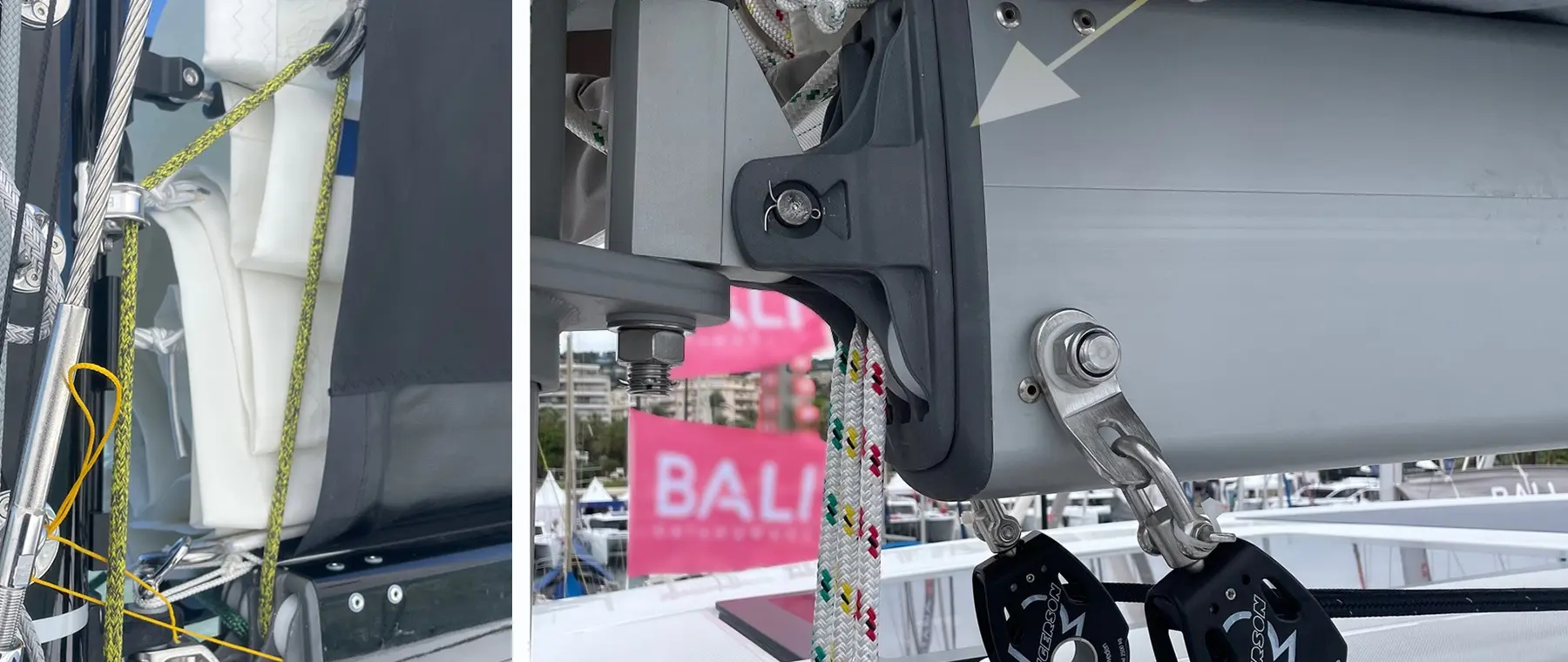
A revised range presented in Amsterdam
Sparcraft is presenting a revised range of sailing booms through its official exhibitor news programme for METSTRADE 2026. The brief announcement, dated 2 September, identifies three principal objectives: greater inertia at comparable weight, changes to single-line reefing arrangements and newly designed inboard and outboard ends with a flush appearance.
The development is relevant to boatbuilders and rigging businesses attending the Amsterdam exhibition from 17 to 19 November. It is also worth examining from the perspective of owners of small cruising and racing sailing boats, for whom the operation and condition of a boom can have a direct effect on ordinary sail handling.
The September release does not identify the individual new sections, their dimensions, their material specifications or the boat sizes for which they are intended. The announcement therefore should not be interpreted as confirmation that a given member of the range is an appropriate replacement for the boom on a particular yacht. The practical relevance of the engineering objectives is broader than the confirmed compatibility of the products themselves.
What the manufacturer means by increased inertia
The reference to inertia in a boom section concerns an important distinction between the quantity of material in a structural section and the way that material is distributed. In the context of beam engineering, the second moment of area is one measure associated with resistance to bending about a particular axis. It is distinct from the mass of the component.
A section can be designed to distribute its material differently and thereby alter its bending behaviour without necessarily increasing its weight. The stiffness of the resulting component also depends on the material, the direction of loading and the complete structural arrangement. Greater section inertia alone does not establish the ultimate strength of the finished boom.
Sparcraft's announcement does not provide numerical section properties or identify the axes about which the reported improvement has been achieved. A purchaser should not use the statement as a basis for calculating a permissible mainsheet load. It describes a design objective rather than a complete structural specification.
For a smaller boat, the mass and dimensions of the boom may be important considerations. A replacement must nonetheless be assessed as part of the rig, not solely on the basis of the weight printed in a catalogue.
Loads arise from the arrangement of the sail and its controls
A boom forms part of a system comprising the mainsail, its attachment to the mast, the mainsheet and other controls. The distribution of forces depends on the layout of those components. Two boats with visually similar booms can have different arrangements for supporting and controlling them.
An owner considering changes to the mainsheet attachment, reefing points or boom vang should understand how the resulting loads are transmitted. Relocating an attachment can change the forces applied to the boom and the surrounding fittings. The correct location is not necessarily the one that appears most convenient when the boat is alongside.
The suitability of a section also depends on details such as the arrangement of openings and local reinforcements. A proposed replacement should be assessed with the dimensions and characteristics of the sail plan in mind. A qualified rigger or the boat's manufacturer can establish the applicable requirements where they are not already documented.
The November exhibition information gives no numerical comparison between the old and new Sparcraft boom sections. It is not an engineering approval for altering an existing rig or transferring its fittings to a different section.
Single-line reefing and the small crew
Reefing is the process of reducing the working area of a sail. In a conventional slab-reefing arrangement, a reduced sail configuration is established using the designated reefing points. The term single-line reefing generally describes an arrangement in which one line is used to control more than one part of that operation, although the actual systems can vary.
For a small sailing boat operated by one or two people, the attraction can be the ability to manage a reef without having to handle several independent controls in rapid succession. The practical usefulness depends on how the line travels, the resistance encountered and the ease with which the reefed sail can be secured in accordance with its design.
A single control line does not remove the need for appropriate sailing procedures. Nor does the use of such an arrangement necessarily guarantee that every stage of the operation can be performed from the cockpit. That depends on the configuration of the boat, its sail and the installed system.
Sparcraft describes improvements to its single-line reefing systems but does not identify the precise mechanical changes. The announcement therefore provides a reason to enquire about the revised arrangement rather than instructions for operating or modifying an existing one.
An important distinction between fewer lines and less friction
Combining functions within a single control arrangement may reduce the number of separate controls presented to the crew. It does not automatically reduce the total resistance encountered when pulling the line. The route through which it travels and the number and condition of its turning points remain relevant.
A long line passing through several parts of a system can be affected by the condition of the rope and fittings. The ease with which the sail can be adjusted may differ between conditions when the arrangement is lightly loaded and when appreciable loads are present. A user should understand the manufacturer's instructions and practise appropriate procedures before relying on an unfamiliar installation.
The accessibility of internal components is another consideration. An owner may eventually need to inspect a line, replace it or identify a source of unusual resistance. A compact arrangement is more useful when the relevant maintenance tasks can be undertaken without unnecessary difficulty.
The company's announcement does not give information on the internal routing, service access or compatible rope diameters for the revised range. These will be important questions for equipment buyers as detailed technical literature becomes available.
The inboard and outboard ends
The official product photograph supplied to METSTRADE shows close views of boom-related fittings and associated ropes. Sparcraft identifies a flush arrangement for the inboard and outboard ends among its changes. These components serve different locations on the boom and may incorporate separate functions.
At the inboard end, the relationship between the boom and the mast is particularly important. The attachment has to accommodate the intended movement of the boom while remaining compatible with the rig configuration. At the outboard end, the arrangement of lines and terminals depends on the sail and the control system.
A visually streamlined end fitting may be appealing on a boat with a crowded cockpit. Its actual dimensions, access for maintenance and compatibility with existing components still require examination. A flush appearance in a press photograph does not establish that no lines or fittings protrude during operation.
The photograph does not provide a complete drawing of the revised system. Owners should obtain the appropriate component documentation and should not assume that hardware shown in a photograph can be installed directly on any older Sparcraft section.
Choosing a replacement on a recreational sailing boat
Sparcraft's official exhibitor catalogue describes a wider boom business incorporating conventional and motorised arrangements, aluminium and composite construction, and standard or custom products. The brief September announcement does not identify which of those categories the revised range covers.
For owners considering a replacement, the first priorities are the characteristics of the existing rig, the condition of the boom and the reasons a change is being contemplated. A desire for simpler reefing may lead to different questions from a replacement required because a structural component has been damaged.
The relevant information can include sail dimensions, the type of reefing, the location of control attachments and the geometry of the mast connection. A supplier requires that information to determine whether a proposed product is appropriate. Where structural damage is suspected, a competent assessment is preferable to continuing to operate the equipment on the assumption that the external appearance reveals its full condition.
A replacement can also affect maintenance requirements and the way the crew operates the boat. These considerations are part of the selection process rather than issues to discover after the equipment has been purchased.
Questions for suppliers at the exhibition
The immediate development is the presentation of three stated improvements to Sparcraft's boom programme. The manufacturer has indicated a desire to achieve better section properties without a substantial weight penalty and has identified reefing and end fittings as areas of change.
For riggers attending METSTRADE, the useful next step is to obtain the drawings and specifications of the new sections, establish the range of intended applications and examine the revised control arrangements. Owners of boats below twelve metres should verify that a proposed section belongs to the intended size and loading range before considering a purchase. The press material alone does not confirm that compatibility.
The announcement has not supplied a price list, commercial availability dates or quantified results comparing the revised products with previous versions. These limitations remain important when considering the engineering claims.
For Leisure Boat Guide, the interest of the development lies in the relationship between structural design and the everyday handling of a mainsail. A carefully chosen boom should suit the complete rig and remain understandable to the people using it. Sparcraft's new programme is worth following as its detailed specifications become available, without confusing a trade-show announcement with a confirmed installation proposal.
Source and lead photograph
Official source: Sparcraft exhibitor announcement, 2 September 2026. Lead photograph: Sparcraft, official exhibitor photographs showing details of boom end fittings and associated lines. Original issuer press asset distributed through the official METSTRADE virtual press room; copyright remains with its owner.