
Spanish registrations remain ahead for the year
Spain's recreational boating market reached 4,873 new registrations over the first ten months of 2026, according to figures published on 4 November by the National Association of Nautical Companies, ANEN. That compares with 4,617 registrations in the equivalent period of 2025, a gain of 256 boats, or 5.5 percent on the association's rounded measure. The underlying records come from Spain's Directorate-General of the Merchant Marine, making this a registration-based industry snapshot rather than an opinion survey of owners or exhibitors.
The distinction matters when interpreting a national market headline. Registrations represent boats entered in the relevant administrative data and do not, by themselves, tell readers the value of contracts, the profitability of dealers or the number of vessels currently offered for sale. An increase in units may still conceal very different conditions for a six-metre boat retailer and a business specialising in larger motor yachts. ANEN's breakdown allows the industry to examine those separate segments instead of treating all boating activity as one uniform market.
October changes the tone of the headline
The report's most immediate warning is the weaker October result. Just 231 recreational boats were registered during the month, against 278 in October 2025. That is a fall of 47 boats and a year-on-year decline of 16.9 percent. The ten-month total remains positive because earlier registrations more than offset that smaller final-month contribution. It would therefore be misleading either to describe Spain's whole market as contracting in 2026 or to ignore the sharp October retreat.
A single month is a limited window through which to judge a sector influenced by weather, delivery schedules, boat-show timing and seasonal buying behaviour. ANEN reports the October decline but does not attribute it to a single cause in this release. Dealers assessing their own order books will need to distinguish delivery timing from any change in underlying demand. Readers should also remember that these are registrations, not a direct measure of enquiries, deposits or orders placed during October.
The cumulative growth rate has moderated
September's official ANEN update put registrations through that month at 4,642, compared with 4,339 a year earlier, a reported increase of seven percent. The October update moves the comparison to 4,873 against 4,617 and reduces the stated cumulative growth rate to 5.5 percent. These consecutive official reports help explain the phrase 'growth moderates': positive year-to-date figures are continuing, but the latest monthly comparison has narrowed the advantage built earlier.
Subtracting September's cumulative total from the October figure gives the 231 October registrations reported separately by ANEN. The same operation on the 2025 cumulative figures produces 278 for October last year. This consistency makes the direction of change clear without requiring any speculative adjustment. What it does not establish is a forecast for November or December. A full-year assessment will depend on the remaining registrations and on whether the October weakness persists or proves temporary.
Small craft still dominate by volume
Boats no longer than six metres account for 3,316 registrations in the January-to-October period. ANEN puts this segment at roughly 68 percent of the total market and reports growth of 2.6 percent on the previous year. It is the largest part of the market by a considerable margin, even though its percentage expansion is more modest than the increase recorded in several larger length bands. Any assessment of Spain's recreational boating sector needs to keep this numerical concentration in view.
Smaller boats are relevant to a broad range of users, from day cruisers and anglers to families entering boating for the first time, although the association's length category does not identify individual owners' intentions. A change of just a few percentage points in such a large category can involve many more units than a dramatic growth rate among larger vessels. Percentage figures and absolute registration counts should therefore be read together. Neither alone fully captures the scale of market movement.
Six-to-twelve-metre market moves forward
Moving above the smallest craft, ANEN records 920 registrations for boats from six to eight metres, a gain of 9.8 percent. The eight-to-twelve-metre band recorded 388 registrations, up 4.3 percent. Both categories were positive during the ten-month period, but their different growth rates underline why retailers should avoid applying the national headline mechanically to every product line. A dealer's experience can depend heavily on which lengths and styles of boat it offers.
Length is a useful common measure across brands, but it cannot reveal propulsion type, equipment level, intended cruising grounds or purchase budget. A newly registered eight-metre boat could fill a very different role from a twelve-metre family cruiser. The figures are most valuable as evidence about the broad direction of each length band. They cannot establish average selling prices or show whether higher registrations have produced an equivalent rise in turnover for individual boatbuilders.
Larger leisure boats post the strongest percentages
The biggest reported percentage gains occur higher up the length scale. ANEN says vessels from twelve to sixteen metres reached 175 registrations, an increase of 38.9 percent. Craft longer than sixteen metres recorded 71 registrations, up 54.3 percent. These are sizeable increases in proportional terms, but both bands remain small compared with the 3,316 registrations recorded for boats of six metres or less. The contrast between market share and growth rate is central to understanding the figures.
For the larger-boat sector, the results are a useful indicator of activity, not a complete audit of superyacht orders. The over-sixteen-metre group encompasses craft that would not ordinarily be classed as superyachts, while some larger projects may take years between sale and registration. ANEN does not provide transaction values or detailed yacht names in this release. The data supports a conclusion that registrations in larger leisure craft are higher, but not a claim that every large-yacht yard is experiencing the same growth.
Motorboats lead the main propulsion categories
Motorboats were the strongest of the principal boat types listed by ANEN, with 2,101 registrations and growth of 14.5 percent. The association calculates that they represented 43.1 percent of the entire recreational craft market over the first ten months. Sailing boats accounted for 230 registrations, up 3.6 percent, while folding inflatables recorded 612, a gain of 4.6 percent. This gives a more nuanced picture than a simple division between power and sail.
Other categories were less buoyant. Personal watercraft reached 1,342 registrations, down 0.6 percent, while the separate inflatable-boat category recorded 501, a drop of 4.8 percent. These classifications should not be casually merged: ANEN distinguishes folding inflatables from the other inflatable category and counts personal watercraft separately. The figures describe how individual segments performed, but without published price data they do not establish which category generated the greatest revenue for manufacturers or distributors.
Charter registrations grow despite October fall
Boats registered for rental or charter use totalled 1,471 through October 2026, an increase of 7.5 percent compared with the same period of 2025. Within October itself, however, the charter market recorded only 31 registrations, down 13.9 percent year on year. The pattern broadly mirrors the whole market: an advance across the ten-month period followed by a weaker latest month. Charter activity should not be confused with the separate question of how many weeks each boat was actually booked.
ANEN's charter breakdown adds depth to this result. The number of rental-use boats over sixteen metres rose from 19 in the first ten months of 2025 to 33 in the corresponding 2026 period. Boats in the twelve-to-sixteen-metre rental band grew 38.6 percent. Personal watercraft represented 44.3 percent of charter registrations, with growth of 13.4 percent; motorboats made up 36.1 percent, rising 8.8 percent; and sailing boats increased by 10.4 percent. These are registration categories, not estimates of holiday demand.
Balearics lead the provincial figures
The Balearic Islands were the leading Spanish province by new recreational boating registrations, with 760 through October and a 15.6 percent national share. Barcelona followed with 563, or 11.6 percent, while Madrid registered 378, or 7.8 percent. Other notable totals were Murcia with 290, Alicante with 283, Girona with 278, Malaga with 264 and Cadiz with 223. This geographical breakdown is especially relevant to businesses deciding where to place dealerships, service capacity and marketing.
The charter market is even more concentrated in the Balearics according to the association's figures. The province accounted for 364 rental-use registrations, representing 24.8 percent of Spain's reported charter total. Barcelona recorded 186 charter registrations and Girona 130. These counts do not measure where each yacht sails during the season, nor do they identify how many visitors charter in an individual destination. They show where the relevant vessels were registered, which is valuable but narrower than a complete tourism map.
What the figures do and do not show
ANEN's November release offers a disciplined picture of an industry still ahead on cumulative registrations, led by motorboats and supported by strong proportional growth in the larger length bands. It also documents a sharp fall during October, meaning businesses should approach the 5.5 percent headline with appropriate caution. The report's source is administrative registration data supplied by Spain's Directorate-General of the Merchant Marine, not an independently sampled survey of boat owners.
For builders, dealers, marinas and service companies, the practical lesson is to compare like with like: registrations by month, boat length, type and use. A marina operator interested in longer vessels will read the increase above sixteen metres differently from a retailer focused on personal watercraft. Before drawing conclusions about 2027, the trade will need final 2026 figures and additional evidence about orders, delivery times and prices. The figures published so far make a useful benchmark; they are not a guarantee of future growth.
Source: ANEN — Spain's recreational boat market report, 4 November 2026.
Primary release and photograph credit
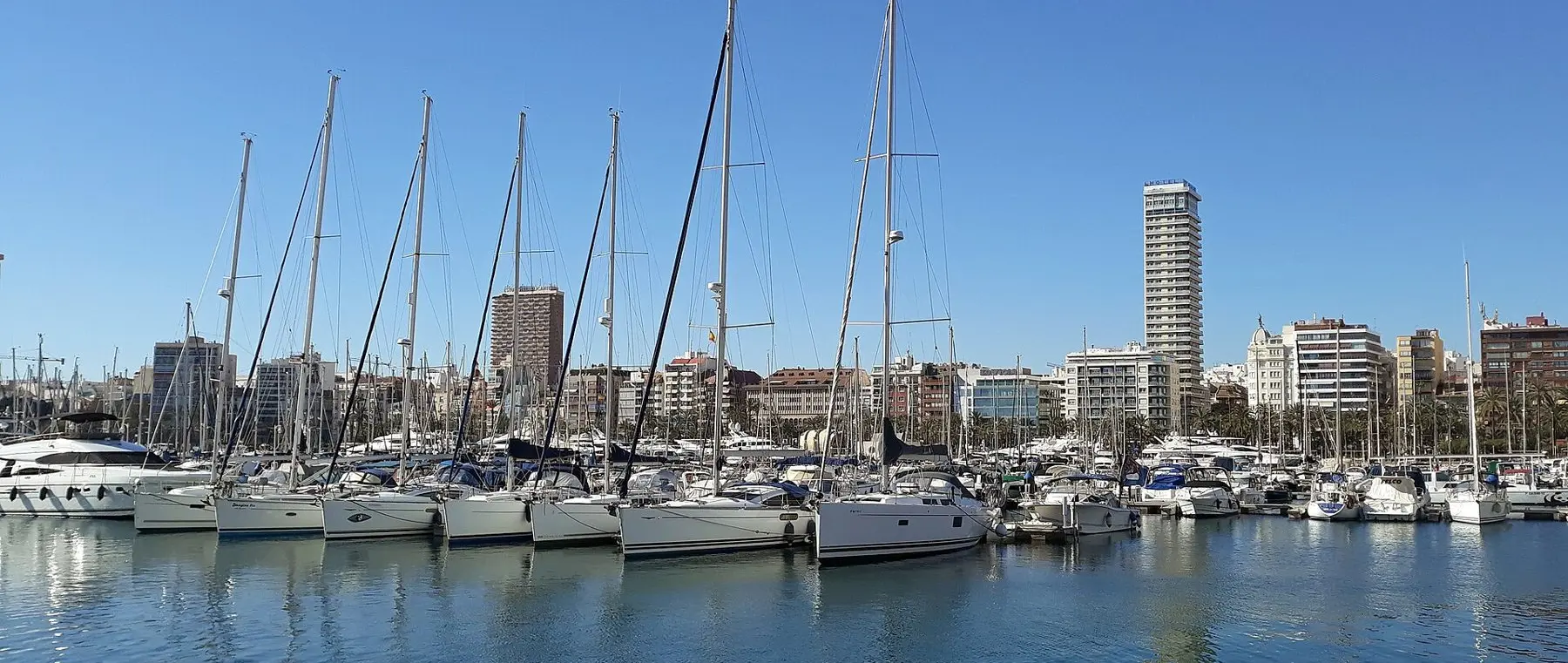
Original issuing organisation. Alicante Marina in Spain, illustrating small pleasure-craft berthing; this is a location photograph, not an image of the vessels registered in the ANEN report. Photograph: acediscovery, Wikimedia Commons, CC BY 4.0; resized without cropping.
