
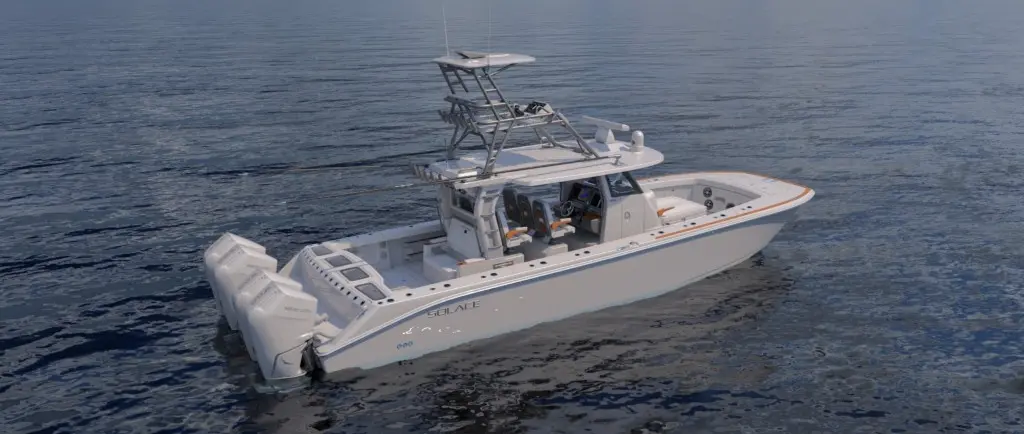
SŌLACE enters a new category of offshore boat
Florida boatbuilder SŌLACE has announced the 41CT, its first centre-console catamaran, ahead of a public presentation at the Fort Lauderdale International Boat Show. At 41 feet 3 inches overall, the new model represents a change in hull philosophy for a company previously associated with conventional offshore centre-console designs. The 41CT is intended to cover serious fishing, family passages and entertaining without requiring an owner to choose an entirely different boat for each activity.
The announcement is dated 20 October 2026 and identifies the Edgewater, Florida, manufacturing site as the design and production base. That places the story firmly in this year's new-model cycle, with the boat due to appear at the show from 28 October to 1 November. The manufacturer has released a dedicated model page and official images, but several commercial and propulsion details still need to be confirmed before prospective owners treat it as a fully specified production purchase.
The dimensions explain the platform's ambition
The 41CT measures 12 feet across the beam according to SŌLACE, creating a broad deck for its 41-foot length. The builder lists an approximate dry weight of 20,000 pounds with engines and publishes a bridge clearance of 9 feet 4 inches without radar. These are meaningful figures for berth planning, lift capacity and waterfront access, although operating displacement will be higher once fuel, crew, provisions and personal equipment are loaded.
The manufacturer's online dimensions include a stated 15-inch draft and separate hull-form figures of 58 degrees at the bow and 21 degrees at the transom. Prospective owners should ask for a written explanation of the draft measurement under the chosen loading and engine conditions, since the ability to operate in shallow water cannot safely be inferred from one headline figure. Actual clearances, propeller depth and local tidal limits remain essential operating concerns.
Why the twin-hull arrangement matters
SŌLACE describes the 41CT as using a patented bisymmetrical twin-hull architecture. In principle, a catamaran can provide a broad transverse platform and distinct space planning opportunities compared with a monohull of similar overall length. The company positions that architecture around stability, efficient passage-making and usable deck area, but the full effect depends on the finished boat's loading, power configuration and conditions.
Independent performance figures have not yet been supplied in the announcement, so a precise comparison with a competing offshore monohull would be speculative. A buyer should ask for controlled sea-trial data, including acceleration, cruising consumption, handling in turns and behaviour in short steep waves. It is especially useful to observe the ride from several passenger positions, as the sensation of movement can vary considerably between the helm and outer seating.
An unusually substantial fishing specification
The builder identifies two 60-gallon livewells and a pair of 187-gallon fish boxes, figures that illustrate the attention devoted to extended fishing expeditions. Casting areas are planned at both the bow and stern, allowing crews to work different parts of the deck. This is more than a day boat wearing fishing graphics: the storage volumes and open platforms indicate that tackle handling has been considered from the start.
The practical benefit of those features still depends on how drains, pumps, hatches and deck routes are arranged. Anglers should inspect how readily they can move a catch from the rail to its storage compartment without obstructing seated guests. Details such as nonslip surfaces, access to pumps, livewell flow and rod stowage may be more important over a long season than an isolated specification figure on a showroom sign.
A large fuel capacity, but no promised range yet
SŌLACE lists 950 US gallons of fuel capacity, a substantial figure intended to support longer offshore days and passages between distant fishing grounds. The number does not by itself establish practical range. Without a confirmed engine package and tested economy under realistic loads, it would be premature to calculate a definitive cruising distance or promise a particular speed.
Fuel planning should start with measured consumption at the intended cruising speed, including sea conditions, reserve allowances and any auxiliary equipment. The model page also specifies 40 gallons of freshwater and 15 gallons of waste capacity. Those resources may matter for all-day comfort and occasional extended use, but owners should confirm how the tanks are arranged and serviced before assigning the boat a particular endurance profile.
Dual-row helm seating changes the travelling experience
A notable part of the layout is dual-row seating at the helm, which SŌLACE says is intended to accommodate more passengers in the comparatively protected forward cockpit. On a long run to a fishing ground, the ability to keep guests seated together and facing forward can be valuable. It may also reduce the tendency for passengers to gather in areas that interfere with the helmsman's work.
Seat geometry is best judged onboard. The number of positions, clear foot placement, visibility from the rear row and access between the helm and side decks all determine whether the arrangement delivers on its promise. Owners who regularly travel with family should also examine where handholds are located and how comfortably passengers can remain seated when the boat is moving through a lively inlet.
The opening aft bulkhead is a key design idea
The 41CT carries forward an opening aft cockpit bulkhead concept that first appeared in the builder's 35CS. When closed, the structure is intended to help isolate the helm area from cockpit and outboard noise and reduce exposure to conditions. Opening it allows the helm and aft cockpit to communicate more directly, changing the feel of the boat during social time or fair-weather operation.
A mezzanine seat beneath the bulkhead adds aft-facing accommodation with cupholders and interior storage. The arrangement could be particularly useful for someone watching fishing action or supervising activity at the stern. However, buyers should inspect how the opening moves, how it is secured while underway and whether the seat remains practical alongside the fishing equipment their own crew carries.
Built at the company's Edgewater facility
The manufacturer says the 41CT was developed by its internal engineering team and produced using the firm's vertically integrated construction approach in Edgewater. The factory is described in the launch announcement as a 200,000-square-foot facility handling important stages of design, tooling and manufacturing. That gives the company considerable control over how a new hull form moves from engineering drawings to a finished boat.
Construction provenance is useful, but ownership due diligence should still focus on the actual hull, installed machinery, warranty terms and dealer support. Buyers should ask about inspection processes, access to major systems and the availability of replacement components. A new hull category often brings a learning curve for builders and owners alike, making clear technical documentation and after-sales arrangements especially important.
What visitors can see at Fort Lauderdale
The builder has specifically confirmed that the 41CT will be displayed at the 2026 Fort Lauderdale International Boat Show. Its own event page identifies Dock C at the Bahia Mar Yachting Center as the company display location. The five-day exhibition offers the chance to study the boat's arrangement in person and ask the manufacturer's team how the twin-hull concept differs from its existing models.
A static show inspection can answer many questions about headroom, deck flow, seating and machinery access. It cannot resolve real operating economy or offshore handling, and the builder has not supplied a complete comparable sea-trial dataset in the launch material. Interested owners should request subsequent on-water demonstrations with their expected load and clarify when a final written specification and configuration schedule will be available.
A first look with realistic questions remaining
The significance of the 41CT is that SŌLACE is extending its approach to premium centre-console boating into the power-catamaran market. Twin livewells, substantial fish-box capacity, a broad beam and an adaptable aft bulkhead indicate a model that is intended to be both a serious offshore tool and a comfortable platform for guests. It is a development worth watching for owners who use their boat for more than one pursuit.
Official details can be checked on the manufacturer's 41CT model page and its Fort Lauderdale display information. The published image is a manufacturer-supplied design visual, not evidence of an independently completed sea trial. Until engine packages, verified performance and pricing are formally established, the responsible conclusion is that the new platform is promising in concept and requires the usual thorough evaluation before purchase.