
A connected control system returns to Amsterdam
German marine-electronics developer Thitronik is presenting SMARTDOCK at METSTRADE 2026 as it seeks greater international distribution and introduces additional features. A product announcement dated 11 November highlights the use of a smartphone to control compatible propulsion and thruster systems while the skipper changes position aboard a boat. The approach is relevant to small motorboat owners who sometimes need to operate without an additional crew member, particularly when berthing or leaving a busy marina.
This is not a newly invented automatic docking service that can be left to drive a boat without supervision. SMARTDOCK already has a product history, including a 2025 DAME Design Awards nomination, and the current announcement concerns its continuing development and distribution ambitions. Its value depends on the specific boat, installed modules and the responsible skipper's ability to observe the manoeuvre. Wireless control should be presented as a supplementary operational interface, not as a replacement for judgement or direct oversight.
Why the ability to move around matters
In a small boat with a fixed helm, the operator often has a good view ahead but a less satisfactory view of a low pontoon, cleat or aft quarter. A short-handed skipper may have to choose between remaining at the controls and checking distances directly from another position. SMARTDOCK proposes to address part of that dilemma by allowing compatible propulsion commands to be issued from a smartphone while the operator stands in a more useful place on deck.
The concept has an important limit. The phone does not make the boat's size, momentum or windage disappear, and the skipper must remain able to see hazards and understand how the vessel will respond. It may be easier to judge the gap at the stern while standing nearby, but the opposite side of the boat can still be hidden from view. Safe operation therefore depends on a deliberate plan, an unobstructed line of sight and realistic control settings rather than merely walking closer to the dock.
Thitronik's modular arrangement
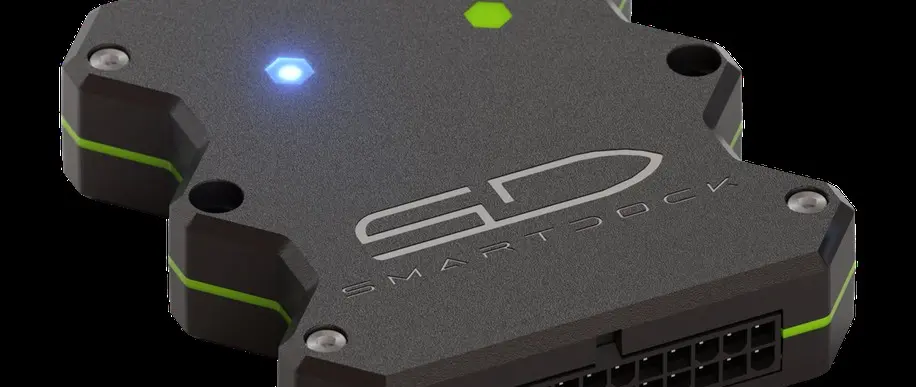
The manufacturer's system is built around separate interfaces for the functions a particular boat needs. The Engine Control Unit, or ECU, handles compatible main-engine controls, while a Thruster Control Unit can incorporate bow or stern thrusters. A proportional variant, TCU-P, is intended for variable-thrust equipment. The product site also describes options for electric anchor and winch operation, illustrating a modular design rather than a single universal box with every possible function built in.
Owners should view these choices as a system-integration problem. A boat with one outboard engine and no thruster will need a different arrangement from a twin-engine motor cruiser with bow and stern controls. The modules must match actual supported equipment and receive appropriate professional installation. A manufacturer listing of broad compatibility categories cannot be assumed to cover every engine generation or software revision. Before ordering, ask the installer to confirm the exact make, model and control protocol aboard the boat.
Bluetooth control and the need for a secure connection
SMARTDOCK uses Bluetooth Low Energy to communicate between the application and onboard equipment. This avoids requiring an internet connection for the basic local control link, a practical benefit in marinas where mobile signal can be unreliable. The manufacturer describes a wireless approach that allows the skipper to move between useful observation points while keeping the phone within the vessel's operational range. The app provides more than one way to display and issue control commands.
A wireless interface also requires clear fail-safe behaviour. A responsible user should know what happens if the phone battery fails, Bluetooth connection is lost, an incoming call interrupts attention or the application is closed unexpectedly. The operator needs to understand how to regain normal helm control and how the system handles a command that stops arriving. These are ordinary safety questions for an electronic propulsion interface, and they should be answered by the manufacturer's current technical documentation and the installing specialist.
New modules and position-holding proposals
The company's current material refers to expanded control functions and a proposed Position Hold feature intended to keep a compatible boat in a chosen location without constant joystick corrections. The manufacturer labels Position Hold as coming soon. It should therefore not be described as an operating feature already available to every customer in November 2026. A planned capability may change before release and may depend on additional hardware or supported propulsion systems.
If a position-holding function reaches the market, owners will need to distinguish it from anchoring and conventional station-keeping equipment. Holding a boat near a dock or waiting area brings requirements concerning clearance, current, propeller wash and the ability to override the system immediately. No promotional claim should encourage a skipper to leave the vessel unattended or assume that the technology can replace watchkeeping. For now, buyers should judge the system on supported, documented functions rather than features still under development.
Retrofitting a boat is not merely installing an app
The manufacturer's description emphasises integration into existing propulsion systems, suggesting a route for boats that have already been delivered. A retrofit can be attractive to owners who would otherwise consider additional deck cameras, remotes or major helm changes. Nevertheless, the installer must address electrical supply, control interfaces, mounting, system protection and the integrity of the boat's normal operating controls. An app alone cannot make an unsupported mechanical throttle or an incompatible outboard respond to digital instructions.
Owners should ask for an installation drawing and written compatibility confirmation before purchase. Those documents should show how the existing controls are retained, how the extra interface is enabled and how an operator returns to conventional control. If the system relies on manufacturer-specific components or firmware, long-term support also becomes part of the buying decision. A successful installation must remain understandable to a mechanic years after the original dealer has handed over the boat.
Single-handed docking remains a serious responsibility
The appeal of smartphone manoeuvring is particularly clear for people who boat alone or with a companion who may not be confident handling lines. Standing where the pontoon is most visible could reduce some uncertainty. The same arrangement can introduce new risks if the skipper concentrates too heavily on the screen, stands where a moving boat could pin them or neglects the approach speed. The safest practice still begins with slow movement, clear escape routes and realistic limits on what one person can manage.
No control technology should persuade an operator to step between hull and dock, to leap ashore or to try holding the boat by hand. A skipper must be prepared to abort an approach if wind, current or traffic makes the manoeuvre unsuitable. Wireless controls can expand a person's viewing options, but the operator remains responsible for the boat, passengers and nearby vessels. Good training with the specific installation should form part of the delivery and must be repeated after significant system updates.
Controls for engines and thrusters are different
Main engines generate propulsive force that moves a boat ahead or astern, while bow and stern thrusters are normally used for lateral adjustment at low speed. Combining these functions on a single interface can provide useful manoeuvring choices, but the user needs to understand each command's effect on the vessel. A twin-engine craft may turn differently from a single-engine boat, and a joystick configuration cannot erase those underlying handling characteristics.
Some boats are fitted with thrusters that provide only on-off operation; others use proportional power. SMARTDOCK's separate TCU and TCU-P modules reflect that distinction. An owner should verify which type of thruster the boat actually has and whether the intended control unit supports it. This is especially important where older equipment or modifications have been made without complete documentation. The best demonstration uses the finished installation on the owner's own boat, in clear water away from obstacles.
A distributor network is part of the product
Thitronik lists SMARTDOCK through the official METSTRADE exhibitor catalogue and identifies stand 05.725. Its current commercial effort includes recruiting distribution and installation partners in additional markets. That matters because the usefulness of an electronic retrofit depends on a technician who can fit it correctly, update software, diagnose faults and explain the equipment to a new owner. A product purchased through an unsupported importer could leave the skipper with limited practical assistance.
Before selecting a supplier, boat owners should ask which propulsion combinations the local installer has fitted successfully. They should request a documented handover, warranty details and an explanation of who provides software support after installation. The system's modularity can be an advantage if it simplifies future changes, but only if components and versions remain compatible. Distribution expansion is a reasonable business development to report; it is not proof that a global service network is already complete.
Digital convenience and helm discipline
SMARTDOCK can also be considered in the broader trend towards electronic controls on increasingly compact boats. Mobile apps now support navigation planning, monitoring and other owner routines, but issuing commands to propulsion is a more consequential task than adjusting a cabin light. Every new control route should therefore be assessed for safety, redundancy and ease of use under pressure. A simple-looking screen may disguise a complicated interaction between several onboard modules.
Owners should familiarise themselves with any limits on phone orientation, touch gestures, connection strength and control activation. They should know whether there is a dedicated emergency stop and how it is reached. The manufacturer and installer must explain the conditions under which the system can be enabled. A controlled demonstration on a quiet day should include a simulated loss of connection and immediate transition back to the fixed helm, conducted safely under qualified supervision.
What to ask at METSTRADE 2026
At the Amsterdam show, prospective buyers can ask Thitronik which specific new features are in production, which remain in development and how they differ from the original SMARTDOCK offering. They should seek an updated compatibility matrix and the supported control procedures for their own propulsion system. Questions about Bluetooth security, software updates, battery interruptions and equipment protection deserve precise technical answers. A general promise of intuitive operation should not be accepted in place of instructions.
The event also provides an opportunity to see physical modules and discuss installation costs. A complete quote should include the interface hardware, installation labour, commissioning and any recurring software or support terms. Owners should distinguish equipment price from the total cost of having a safely working system aboard. They should also confirm whether a change of smartphone or a future operating-system update will affect the application and how the manufacturer handles such transitions.
A useful option for small boats, not an autonomous skipper
The verified development is that SMARTDOCK is being promoted for wider distribution and new functions ahead of METSTRADE 2026, building on a system that can control compatible propulsion and thrusters from a smartphone. For Leisure Boat Guide readers, the potential value lies in improved observation positions during controlled low-speed manoeuvres. It is a particularly interesting concept for owners who frequently operate with minimal crew and who have struggled with visibility from a fixed helm.
The important outstanding questions concern documented compatibility, fail-safe behaviour, operator training and support. Position Hold remains a proposed feature, not a licence to abandon the helm. Leisure Boat Guide has not independently tested the system or verified claimed millimetre-level precision on a moving boat. The news is worth following because it places an established consumer device at the centre of a safety-critical marine function, and because the quality of that engineering will determine whether the promised convenience is useful in practice.
Official editorial source: www.metstrade.com. SMARTDOCK control hardware, official product rendering provided by Thitronik to METSTRADE.