
The small-boat problem is often too many separate systems
A compact cruiser may have a capable chartplotter, a battery monitor, an automatic bilge pump and a separate alarm system, but the equipment may have been fitted at different times and use different methods of communication. UK technology start-up SmartBoat is trying to address that fragmentation with SmartBoatOS and an associated application intended to bring compatible boat functions into one interface. A November 2026 announcement distributed by marine start-up platform Yachting Ventures says the company has opened a £500,000 funding round to support commercial development. The financial news is important because it indicates that the technology remains in a growth phase rather than an established universal standard. For Leisure Boat Guide, the more significant question is whether a modular platform can genuinely improve an older boat under twelve metres without creating a new source of dependence, confusing control functions or introducing unreliable automation.
What SmartBoat describes as its objective
The company’s publicly available platform material describes a vendor-neutral approach built around bringing compatible data, controls and alerts into one place. Owners would be able to select information relevant to their craft and arrange screens according to their priorities. That is different from buying a completely new helm package and replacing every older device at once. SmartBoat’s underlying concept is that the onboard systems remain useful, while an additional software and electronics layer helps people view or manage them together. The qualifier compatible matters. Some products communicate through open marine standards, others through their own proprietary protocols, and older equipment may offer very limited external access. A useful implementation must explain which brands, device generations and individual functions are supported rather than suggesting that every circuit aboard any boat can automatically join the platform.
A retrofit has to begin with the electrical diagram
On a small second-hand sailing boat, the most difficult part of connected monitoring may be understanding wiring installed over successive ownership cycles. The original plan may be incomplete, cables may not be labelled and a previous owner may have added accessories without documenting the change. Before bringing those circuits into a digital interface, the installation should identify essential loads, circuit protection and the location of appropriate switching equipment. Adding a software layer does not repair poor connections or eliminate the need for fuses. In fact, inaccurate descriptions of circuits could make diagnostics harder by presenting the wrong information to the operator. A qualified installer should confirm what the boat can safely monitor and control, then commission functions in a controlled sequence. The company’s architecture may offer new ways to organise that work, but technical inspection remains the foundation of any reliable retrofit.
Monitoring and control have different risk levels
Reading a battery voltage or seeing that a cabin light is on generally presents less risk than remotely switching a high-current circuit or operating a pump. A digital system should make that distinction clear. The owner may be happy to monitor a fridge, temperature sensor or tank level from a phone, but certain functions should remain subject to physical controls, protective interlocks or direct human supervision. SmartBoat materials describe both monitoring and automation, and the company’s beta component specifications include modular interfaces for electrical circuits and sensors. Those statements identify areas of development rather than confirming the precise operating characteristics of every released product. An owner should establish which functions are already commercially supported and whether the hardware meets the applicable installation requirements. Especially on older boats, convenience should never justify bypassing the designed safety protections of essential electrical equipment.
A small boat's power budget is unforgiving
Connected modules, wireless gateways and remote communications equipment consume electricity even when they are not displaying a colourful dashboard. On an eight-metre sailboat with limited battery capacity, a modest continuous draw can matter over several days away from shore power. The practical budget should include each controller, communication modem, sensors and any equipment that stays awake while the vessel is unattended. Owners should ask for current draw under normal operation, standby and fault conditions. A battery monitor may itself become a source of discharge if it is installed without a sensible shutdown strategy. An operator also needs to consider the power supply used by navigation and safety equipment. A well-designed system should report its own consumption accurately and provide a predictable response when the battery bank approaches a low state of charge. The platform’s convenience is valuable only when it does not undermine the small boat’s essential electrical reserve.
The appeal of a custom dashboard
A family cruiser, a weekend fishing boat and a small racing yacht have very different information priorities. A racing crew may want wind, speed and selected performance figures visible at a glance, while a family owner might care more about battery state, freshwater supply and whether the bilge pump has operated. The ability to arrange screens and alerts around the boat’s actual use is therefore appealing. But customisation must not lead to poor usability. A critical warning should remain easy to see even when a user has filled the screen with less important widgets. The interface should also be legible in direct sunlight, usable with wet hands where appropriate and accessible when the network connection is unreliable. SmartBoat’s published promise of flexible dashboards needs to be judged in real navigation and maintenance tasks. A polished illustration alone cannot establish how quickly a tired skipper can identify a fault.
Older sensors may not report what owners expect
Many small boats have a mix of analogue gauges, digital engine information and separate proprietary instruments. A bridge device cannot reliably infer data that the underlying system does not provide. For example, battery voltage is not a complete measurement of remaining usable energy, while an alarm on a single float switch cannot detect water in an unrelated compartment. Some older engines provide no suitable diagnostic output at all. An owner considering SmartBoatOS should compile a list of actual equipment and check each requested monitoring function with the supplier. The system may require additional current sensors, dedicated monitoring modules or wiring changes. That is not necessarily a weakness, but it should be reflected honestly in the installation quotation and maintenance plan. Claiming universal compatibility would risk disappointing owners who expect a simple app download to transform an ageing electrical installation.
Security matters when boat controls become connected
Any device that exposes monitoring or control functions beyond the immediate helm introduces questions about authentication, network access and updates. A remote app may be convenient for checking the boat’s status from home, but owners should understand who can log in, how access is revoked and what happens after a phone is lost. Boat-sharing families and clubs may need separate user permissions. The company should publish a policy for software support, security patches and the treatment of personal information. It is also important to establish whether core monitoring and switching functions remain available locally when a remote service is offline. A boat must not become impossible to operate merely because a phone has no signal or a cloud service is temporarily unavailable. These are standard engineering and security considerations for connected systems, not allegations of known vulnerabilities in SmartBoatOS.
An open approach needs durable documentation
The term open is useful only if owners and installers can understand what is genuinely interoperable. A vendor-neutral platform may use published interfaces or software abstractions, but some equipment manufacturers still impose restrictions on proprietary controls. Before buying, the owner should ask what documentation is available, whether logs can be exported and how the system handles discontinued devices. If the company changes its business model in future, will the boat retain a basic level of functionality? Are replacement controllers available through ordinary marine channels? Is there an understandable method for reverting to safe manual operation? Clear answers distinguish a long-term marine solution from a short-lived consumer gadget. The current platform’s commercial development is an opportunity to establish those principles early, before many boats depend on the same software for everyday functions.
The funding round signals both ambition and uncertainty
Yachting Ventures’ late-November announcement states that SmartBoat is raising £500,000 to commercialise its next-generation platform and build out its market presence. It identifies founder Chris Saunders and describes an investment pitch scheduled for 1 December 2026. Those facts show how the company plans to finance development, but a fundraising round is not evidence that the target has already been collected or that the business is profitable. Nor is it an assurance of delivery dates or sustained support for every proposed component. A buyer should distinguish an available product from a feature that exists on a roadmap. Investing in a new technology can give early adopters useful functionality, but it may also involve software changes, new hardware revisions and longer integration work than mature equipment. Consumers are entitled to clear statements about what they are paying for today.
The original vessel project provides context
In an earlier November 2026 founder interview, Saunders explained that the concept grew out of the challenge of modernising systems aboard an older sailing yacht without losing its character. That background helps explain why retrofit compatibility is central to the company’s message. The boat associated with his story is larger and different from many craft covered by Leisure Boat Guide, so its needs cannot be transferred directly to a small cruiser. A modest eight-metre boat may have fewer systems but far less space for wiring and hardware. The underlying challenge—separate devices that work well individually but poorly together—can still be shared. A platform developed with a restoration project in mind might be attractive to older-boat owners if the cost and complexity can be scaled appropriately. Practical evidence from smaller installations would help establish that proposition.
The photograph is not a product performance test
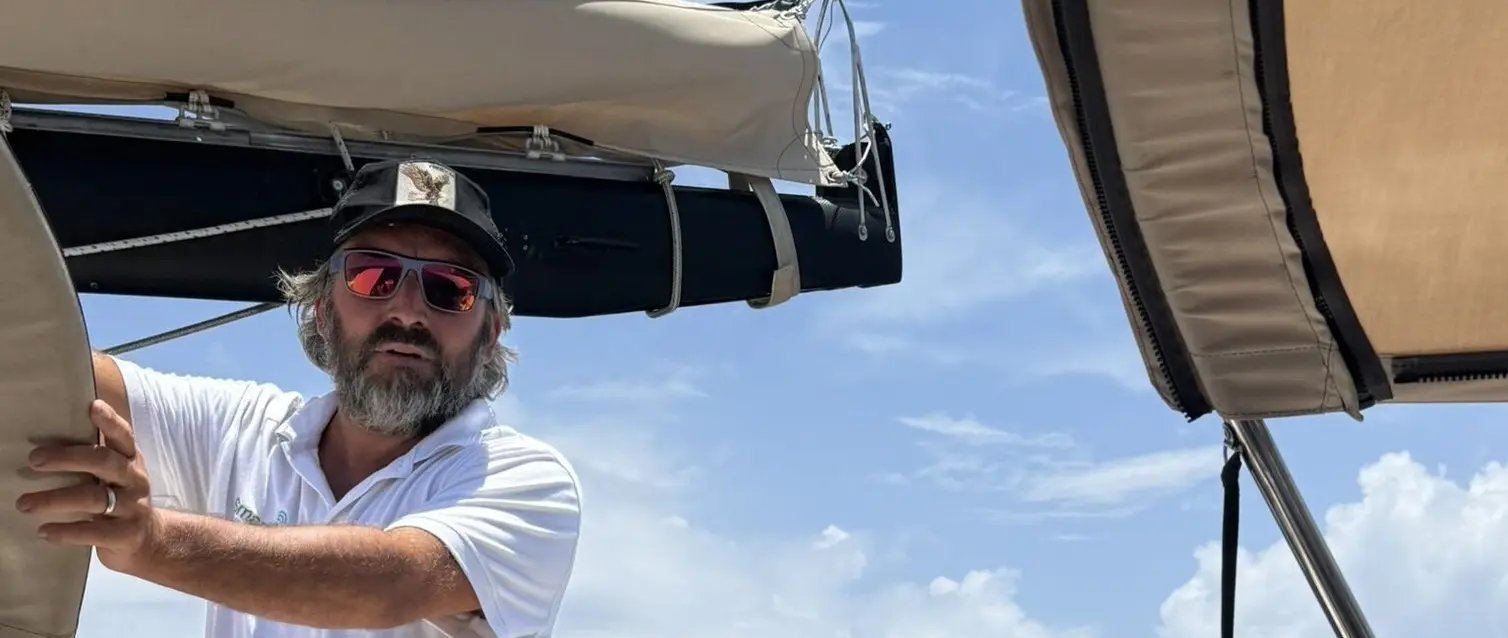
The image accompanying this report is an authentic original photograph distributed with Yachting Ventures’ 2026 SmartBoat founder interview. It provides real context for the company’s development work, rather than claiming to show an independently commissioned small-boat retrofit. That distinction is important because images of attractive yachts or enthusiastic founders can make a technology business seem more mature than the published evidence supports. The company has described its software and module architecture, but Leisure Boat Guide has not independently installed and tested SmartBoatOS on a named vessel. No unsupported claims about fault-detection accuracy, battery savings or universal protocol support are made. The news is the company’s 2026 commercialisation effort and its proposed approach to connected boats, with a separate technical discussion of what ordinary users should ask before joining a potentially evolving ecosystem.
Maintenance information could become a useful by-product
When a monitoring system captures reliable circuit or equipment information over time, it can help owners identify recurring problems and produce a clearer maintenance history. A record that a bilge pump has run frequently, for example, may prompt inspection, while an abnormal battery trend could encourage a charging-system check. These alerts still need interpretation and suitable sensors. Automation cannot establish the cause of a fault without adequate measurements, and a mobile notification should not be confused with a completed repair. Owners should want to record work performed and keep access to that history if the boat changes hands. For a modest cruiser, better maintenance records might prove more valuable than complex remote switching. The long-term test is whether the platform makes owners more aware of their boat’s condition without forcing them to become software administrators to perform routine checks.
A sensible trial for a small-boat owner
The most useful demonstration would involve a representative older boat with known wiring and a small set of monitoring tasks, such as battery state, selected alarms and temperature readings. Each input should be compared against an independent reference and its fault behaviour documented. The installer should then test loss of communications, loss of power and restoration of the system. If remote controls are included, their permissions and safety interlocks must be checked separately. The owner should be able to operate core equipment without the app and understand how to maintain the new modules. A written schedule of software support and component availability would complete the evaluation. This is a more credible purchasing basis than a promise that all onboard systems can be displayed together without further work. Small-boat technology succeeds when its advantages are measurable and its risks remain manageable.
What the next stage should establish
SmartBoatOS reflects a real problem in the recreational boating market: capable equipment installed in separate systems can be difficult for owners to manage coherently. The November 2026 funding announcement gives the company an opportunity to expand development, but the product’s commercial future and support arrangements require continuing evidence. An owner considering the platform should request an explicit list of compatible devices, a detailed installation quotation, documented local fallback behaviour and current security support terms. If those conditions are met, a modular connected system may allow older small boats to gain useful oversight without a wholesale electronics replacement. If not, simpler independent instruments may remain the more dependable option. The important story is therefore not the ambition of one dashboard, but whether SmartBoat can turn open integration into reliable, secure and affordable everyday functionality aboard real leisure craft.
Primary reporting and image credit
Primary manufacturer and organiser source(s): https://yachtingventures.co/smartboat-opens-500k-funding-round-to-commercialise-next-generation-marine-operating-system/. © Yachting Ventures / SmartBoat / original photographer. Genuine November 2026 company interview photograph, not evidence of a particular completed SmartBoatOS retrofit. Image is used only for correctly attributed factual editorial coverage and never represented as open-licence stock photography.