
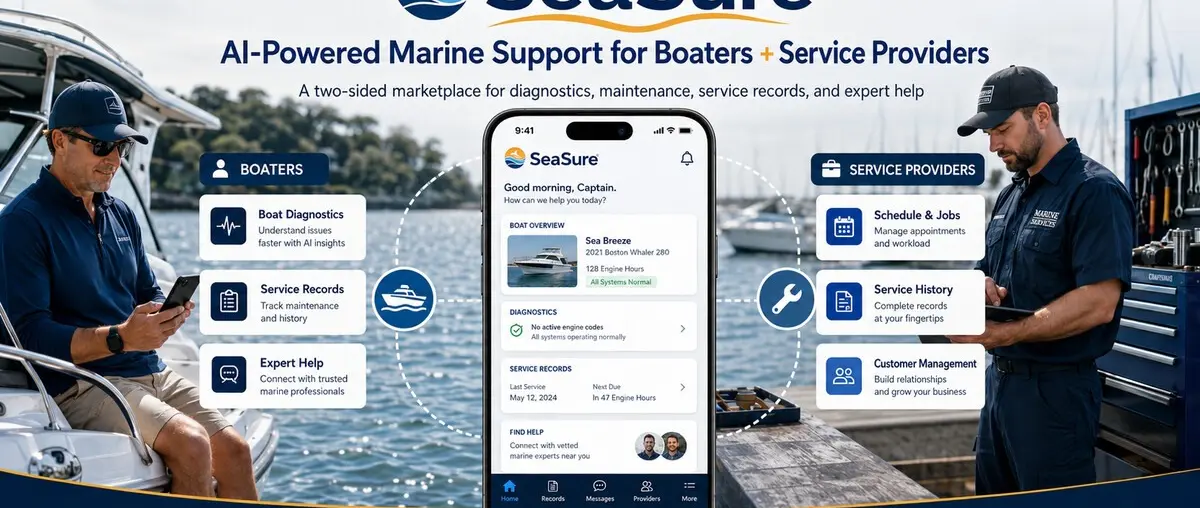
A boat-specific approach to maintenance information
Boat owners who perform some maintenance themselves often have to juggle manuals, invoices and previous repair notes. SeaSure is proposing an individual digital record to bring that information together. The latest product announcement describes the available features, but suitability depends on the boat, its existing equipment and a correctly planned installation.
The company describes the system as a shared intelligence layer for owners, technicians, builders and equipment suppliers. It is intended to connect information accumulated during ownership with the people who service the boat and, eventually, with those who design and manufacture its components.
For a twelve-to-twenty-four-metre leisure boat, the practical appeal is readily apparent. Such vessels often carry several brands of propulsion, navigation, electrical, plumbing and climate-control equipment, leaving a captain or owner with a collection of documents scattered across devices, emails and service folders.
Twelve specialised agents and a digital vessel record
SeaSure says the platform has been developed around twelve specialised artificial-intelligence agents. These are described as supporting vessel-specific queries, access to information, remote assistance and the conversion of real service outcomes into material that may assist subsequent troubleshooting.
The most important feature for an owner is not the number of agents but whether the system can identify the correct equipment and its configuration. A model-specific manual can still be misleading if a yacht has received a different engine installation, software update or refit since it was built.
To create a reliable digital record, owners will need to check identifying details, preserve service documentation and ensure changes made by contractors are reflected in the vessel profile. A well-maintained record can make future fault investigations more efficient, while incomplete records may undermine even a sophisticated search facility.
An information tool, not an autonomous engineer
SeaSure aims to help technicians begin work with the relevant history and documentation, rather than repeating the same preliminary investigations on every service visit. The company also sees a benefit for manufacturers and suppliers, who could learn from recurring field problems and the outcomes recorded by service providers.
The service should nevertheless be regarded as decision support, not a substitute for a trained marine engineer or authorised maintenance procedure. Advice about electrical power, fuel systems, propulsion control and other safety-critical equipment must be checked against the correct technical documents and the physical condition of the installation.
Owners also need clarity about who can view the vessel record, how access is granted to outside contractors and whether commercially sensitive or personal information will be shared. Data governance is particularly relevant on professionally crewed yachts, where service records may contain operational details that the owner would prefer to keep private.
IBEX launch and what owners can evaluate next
The platform was introduced through the IBEX start-up environment after a period of development and testing. SeaSure’s website currently emphasises the boating-owner experience, while provider, builder and supplier applications are presented as part of the broader intended ecosystem.
That sequencing matters: an announcement that an integrated professional network is planned is not evidence that every partner tool is already widely available. Buyers should ask which functions are live today, what boat systems are supported, how external technicians are enrolled and how errors or outdated information are corrected.
If the approach matures, its potential value could lie in reducing wasted time between finding a fault and locating the right component-specific information. For now, owners should treat it as an emerging service worth evaluating alongside ordinary digital maintenance logs and professional support arrangements.
What a small-boat owner should check
Before fitting the system to a recreational boat, owners should confirm the exact model, supported hardware and any extra parts needed for their installation. It is also worth asking which functions remain available if the vessel loses internet service or a component fails.
The technical benefits must be balanced against installation expense, maintenance and crew familiarisation. A practical demonstration with the actual electronics or machinery configuration is more useful than assuming every capability described by the manufacturer will work on every boat.