
A new Indiana builder enters the pontoon market
Seaglass Pontoons has entered the US recreational-boat market with a newly presented family of 20- and 22-foot boats, supported by a small set of seating layouts and openly displayed manufacturer prices. A dated 23 November 2026 industry interview names the leadership and describes the launch from Howe, Indiana, while the builder's own current site supplies original model, equipment and pricing details.
The development matters to owners because compact pontoons remain a popular way to spend time with friends and family on inland waters, yet product menus can be difficult to compare. Seaglass says it is trying to reduce the number of decisions a buyer must make without removing the basic choices that shape how people use the boat.
Three established executives founded the company
The new brand was founded by Bill Fenech, Matt Zimmerman and Andy Roeder. Contemporary trade reporting identifies Fenech as founder and chief executive, Zimmerman as president and Roeder as chief financial and operating officer. The group brings experience from marine and recreational-vehicle businesses rather than presenting Seaglass as a large, long-established boat manufacturer.
That background may help explain the company's emphasis on dealer relationships and clear purchasing processes, but past roles cannot guarantee the quality or availability of every Seaglass hull. A buyer should evaluate the actual craft and contractual support arrangements, not only the founders' reputations.
The production base is Howe, Indiana
Seaglass says its pontoons are produced at a facility in Howe, Indiana. The November trade account describes investment in equipment and an experienced manufacturing team, while the company's own frequently asked questions also identify the town as its manufacturing location.
A domestic production address gives prospective US customers a useful starting point for investigating dealer and service connections. It does not establish the origin of every component or the speed at which a particular boat can be delivered. Those practical details depend on build configuration and the selling dealer.
Two principal layouts define the range
The manufacturer divides its current lineup into Quad Bench, identified by QB, and Versa Lounge, identified by VL. Both are offered in 20- and 22-foot variants, with the longer boats also available as triple-pontoon configurations. This is a deliberately compact model family rather than a long sequence of unrelated brands and deck plans.
Owners can begin by deciding whether they want multiple fixed social corners or a lounge that can adapt to different seating positions. The best configuration depends on how the group spends time aboard, whether passengers move frequently and what safety or storage equipment needs space.
Quad Bench creates four seating zones
The QB layout is described by Seaglass as providing seating and comfort in each corner. Its aim is to maximise usable space while retaining enough cupholders, charging points and storage for a group. The official product page uses a specific deck diagram and company photography, helping buyers see how that design is intended to work.
The exact arrangement should be tested in person. A photograph or a seating count cannot establish how comfortably people can walk past a helm or reach a gate while others are seated. A practical walkaround reveals more about safe movement than an attractive overhead graphic.
QB20 is the smaller advertised model
The QB20 is shown by the manufacturer with a 20-foot hull, a deck length of 22 feet 2 inches and an overall length with motor of 24 feet 4 inches. That last measure is important because marina operators or storage providers may assess the complete vessel rather than the shorter hull number printed in a model name.
The company advertises a ten-person maximum for the QB20, together with a 30-US-gallon fuel capacity. Capacity figures are formal limits that still require proper loading and regard for actual conditions. An owner should not assume the maximum number is comfortable for every outing or that every fuel installation is identical.
A QB20 package has a specific quoted price
On the current US manufacturer page, Seaglass quotes a no-haggle price of US$40,886 for a QB20 with a 90-horsepower Mercury outboard, including freight and dealer preparation under the stated terms. That is a concrete advertised configuration and more informative than a vague claim that the boat is inexpensive.
The amount must not be treated as a guaranteed international price or a promise that taxes and options never affect the final invoice. A buyer should confirm current promotional terms, local tax treatment and whether the selling dealer participates. An honest comparison requires equivalent engine and equipment packages.
QB22 offers the same family idea in a longer hull
The QB22 is advertised with a 22-foot hull and a deck length of 24 feet 2 inches. The company publishes an overall motor-inclusive length of 26 feet 4 inches and a stated maximum of eleven passengers. It therefore expands the same social seating concept without fundamentally changing the general purpose of the boat.
Seaglass lists a 115-horsepower Mercury package at US$44,717 in its current no-haggle table. The difference from QB20 should not be interpreted solely as an engine upgrade; dimensions and allowable load change as well. Prospective owners should inspect the longer model to decide whether the additional space will actually be used.
The QB22 Tri is a different pontoon configuration
The manufacturer also offers a QB22 Tri, adding a third pontoon to the 22-foot family. Its website lists a maximum of thirteen people, a 58-gallon fuel tank and a 150-horsepower Mercury package at US$55,149. These are the maker's advertised details and need to be checked against the actual delivered boat.
Three pontoons can alter buoyancy, handling and equipment compared with a two-tube arrangement, but that does not mean the boat is automatically suitable for every speed or body of water. A skipper must follow the certified configuration and the manufacturer's guidance.
Versa Lounge emphasises convertible seating
The company's VL family aims for seating flexibility. Seaglass describes a split-back design offering more than thirty possible seating positions and a swivelling dinette table. This is an advertised design feature rather than a count independently tested under every operating condition.
Furniture configurations that are convenient while floating quietly may not all be safe when the boat is underway. Owners should understand how backrests and tables are locked in place, and which positions are permitted with the engine running. Practical value comes from how reliably the layout changes in normal use.
The VL20 introduces a different price point
The official model listing quotes a VL20 with a 90-horsepower Mercury motor at US$43,496 under its stated transparent-pricing programme. The model retains the general compact twenty-foot class but changes the deck and seating concept compared with the QB20. The higher listed figure is associated with a different arrangement, not simply a claim that it is more luxurious.
A buyer should compare the published configurations item by item, including upholstery, table positions, helm equipment and the exact motor. The importance of each feature depends on whether the family uses the boat mainly for visiting, swimming, short cruises or other activities.
Electronic and furnishing details are deliberate
Seaglass lists a seven-inch Vista Touch display, a fibreglass helm, Wet Sounds speakers and a feature called Serve & Stow on its model presentation. It also mentions a Helm Hub intended to keep some belongings or refreshments conveniently organised. These additions show the company's focus on social convenience alongside the seating layout.
An online list may mix universal features and configuration-specific items. Customers should check the current standard-equipment schedule and whether any electronic systems require connectivity or software support. Convenience features should never obstruct access to required safety equipment or distract the driver from the water.
Dealers are part of the launch strategy
Seaglass says it works with selected independent dealers and provides a dealer locator as well as a boat configuration route. The November industry account describes the company establishing a network in the United States and Canada, and the official FAQs refer to boats reaching local dealers. That makes the distribution plan a meaningful part of the new venture.
Public information about deliveries is not fully consistent: the contemporary trade article describes initial shipping expectations extending into January, while the company's later FAQs state that some craft are arriving at dealers. These are time-dependent statements, not proof that a particular dealership has a boat in stock. Buyers should contact their chosen dealer for a current, specific answer.
Trade association participation adds context
The launch report also notes Seaglass's participation in the Marine Retailers Association of the Americas as a boat brand partner, a relationship announced earlier in September. The company intends to be visible to marine retailers as it develops distribution. This is a business-development step, distinct from a product certification or a customer warranty.
Participation in an industry group may help the builder reach dealers, but it does not imply every retail business endorses the new boats. A future owner should look for service accessibility, clear documentation and reputable independent support rather than interpreting an association membership as a guarantee.
Original manufacturer imagery avoids visual recycling
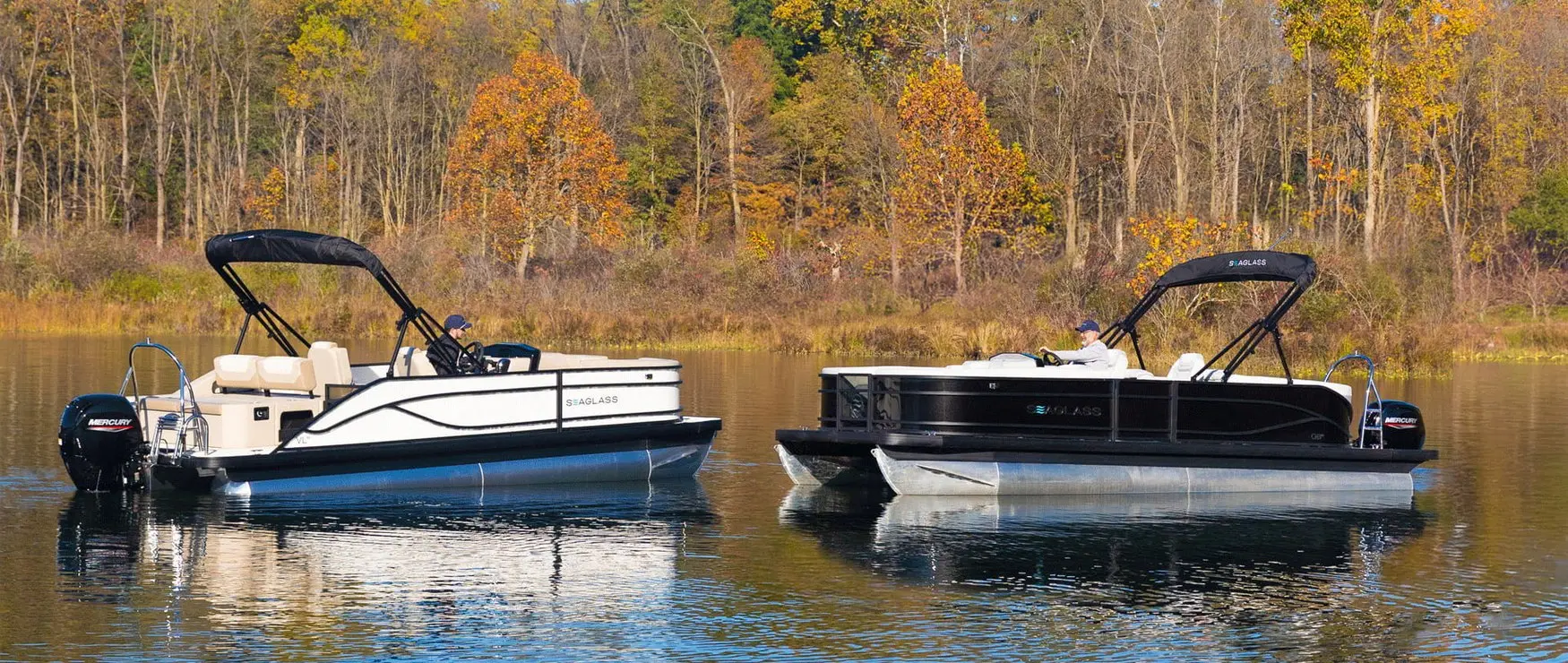
The accompanying photograph was obtained directly from Seaglass Pontoons' own November 2026 models website. It illustrates the company's new recreational boat family and is identified as a builder-supplied visual. No independent test or specific owner delivery is claimed from the image.
The photo's original media file and rights-source page were retained. A comparison against the original-photo archives of all three yacht-guide sites screened for exact reuse and perceptually similar pictures, and a distinct company image was selected. Copyright remains with Seaglass and the original photographer; no AI-generated boat has been substituted.
What a small-pontoon buyer should check
Anyone comparing QB20, QB22 and VL20 should begin with the complete overall length including motor, passenger capacity and the intended normal cruising area. They can then compare social space, storage, engine service support and the actual deal offered by a local representative. The brand's no-haggle presentation makes it easier to start asking structured questions.
Buyers should request a fully specified quotation and written warranty conditions. A November 2026 launch announcement and an active model page confirm the range and its intended market, but not individual delivery timing, operating performance or local dealer stock. Those details need direct verification before a commitment.
Verified original news sources and image credits
Original independent news reporting based on the original responsible organisation or boatbuilder announcement, the corroborating official or independent record, the corroborating official or independent record. Original first-party boat photographs used to illustrate the same verified craft are credited © Seaglass Pontoons and the original photographers. Earlier manufacturer photos are not represented as 27 November 2026 event-day photos. No first-hand sea trial, price, sales availability or unreported result is claimed.