
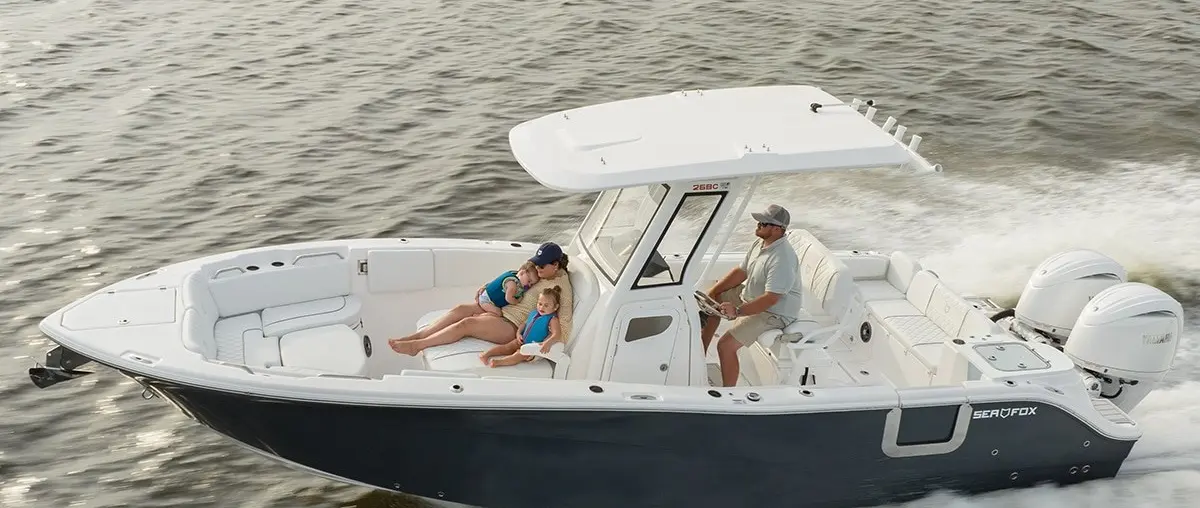
A genuine offshore and family compromise
The Sea Fox 268 Commander belongs to a group of centre consoles designed to handle fishing offshore while remaining practical for short family excursions. Sea Fox emphasises the boat's Carolina flare, generous cockpit and a layout that accommodates both working anglers and guests sitting forward. It is the combination of those functions, rather than a single piece of equipment, that makes the model worth considering.
The manufacturer's current model page lists a hull length of 26 feet and a 30-gallon livewell, together with the ability to configure outboard power to suit the owner. Sea Fox also promotes the model as relatively convenient to tow over longer distances. Prospective buyers should treat that as a reason to investigate the trailer package, not as proof that any vehicle or slipway will be suitable.
A centre console preserves routes to the bow and stern on either side of the helm, a useful feature when docking or handling fishing lines. It also asks crew to make deliberate decisions about where bags, coolers and rods are stored. On a boat used by families, this circulation becomes particularly important because guests may be moving around the deck while one person is operating the vessel.
Reading the hull design realistically
Sea Fox calls out its Carolina flare, a forward hull form that can help manage spray and adds a distinctive profile. The earlier manufacturer's detailed specifications list 20 degrees of transom deadrise and a nominal 16-inch draft. Those figures are useful design references, but the exact configuration and build year must be confirmed before an owner relies on them for manoeuvring or shallow-water planning.
Hull shape is only one contributor to comfort at sea. Boat speed, weight distribution, sea direction and the skipper's use of trim can have a bigger influence on passengers than any single angle quoted in a brochure. A dealer demonstration should therefore include a range of speeds and turns, not only a straight-line run in smooth water.
Sea Fox describes the Commander as capable in imperfect offshore conditions while remaining manageable for transport and family use. This is a fair statement of design intent, not a guarantee that the boat is appropriate in every forecast. The skipper must match a passage to experience, safety equipment, the passengers aboard and the route's safe alternatives.
Working the cockpit
The company highlights in-floor fishboxes and a leaning-post helm seat with a backrest and hinged bolsters. Those details serve different purposes: the boxes provide separated stowage for catch, while the adjustable helm position can support a skipper who alternates between sitting and bracing upright. Both should be operated during a viewing to judge whether the hardware is robust and easy to clean.
Fishbox capacity is useful only when drainage, hatch supports and insulation perform as expected. Prospective owners should pour a small amount of clean water into the appropriate compartments during a supervised inspection and check where it goes, rather than assume every compartment is self-draining. The same discipline applies to the livewell pump and any raw-water washdown fittings included in the actual build.
The best cockpit arrangement also depends on what type of fishing dominates. Bottom anglers may want different rod access and deck clearance from a crew trolling offshore, while a family focused on occasional fishing may value additional cushioned seating. The 268 Commander provides a plausible starting point for these choices, but the final equipment list must be agreed before ordering.
Power ratings and model-year differences
One important buying detail is that Sea Fox's current online overview presents a maximum-power figure of 450 horsepower, while an older manufacturer specification document for the 268 Commander lists 400 horsepower. Those figures should not be treated as interchangeable. They may refer to different hull years, certification or configurations, and only the rating plate and technical documentation for the exact vessel can settle the question.
Owners considering single versus twin outboards also need to examine the available combinations, transom weight and service arrangements. Two engines can change handling, redundancy and maintenance expenses, whereas a single installation may simplify some service tasks. Neither should be selected solely because of an advertised maximum number; the intended cruising areas and support network matter as well.
A current written specification should include total engine weight, propeller details, steering equipment and actual fuel tankage. The earlier Sea Fox document quotes 140 US gallons, but prospective purchasers should verify whether that applies to the current build rather than copy it automatically into a range calculation. Exact usable fuel and real-world burn rates are essential for safe operating plans.
Comfort beyond the fishing equipment
Sea Fox characterises the 268 Commander as combining an angler-friendly stern with family-oriented seating and amenities farther forward. The basic appeal is obvious: guests have a place to sit without standing in the main work area while fishing equipment remains accessible aft. Good dual-purpose design, however, depends on the transition between modes and not merely on the existence of two seating zones.
At the helm, leaning-post bolsters allow a change in operating position, which can make a long passage less tiring for some skippers. The console and windscreen should also be checked for visibility and shelter at normal cruise. The height and location of grab rails, footrests and electronics determine whether a smaller or taller operator can use the controls comfortably.
Owners who spend time at sandbars should inspect boarding access, anchor handling and the amount of usable shade with passengers aboard. If the boat is carried on a trailer, they should add launching arrangements and flushing routines to the decision. A craft that is enjoyable afloat but burdensome to launch, clean and store may see less use than its specification suggests.
The most useful pre-purchase tests
The 268 Commander offers an interesting balance of conventional centre-console utility, offshore-oriented hull styling and family seating. Its current manufacturer's materials support the model's main appeal and list substantial fishing equipment. Yet the conflicting maximum-power figures in different official publications make it especially important to establish the precise model year and its approved configuration.
Before signing, ask the dealer to demonstrate the fishbox drains, livewell, leaning-post adjustment and access to pumps and batteries. Measure the trailer or berth requirement with engines attached, obtain a written equipment schedule and compare engine operating costs. A sea trial with typical passengers and gear will reveal far more than one conducted with the boat almost empty.
This account is based on Sea Fox's official current 268 Commander presentation and the builder's earlier technical specification sheet. Figures and available features can change as the production run evolves, so the buyer should use hull-specific documents as the final authority. For anglers who also want a comfortable coastal family boat, that careful verification is worth the effort.